Shingle Calculator
Estimate shingle bundles, squares, starter and ridge cap by shingle grade.
Shingle Order
Slope area, after the pitch factor. Not the footprint.
Two laminated layers. The default reroof product in most markets.
Straight runs, fewer cut ends. It only fills the waste slider below.
Estimates only. Not professional advice.
Field bundles
66
bundles of architectural shingles at 3 to the square, covering 2,000 sq ft of roof plane with 10% waste allowed.
- Coverage per bundle
- 33.3 sq ft
- Repair stash
- 2 bundles
- Underlayment rolls
- 6
- Roofing nails
- 33 lb
- Order weight, field only
- 4,620 lb
- Field shingles at $30 to $50 a bundle
- $1,980 to $3,300
Field shingles only, at a per-bundle price. Starter, cap, underlayment, tear-off and labour are not in that range.
Last updated August 12, 2026 by our expert review team.
Exposure and headlap
One shingle course at a time, from the starter run to the ridge cap
A bundle count is really a course count. Every shingle is laid so that the one above buries most of it, and how much stays in the weather is what decides how many shingles a plane swallows. The plane below is drawn to scale for the grade selected in the calculator.
Both directions are at one scale, and the plane is cut above the field courses because a real one runs thirty-odd. Cap pieces are drawn at the field exposure; cap coverage is its own figure on the wrapper.
What the linework leaves out is the nailing. Fasteners go through the reinforced strip just above the exposure line, so every nail is covered by the course above it and none of them are visible here. Getting them high or low is the usual cause of a blow-off on a roof whose count was right.
Per bundle, per square
Bundles per square by shingle grade, and the grade that breaks three
Three bundles to the square is the figure everyone quotes, and it holds for 3-tab and for the standard laminates. It does not hold at the top of the range. A designer profile at four to the square puts a third more bundles on the same roof, at a heavier bundle, before anyone has argued about price.
3-tab
One flat layer, three tabs, the cheapest way to cover a plane.
3
33.3
5 in
26
66 bdl3,960 lb
Architecturalyour grade
Two laminated layers. The default reroof product in most markets.
3
33.3
5 5/8 in
21
66 bdl4,620 lb
Impact-resistant
A laminate built to a Class 4 impact rating. Check your insurer's rules.
3
33.3
5 5/8 in
21
66 bdl4,950 lb
Designer
Heavy specialty profiles. This is the grade that breaks three to the square.
4
25
8 in*
12
88 bdl7,040 lb
Coverage per bundle is 100 sq ft divided by the bundles-per-square spec, the shingle count is that coverage divided by the area one shingle leaves in the weather, and the right-hand column re-runs the calculator's own line against your area and waste. Sizes stay in inches, which is how a wrapper prints them. *Designer profiles vary by product.
Four bundle orders
Shingle bundles for four roofs, 3-tab weight against designer weight
Four plane areas, four grades, each with the waste allowance that shape usually carries. Watch the bundle line against the square line: the last roof is a fifth bigger than the third and needs57 more bundles.
1,200 sq ft roof, gable, 10% waste
40
bundles · 13.2 sq · 2,800 lb
Small ranch, one plane each side
Under fifteen squares, so one delivery and one lot number. Ask for the whole order off one pallet.
2,000 sq ft roof, gable, 10% waste
66
bundles · 22 sq · 4,620 lb
The default two-storey gable
The setup this page loads with. Three bundles to the square, and the waste allowance is applied once.
2,500 sq ft roof, hip, 15% waste
87
bundles · 28.8 sq · 6,525 lb
Hip roof in hail country
Same three bundles to the square as a plain laminate, but the bundles are heavier and the hips eat more of them.
3,000 sq ft roof, complex, 20% waste
144
bundles · 36 sq · 11,520 lb
Designer profile on a cut-up roof
Four bundles to the square instead of three. That single spec adds 36 bundles over the same roof in a laminate.
Stated in imperial, because a square is 100 sq ft and a bundle wrapper is printed that way. Type any of the four areas into the calculator to read the same order in metres. Sheathing under these planes is on the plywood calculator.
The wrapper list
What a shingle order carries besides the field bundles
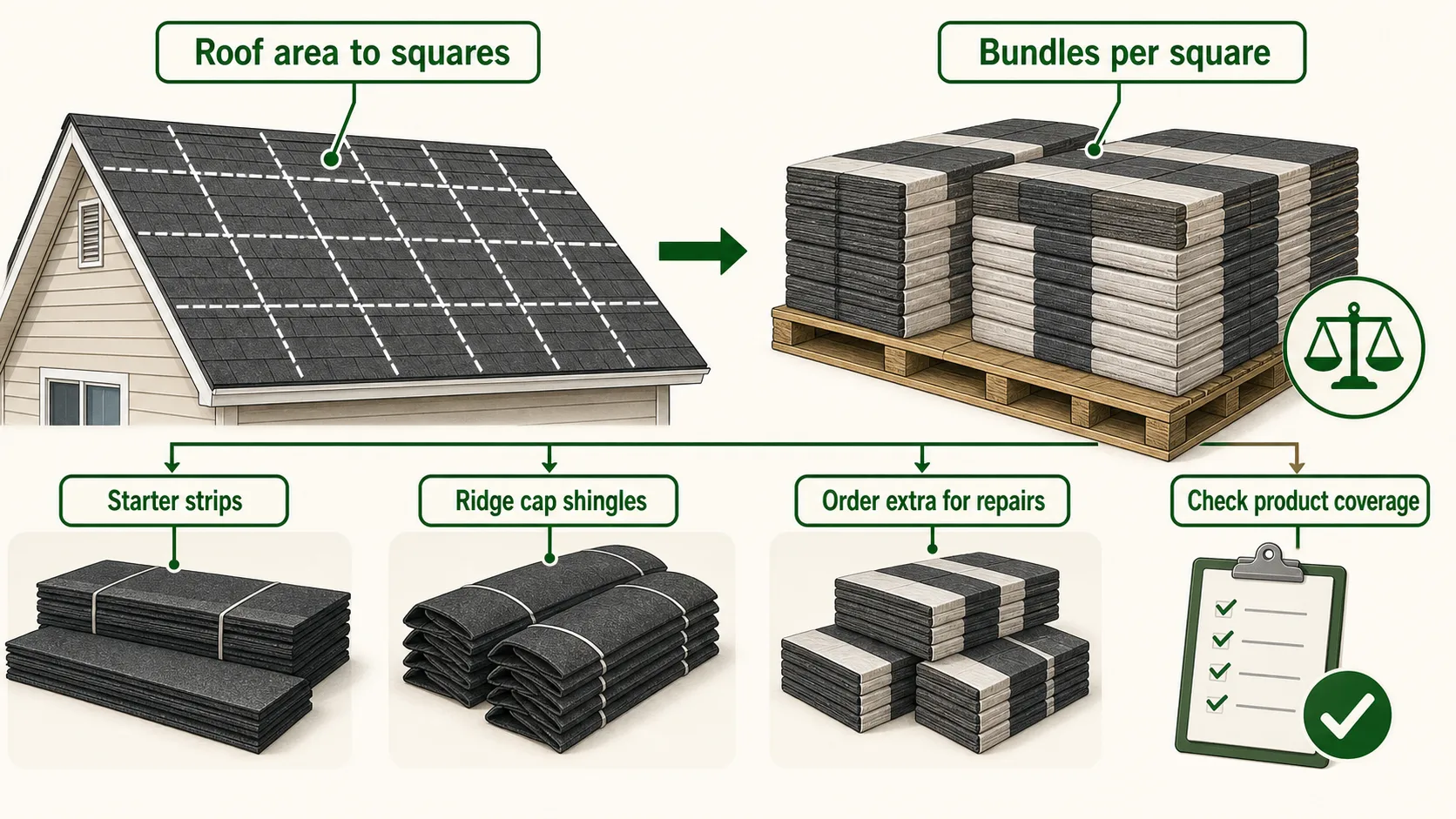
Six lines, and only the first one is priced by the square. The other five are sold on their own coverage rates, which is why a roof can arrive with the right number of shingles and nothing to start or finish them with.
Field bundles
The main count, and the only line the bundles-per-square spec touches. Everything else on this list is sold on its own coverage rate.
Starter strip
Runs the eaves, and on most manufacturers' instructions the rakes as well. It puts a factory sealant bead under the first course so wind cannot lift it.
Hip and ridge cap
Pre-cut pieces that fold over the ridge and down each side. A cap bundle covers far less linear run than a starter bundle, so the two counts are never interchangeable.
Underlayment
Sold by the roll against the same waste-included order area. Ice and water membrane at the eaves and valleys is a separate roll again.
Nails and sealant
Roughly a pound and a half of roofing nails per square, plus tubes of asphalt sealant for the cap and any flashing that gets bedded.
Repair stash
About three percent of the field count, set aside in the shade and labelled with the lot number. It is the cheapest insurance on the whole order.
Nailing and lot numbers
Shingle habits worth keeping between the wrapper and the roof
None of these change the square count. All six change what turns up on the pallet, and half of them are about the product spec rather than the roof.
Enter roof surface area, not the footprint of the house. If you only have a floor plan, run the roof area calculator first and bring the slope figure back here.
Read the bundles per square off the wrapper before you trust any rule of three. It is printed next to the coverage figure on every bundle, and it is the single number that decides your count.
Buy the whole field order on one lot number. Granule colour drifts between production runs, and a plane patched from two lots reads as two different roofs in flat afternoon light.
Starter and cap are separate products with separate coverage. Cutting field shingles down for either job puts the factory sealant strip in the wrong place along the eave.
Order area is a shingle number, not a soffit number. Eave detailing, intake vent and panel counts live on the soffit calculator.
Bundle count is one line on a reroof. For the whole material takeoff, underlayment, cap length by roof shape and the cost range, use the roofing calculator.
Bundle arithmetic
Shingle bundle arithmetic: squares, coverage and where it rounds up
The calculator starts where a roof measurement ends. It takes the plane area you already have, adds one waste allowance, converts to squares, and multiplies by the coverage spec for the grade.
order area = roof plane × (1 + waste%)squares = order area ÷ 100field bundles = ⌈squares × bundles per square⌉starter bundles = ⌈starter run ÷ starter coverage⌉cap bundles = ⌈cap run ÷ cap coverage⌉underlayment = ⌈order area ÷ roll coverage⌉repair stash = ⌈field bundles × 3%⌉, minimum 1nails = squares × 1.5 lborder weight = field bundles × bundle weightWritten in the imperial units the trade prices in, since a square is 100 sq ft and coverage is printed in feet. Switching the toggle converts the inputs and the answers, not the definitions.
Bundles, up to a whole bundle
Nobody sells two thirds of a bundle. A plane that works out at 65.2 bundles is a 66 bundle order, and that last bundle is most of your on-site spare before the repair stash.
Squares, shown to one decimal
The square figure is display only. The bundle count is taken off the unrounded number, so 21.98 squares still rounds the bundles the way 21.98 says, not the way 22.0 would.
Starter and cap, up to a whole bundle
Each is counted off its own linear run and its own coverage, so a 40 ft ridge at 25 ft a bundle is two bundles with most of one left over.
Repair stash, never below one
Three percent of a small roof rounds to nothing, so the floor is one bundle. On a 20 square roof it is two.
Before the pallet drops
Shingle coverage, weight and warranty: eight questions before you order
Answered against the same coverage specs and bundle weights this calculator reads, so nothing here disagrees with the number above.
How many bundles of shingles are in a square?
Three bundles cover one 100 sq ft square for standard 3-tab and architectural shingles, so each bundle covers about 33.3 sq ft. Designer and specialty profiles are the exception, and many of them run four bundles to the square, which is 25 sq ft per bundle. The figure is printed on the wrapper, and this calculator uses the bundles per square for the grade you select.
What is shingle exposure and why does it set the bundle count?
Exposure is the part of each shingle left in the weather once the course above laps it. A 12 in 3-tab laid at 5 in exposure buries 7 in of itself, and a 13 1/4 in laminate laid at 5 5/8 in buries 7 5/8 in. Less exposure means more courses and more shingles across the same roof plane, which is where a bundles per square figure comes from.
How many bundles do I need for a 2,000 sq ft roof?
About 66 bundles of architectural shingles once a 10 percent waste allowance is added, which is 22 squares at three bundles each. Starter strip, hip and ridge cap and a repair stash are counted separately, because each is a different product with its own coverage rate.
Do starter strips and ridge cap come out of the field bundles?
No. Starter strip and hip and ridge cap are their own products with their own coverage, commonly around 100 linear ft per starter bundle and about 25 linear ft per cap bundle. Cutting field shingles down for either job wastes material and leaves the factory sealant bead in the wrong place.
How much does a bundle of shingles weigh?
This calculator uses about 60 lb for 3-tab, 70 lb for architectural, 75 lb for impact-resistant and 80 lb for designer profiles. That is why the order weight line matters. A 66 bundle architectural order is around 4,620 lb, which is a staging and delivery decision before it is a roofing one.
What shingle warranty should I expect by grade?
3-tab products carry the shortest terms, architectural laminates commonly carry a limited lifetime term for the original owner, and designer profiles sit at the top of a manufacturer's range. Wind coverage and any Class 4 impact rating are separate items inside the warranty, and enhanced terms usually require the same brand's starter, cap and ventilation.
Why does this page give a different answer than the roofing calculator?
This page starts from a roof surface area you already have and answers a product question: bundles, coverage, exposure and weight for the shingle grade you pick. The roofing calculator starts from a footprint and a pitch and runs the whole takeoff, including underlayment, cap length by roof shape and a material cost range. Use that page for the full order and this one for the bundle decision.
Should I order extra bundles for repairs?
Yes, about 3 percent of the field count, which this calculator shows as a repair stash. Granule colour drifts between production lots, so a bundle bought three years later rarely matches. Store the spares flat, out of the sun, and write the lot number on the wrapper.
Short on day two
How a shingle order comes up short on the second day
Five failures, in the order they bite. The first changes the bundle count outright. The rest leave a crew on a stripped deck waiting on a second delivery.
Assuming every shingle runs three bundles to the square
It is true for 3-tab and for standard laminates, and it is wrong for the grade sitting at the top of most brochures. Designer profiles in this calculator run four, which is a third more bundles for exactly the same roof plane.
Read the bundles-per-square figure on the wrapper, then pick the matching grade above. The table in the coverage section shows what each one does to your own count.
Cutting starter strip out of field bundles
A field shingle has its sealant bead partway up the face, so a cut-down starter puts the adhesive nowhere near the eave edge, which is exactly where uplift starts.
Order dedicated starter, and count it off the eave and rake run rather than off the square count. The starter length field is in the order details panel.
Ordering the field in one go and the cap later
Cap comes off a different production run and often a different plant. Colour drift shows worst along the ridge, which is the one line visible from the street on every elevation.
Put field, starter and cap on the same purchase order and confirm one lot number for all three before the truck loads.
Adding the waste allowance twice
Picking a roof shape fills the waste slider with a starting figure. Typing a second allowance on top of it silently orders a fifth more shingles than the plane needs.
Treat the slider as the total. Change it once, for the whole roof, and read the order area line in the results to confirm what it did.
Booking a delivery without checking the weight
Bundle weight climbs with the grade, and the count climbs at the same time on a designer profile. Two spec changes compound into a load a garage roof or a driveway apron may not take.
Read the order weight line, then decide between a ground drop and a rooftop delivery. Split the load across two drops if the deck is old.
Grade by grade
Shingle price per bundle and what each grade buys in warranty
One axis, four grades, material only. The bars are what a bundle costs, not what a roof costs, and the gap between the top two is bought with warranty term and impact rating rather than with coverage.
The shortest warranty terms of the four, and the lowest wind coverage. Still the right answer on a shed, a detached garage or a rental turnaround.
Commonly a limited lifetime term for the original owner, with higher wind coverage than a 3-tab. The reason it has become the default reroof.
A Class 4 impact rating under UL 2218, which is the line insurers write premium credits against in hail country. Confirm the credit before paying the difference.
Top of a manufacturer's range on term and appearance, and the one grade whose coverage spec you have to check rather than assume.
Material only, and planning ranges rather than quotes. Enhanced warranty terms usually require the same brand's starter, cap and ventilation, and a registered installer. Tear-off, deck repair, flashing and labour are the larger half of a reroof and are not on this axis.
Disclaimer
These estimates are for planning purposes only. Actual costs vary by location, material availability, and project complexity. Always get at least 3 local quotes. This calculator does not replace professional advice.
Sources