Soffit Calculator
Count soffit panels, fascia, J-channel and vented intake from one eave measurement.
Eave and overhang
Before you order
Walk the eave with a screwdriver first. Soft fascia decides whether this is a panel order or a carpentry job, and that answer moves the price further than the material you pick.
Estimates only. Not professional advice.
Soffit panels to buy
15panels
Vinyl Soffit at 12 sq ft of face each, covering 176 sq ft of eave once the 10% cut allowance is in.
- Eave area, no allowance
- 160 sq ft
- F-channel or fascia receiver
- 176 ft
- Panel size
- 12 in × 12 ft
- Cut allowance
- 10%
- Vinyl Soffit material
- $264 – $528
Trim runs assume one length of fascia, one of J-channel and one of F-channel around the whole eave. Gutter work, bird blocks, baffles, paint and labour are not in the price.
Eave takeoff
What to measure before you order soffit panels
Two numbers drive the whole order: how far the eave runs, and how deep the overhang is. Both are easy to measure wrong, and both are wrong in the same direction, so a small error at the tape turns into a second trip to the supply house.
The eave run, not the footprint
Add up the straight runs that actually carry soffit: the two long eaves, the garage return, every bump-out. A gable rake has no soffit unless someone boxed it in, so do not walk the outline of the house and call it the perimeter.
Overhang depth, wall to fascia receiver
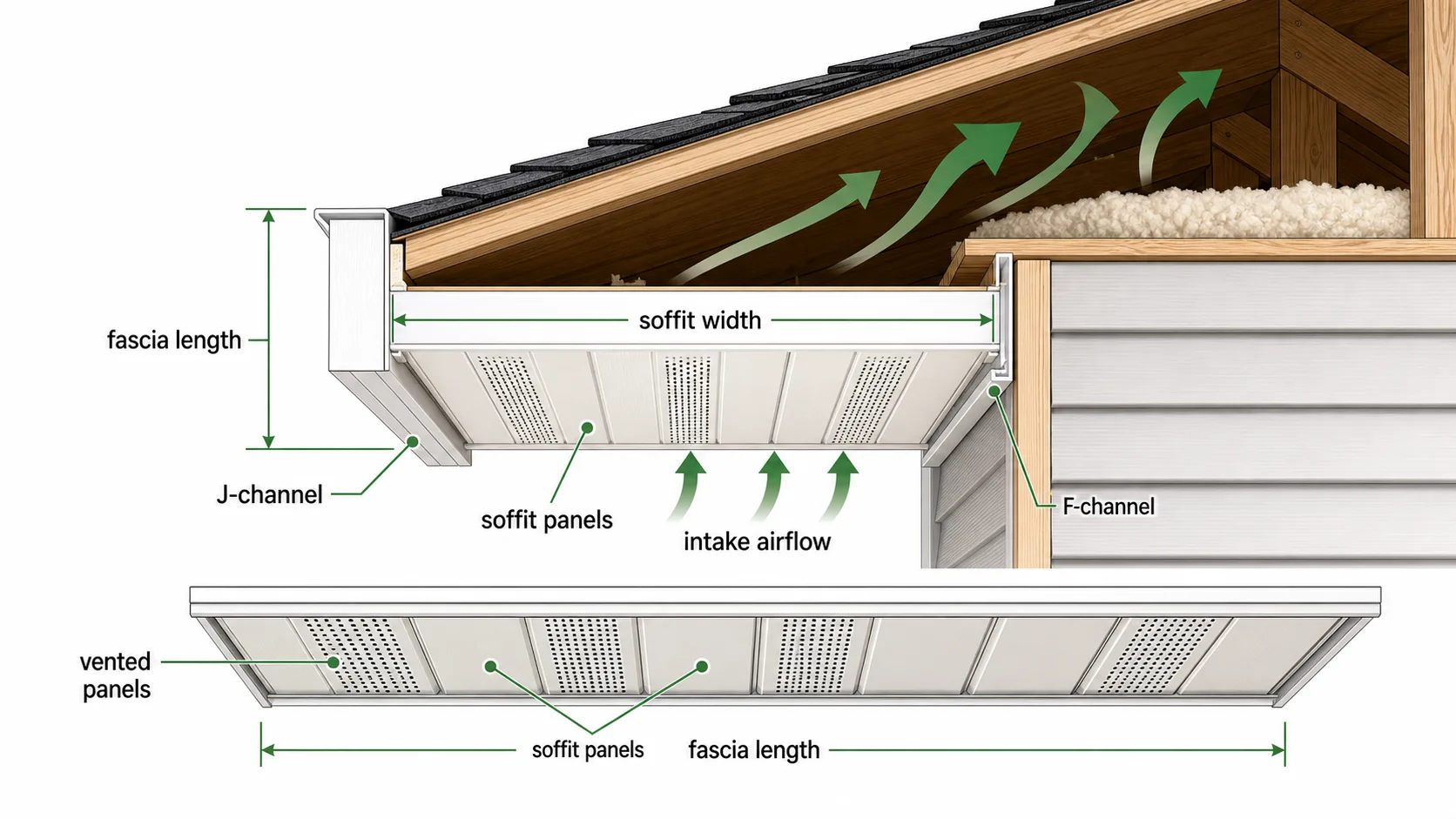
The panel spans from the wall channel to the receiver behind the fascia. The gutter lip and the drip edge sit outboard of that line and are not panel span. Measure at two or three points, because framing wanders.
Porch ceilings and boxed returns
A porch ceiling is usually deeper than the main eave and often a different material. Measure and price it as its own run instead of averaging it into the overhang depth.
What the old panels are doing
Before you copy the existing vent layout, get in the attic. Perforations that are painted over, screened shut or buried under blown insulation are not intake, whatever the panel looks like from the driveway.
The fascia behind them
Press a screwdriver into the fascia every few feet. Soft board will not hold a receiver or a gutter spike, and finding that out after the panels are cut is the expensive version.
Written and reviewed by
Creator
Hawkin
Certified Cost & Estimating Professional
AACE-certified estimator working with 20+ insulation companies including the two largest franchises in America.
See full profileExpert Review
Ehsan Ghazanfari
Licensed Structural Engineer
FISE-certified structural engineer with 11+ years designing bridges, retaining walls, and foundations. MSc from Aalto University.
See full profileUpdated August 5, 2026
How we verify our calculatorsNot in this estimate
- Gutter removal and rehang
- Fascia repair or replacement
- Bird blocks and rafter baffles
- Paint, screen and fasteners
- Roof-edge flashing
- Labour
One number worth sanity-checking: the eave run is almost always shorter than the walk-around perimeter of the house, because the two gable ends usually carry no soffit at all. On a simple gabled rectangle that is the two long sides only, so a house measuring 50 by 30 ft has an eave run nearer 100 ft than 160 ft.
Intake ledger
How much intake your vented soffit panels really open
A soffit is not cladding, it is the low half of a ventilation path. The panel count above is a materials figure, and it hides the number that matters: a vented panel is perforated over part of its face and solid over the rest, so the face area you just bought and the free air it delivers are two different numbers.
Drawn to scale from your overhang depth and the panel width of the profile you picked. Solid panels pass no air at all, so intake happens only where the dots are.
Every third panel vented puts 12 in of perforated soffit in every 36 in of eave, which works out to about 53 ft of perforated run out of 160 ft total. Air arrives in that rhythm rather than evenly, so a blocked bay stays blocked no matter how many panels you counted.
Intake ledger
- Soffit face ordered
- 176 sq ft
- Vented panel face
- 60 sq ft
- Same, in vent-label units
- 8,640 sq in
- Share of the run
- 34%
- Vented panels
- 5
- Perforated run
- 53 ft
Face area is not free air
Manufacturers print a net free area rating for each vented profile, as an area of open hole per unit of panel. Multiply that rating by the 8,640 sq in of vented face above and you have the intake this order actually opens. It is always the smaller of the two, and the gap between them is why two orders with identical panel counts do not ventilate the same.
The lever you control
Ordering every panel vented instead of every third multiplies that vented face by 3.0×, from 60 to 180 sq ft, on the same 15 panels. This estimate prices vented and solid panels the same, so the switch does not move the cost line above. What it does move is how the eave looks from underneath, which is why porches usually keep solid panels.
This ledger prices the intake half only. The exhaust half, ridge vent or gable vent, is not in this calculator, and the ratio your inspector applies between vent area and attic floor area comes from the code adopted where you live. Take your panel rating, your attic floor area and your exhaust figure to the same sheet before you order, because a system short on either half behaves as though it has neither.
Receivers
Soffit installation notes, wall side to fascia side
Panels are the easy part of an eave. What decides whether the finished run looks flat and stays flat is the trim it lands in and the order the work happens in.
Treat vented panels as intake, not decoration. They only work when insulation, paint, and debris are kept clear of the perforations.
After estimating soffit, use our roofing calculator for shingle estimates to complete your roofline project.
Use our rafter calculator to size overhang framing before installing soffit panels.
Vinyl soffit is low-maintenance, but it still needs room to expand. Leave the manufacturer-required gap at receiving channels.
Use J-channel at the wall side and F-channel or a compatible receiver at the fascia side. Panels need support on both long edges.
Paint or seal wood soffit on all sides before installation. The back side matters because eaves see humid attic air and wind-driven rain.
Replacing siding too? Our siding calculator estimates materials for vinyl, fiber cement, and wood siding.
Rooflines
Soffit panel counts for four eave runs
Four real rooflines run through this calculator at its default 10% allowance. Every figure below is produced by the same takeoff the tool uses, so the columns cannot drift from it.
Ranch, straight eaves
120 ft eave · 12 in overhang · Vinyl Soffit
Straight runs and one gutter line make this the DIY case. Check that the old perforations are not painted shut before you copy the same vent rhythm.
- Panels
- 11
- Vented, every third
- 4
- Face with allowance
- 132 sq ft
- Material
- $198 – $396
Two-story in a hot climate
160 ft eave · 16 in overhang · Aluminum Soffit
Aluminum holds its line across long sunny eaves. Budget staging and gutter removal separately, because neither is in the panel figure.
- Panels
- 20
- Vented, every third
- 7
- Face with allowance
- 235 sq ft
- Material
- $704 – $1,408
Deep overhang upgrade
200 ft eave · 24 in overhang · Fiber Cement
Doubling the overhang doubles the panel area off the same roofline. Check the panel span limit before you commit to a heavy board.
- Panels
- 37
- Vented, every third
- 13
- Face with allowance
- 440 sq ft
- Material
- $1,760 – $3,080
Cottage porch ceiling
100 ft eave · 12 in overhang · Wood (T&G Pine)
Tongue and groove reads right over a porch, and narrow boards mean far more pieces for the same area. Seal the backs before they go up.
- Panels
- 31
- Vented, every third
- 11
- Face with allowance
- 110 sq ft
- Material
- $275 – $550
Narrow boards are why the porch takes more pieces than the ranch for less area: tongue and groove covers 5.5 in a board against 12 in for a vinyl panel.
Order desk
Soffit questions people ask at the order desk
What the counter gets asked when someone arrives with a panel count and no plan for the trim or the air.
What exactly should I measure for soffit width?
Measure from the wall or frieze board to the inside face of the fascia receiver. Do not include the gutter lip, drip edge, or decorative fascia cover in the soffit width.
How many vented soffit panels do I need?
The calculator uses an every-third-panel planning rule. Final ventilation should be checked against net free area, attic floor area, and exhaust venting. A roof with ridge vents usually needs clear intake at the eaves.
Why is net free area smaller than the vented panel area?
A vented panel is perforated over part of its face and solid over the rest, so only a fraction of the panel passes air. The manufacturer prints that fraction as a net free area rating. The panel face area from a takeoff is always the larger of the two numbers.
Can I use all vented soffit panels?
Often yes, especially when intake is limited. All-vented soffit can simplify ordering, but it may show perforations in exposed porch areas where solid panels look cleaner.
Why do I need both J-channel and F-channel?
Soffit panels need a receiver at the wall side and at the fascia side. J-channel commonly receives the wall side. F-channel or a fascia receiver supports the outside edge.
Should I replace fascia when replacing soffit?
Inspect fascia before ordering. Soft, split, or wavy fascia will not hold gutters or receivers well. Replace damaged boards before installing new soffit panels.
How much waste should I add for soffit?
Use 10% for straight eaves. Use 15% for lots of returns, bay windows, rake transitions, porches, or when cutting around brackets and odd framing.
Is vinyl, aluminum, or wood soffit better?
Vinyl is easy to maintain and budget-friendly. Aluminum handles heat well and feels crisper around long eaves. Wood looks traditional but needs sealing and repainting.
What is not included in the soffit estimate?
The calculator does not include gutter removal, fascia repair, bird blocks, baffles, paint, fasteners, screen, roof-edge flashing, or labor. Add those to the project list separately.
Rework
Soffit work that has to be redone, and the fix
None of these show up on the day the last panel goes in. They show up as a stain on a ceiling or a sagging gutter a season later, and every one was decided before the order was placed.
Copying the old vent layout
The panels that are up there may be painted shut, screened over or buried under blown insulation, and none of that is visible from the ground.
Get in the attic with a light before you order. Decide the vent rhythm from what the bays can actually breathe, not from what the last owner installed.
Measuring to the gutter edge
The gutter and the drip edge hang outboard of the fascia receiver, so a tape run to the gutter lip adds span that no panel has to cover.
Measure wall channel to fascia receiver. On a 200 ft eave, two inches of phantom overhang is another 33 sq ft of panel you paid for.
Ordering panels but not receivers
A panel count is not an install kit. Every long edge needs support, and every corner and return needs a piece that is not a panel.
Order J-channel for the wall side, F-channel or a fascia receiver for the outside, plus fascia wrap, fasteners and return trim in the same delivery.
Leaving soft fascia in place
New panels locked into a wavy board read wavy for the life of the roof, and the gutter fixings behind it are into the same soft wood.
Probe the board every few feet and replace what gives. It is cheap while the eave is open and a full teardown once the soffit is closed.
Blocking the intake you just paid for
Loose insulation drifts into the eave and paint fills perforations, so the intake goes to zero while the panel still looks vented.
Fit baffles in every rafter bay before insulation goes near the eave, and keep a brush and roller off the perforated field entirely.
Panel math
How this soffit calculator counts panels, trim and vents
The eave is treated as one continuous strip. Its area is the run times the depth, and the depth is the term that moves fastest: doubling the overhang doubles the order off exactly the same roofline.
In the order the tool runs
- 01Eave area = eave run in ft × overhang depth in inches ÷ 12.
- 02Face to buy = eave area × (1 + waste allowance).
- 03Panels = face to buy ÷ one panel's face area, rounded up.
- 04Vented panels = panels ÷ 3, rounded up, when the vent plan is on.
- 05Fascia, J-channel and F-channel = the eave run × (1 + waste allowance), each rounded up.
What the rounding does
Panels round up, and so does every trim run, so a short eave carries proportionally more offcut than a long one. On the vinyl soffit you have selected, one panel is 12 sq ft of face, which is the smallest step the order can move in.
The vent figure is a planning rule, not a ventilation calculation. It puts intake material on the order in a rhythm installers actually use. What that material delivers as free air depends on the rating of the profile you buy, which is the point of the ledger further up the page.
Material prices
Soffit cost per square foot by material
Material only, in the unit the toggle is set to. The spread inside each material is mostly profile weight and colour, and it is wider than the gap between two neighbouring materials.
Shared axis, $0 to $8 per sq ft. Installation adds a further $3 to $6 per sq ft depending on eave height and access.
Soffit panel coverage by profile
Face area per panel is what turns your eave area into a panel count, and it is the reason a wood soffit takes several times as many pieces as a vinyl one over the same eave.
Panel counts are rounded up, before any cut allowance, and computed from the same panel dimensions the calculator uses.
Disclaimer
These estimates are for planning purposes only. Actual costs vary by location, material availability, and project complexity. Always get at least 3 local quotes. This calculator does not replace professional advice.
Sources