Plywood Calculator
Count plywood sheets, waste, weight and cost for a subfloor, wall or roof deck.
Area to Cover
Estimates only. Not professional advice.
Sheets to order
9sheets
3/4" CDX (Construction) at 4' × 8' (32 sq ft), covering 264 sq ft with the 10% allowance already in it.
- Waste allowance
- 10% on 240 sq ft
- Coverage per sheet
- 32 sq ft
- Weight per sheet
- 80 lbs
- Layout says
- 8 sheets
- Sheets, before fasteners
- $270 to $450
Sheet goods only. Adhesive, screws, blocking, delivery and labour are all separate. The sheet count above rounds up on area, and the layout below checks it against the way the sheets actually land.
Last updated August 5, 2026 by our expert review team.
Sheet layout
Plywood sheet layout: where the full sheets land and where you rip
A sheet has a width and a length, and your rectangle almost never divides evenly by either one, let alone both. That makes plywood a fitting problem rather than a coverage problem, and it is why a flat waste percentage can be out by several sheets in both directions. Here is the same rectangle with the sheets laid on it.
Sheets run with their long edge along the length here, because that orientation buys fewer of them. Turning the stack 90 degrees is free and is the first thing worth trying.
Which count to buy to
A flat 10% allowance buys 1 sheet more than the layout needs. 8 sheets is what goes down if the cuts go to plan, so treat the difference as spares rather than material.
- Sheets the layout needs
- 86 down whole, 2 cut
- A flat 10% allowance buys
- 9240 sq ft plus 10%, rounded up
- Waste the layout really leaves
- 6.7%Under the 10% you allowed
- Edge pieces off one sheet
- 2Rip them together, not one sheet at a time
- Offcut worth keeping
- 1At 4 × 4 ft
At the lumber yard
Buying plywood: what to settle before the sheets are on the truck
Grade, thickness and how the sheets get cut are all decided before you pay, and none of them is cheap to change afterwards.
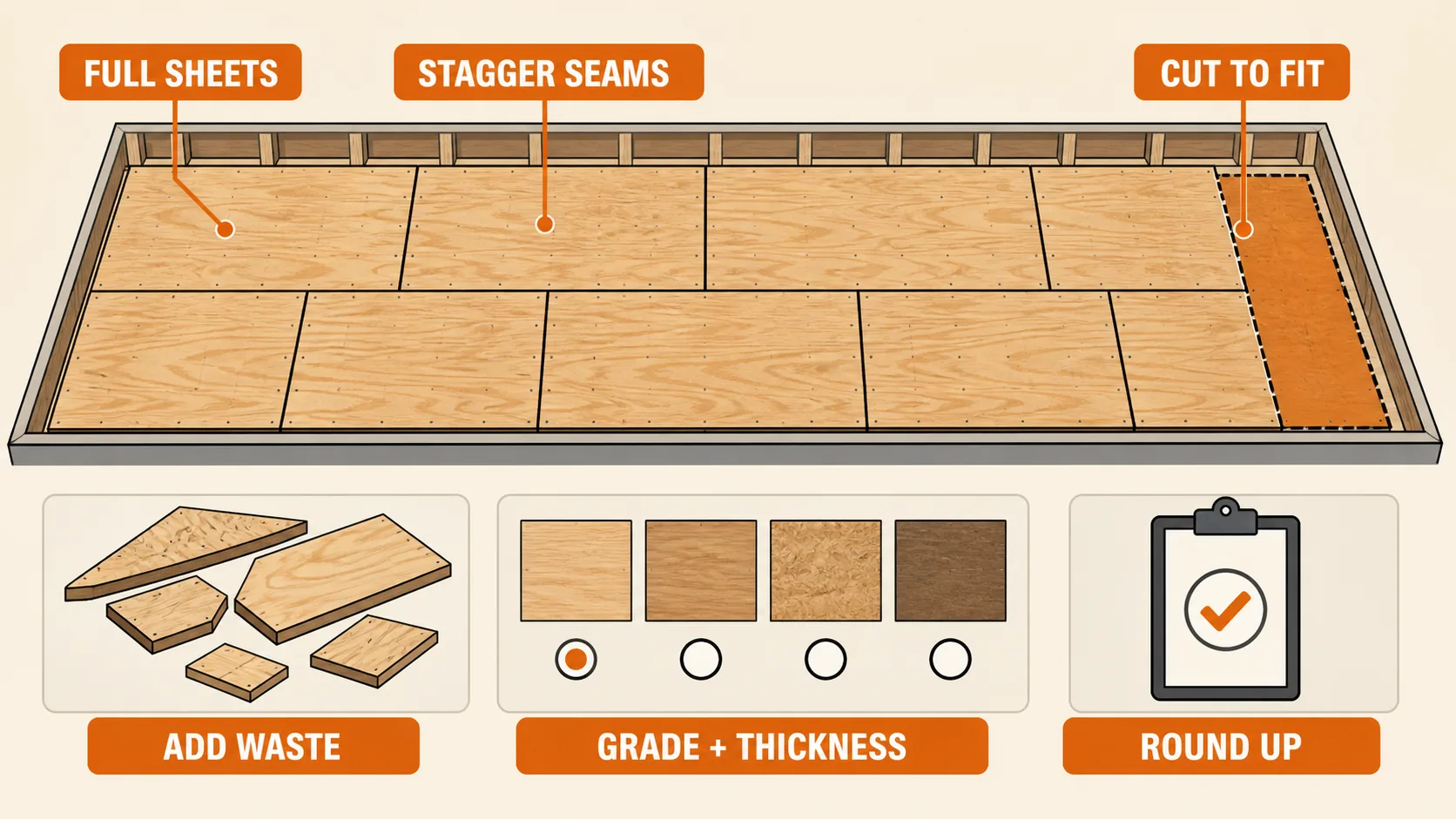
The same six decisions in one picture: whole sheets, offset end joints, the cut-to-fit edges, what is left on the pile, and the grade and thickness that set the price.
CDX is the standard for subfloors and wall sheathing. The X is the glue, not the veneer: it means the panel survives exposure during construction, not that it belongs outdoors for good.
Buy full sheets and cut on site. Pre-cut plywood costs 30 to 50% more per square foot than a full sheet, and the offcut you would have kept goes home with the store.
OSB costs 25 to 40% less than plywood but swells at the cut edges when wet, and the swelling is permanent. Use CDX or marine grade anywhere moisture reaches.
Marine grade has waterproof glue and void-free veneers. It costs 2 to 3 times more, which only pays on boat building, docks and permanent outdoor structures.
Set the stud or joist layout before you order sheathing, with our framing calculator. Sheet edges have to land on framing, and that decides the layout above as much as the room does.
Price the alternative before you commit. Our board foot calculator puts dimensional lumber on the same footing, and our roofing calculator covers what goes over a roof deck.
Sheet math
What the plywood sheet count is built from
Area, then the allowance, then a whole number of sheets, then price and weight from the grade and thickness you picked. The layout above is the cross-check on the middle step, not a replacement for it.
area = length × widthorder area = area × (1 + waste)sheets = ceil(order area ÷ sheet area)cost = sheets × grade price × thickness factorsheet weight = sheet area × 2.5 × thickness factorboard feet = order area × thickness in inchesThe thickness factor is a multiplier on the grade price, set to 1.0 at 3/4 in, so a thinner sheet of the same grade costs proportionally less and a thicker one more. It does the same job on weight. The sheet count rounds up because nobody sells a third of a sheet, and that rounding is the only waste a pure area calculation can see.
Not included: adhesive, screws or ring-shank nails, blocking, edge sealing, delivery and labour. A board foot is one foot by one foot by one inch, and it is quoted as a board foot in both unit modes because that is how a mill sells timber volume.
One 4' × 8' (32 sq ft) sheet of CDX (Construction), at each thickness. Change the grade above and every price in this table moves with it.
At the saw
Plywood questions worth settling before the cuts start
Eight answers, opening with the sheet count people search for and closing with the waste number the layout above argues about.
How many 4x8 sheets do I need for a 12x12 floor?
5 sheets. Three go down whole, the 4 ft strip left along one wall takes three more pieces at 4 ft by 4 ft, and those come two to a sheet, so two more sheets cover them. That leaves one spare 4 by 4. A flat 10% allowance on 144 sq ft also lands on 5, which is the happy case.
Is CDX or OSB better under a subfloor?
CDX plywood is stronger and holds up better to moisture. OSB is cheaper but the cut edges swell when wet and never recover. CDX is the choice for a subfloor you want to stay flat and quiet.
What thickness for subfloors?
3/4" (23/32") for joists on 16" centers. 5/8" works for 12" joist spacing. Never use 1/2" for subfloors.
How much does a sheet of plywood cost?
CDX 3/4" 4x8 sheets run $30 to $50. OSB is $20 to $35. Marine grade costs $80 to $130. Thinner sheets cost less and thicker sheets more, and every price moves with the lumber market.
What is the weight of a plywood sheet?
A 3/4" 4x8 CDX sheet weighs about 60 lbs. 1/2" weighs about 40 lbs. OSB is slightly heavier than plywood at the same thickness.
Should I buy 4x8, 4x10 or 4x12 sheets?
4x8 is standard for walls and most floors. 4x10 reduces joints on taller walls. 4x12 is used for tall commercial walls and cathedral ceilings. The longer sheet is also worth pricing when your run divides evenly by 10 or 12 and not by 8, because it can drop the sheet count outright.
Can I use MDF for subfloors?
No. MDF swells permanently when exposed to any moisture. It is for interior cabinetry, shelving, and trim only.
How do I calculate plywood waste?
10% for rectangular areas with straight cuts. 15% for irregular shapes, angles, or lots of cutouts. Always round up to the next full sheet. A percentage is only ever an approximation on sheet goods, because the real waste depends on how the sheets land on the rectangle, which is what the layout above works out.
Nested jobs
Four plywood jobs, nested and priced
All four on the 4 ft by 8 ft sheet, run through the same arithmetic as the calculator above. The layout count is what goes down; the allowance line is what a flat 10% would have put on the order.
Bedroom subfloor
5
sheets by layout
$150 to $250
- Area
- 12 × 12 ft
- Sheet
- 3/4 in
- Grade
- CDX
- Whole sheets
- 3
- Flat 10% buys
- 5
Divides by 4 both ways but not by 8, so the far strip is ripped from half sheets and one 4 by 4 goes on the pile for later.
Two-car garage sheathing
18
sheets by layout
$459 to $765
- Area
- 24 × 24 ft
- Sheet
- 1/2 in
- Grade
- CDX
- Whole sheets
- 18
- Flat 10% buys
- 20
The rectangle every sheet supplier dreams of. It divides by 8 and by 4 with nothing left, so the layout is exact and the allowance is pure spare.
Ranch roof deck
32
sheets by layout
$816 to $1,360
- Area
- 40 × 25 ft
- Sheet
- 1/2 in
- Grade
- CDX
- Whole sheets
- 30
- Flat 10% buys
- 35
The 1 ft strip along the ridge side is the whole story: four of those strips come off one sheet, which is why the layout beats the percentage here.
Cabinet backs
2
sheets by layout
$54 to $84
- Area
- 10 × 4 ft
- Sheet
- 1/4 in
- Grade
- BC Sanded
- Whole sheets
- 1
- Flat 10% buys
- 2
Tiny job, terrible ratio. Two sheets cover 40 sq ft of backs and most of the second sheet stays in the van.
Spoiled sheets
Where a plywood order goes wrong
Six failures, numbered by how early they happen. The first two are decided at the counter and the rest on the deck.
Trusting the waste percentage on an awkward rectangle
A percentage cannot see geometry. A 9 by 9 ft platform is 81 sq ft, so 10% says three sheets, and the layout says four. Small and awkward is where the percentage misses, and it misses low.
Using OSB where water can reach it
Edge swell on OSB is permanent. Once the cut edges take up moisture the panel never comes back flat, and sanding it makes a hollow. Use CDX or marine grade for anything exposed.
Going thinner than the framing wants
A 1/2 in subfloor bounces underfoot and telegraphs every joist. 3/4 in is the residential standard, and local code sets the minimum for your joist spacing, so check it before you buy a pallet of the wrong thing.
Running all the end joints on one line
Aligned seams make a hinge across the deck. Offset the end joints between rows so the sheets tie the framing together, and keep every edge landing on a joist or a stud rather than in mid air.
Storing sheets flat on damp ground
Plywood cups and delaminates within days on a wet surface. Stack it on stickers clear of the ground, cover the top only, and let air move underneath.
Cutting the edge pieces one sheet at a time
Rip every edge piece of the same size out of as few sheets as possible. The layout above shows which pieces share a sheet, and ignoring that is how a job that needed eight sheets ends up buying eleven.
Grade prices
Plywood cost per sheet: five grades on one axis
Priced at 3/4" on the 4' × 8' (32 sq ft) sheet, so the step from OSB to marine grade is the real step and not a chart trick. The right-hand figure is the same grade applied to your own sheet count.
CDX (Construction)
your grade$30 to $50
$270 to $450
BC Sanded
$45 to $70
$405 to $630
Marine Grade
$80 to $130
$720 to $1,170
OSB (Oriented Strand)
$20 to $35
$180 to $315
MDF (Medium Density)
$25 to $45
$225 to $405
Grade prices are quoted at 3/4 in and scaled by the thickness factor, so switching thickness above moves the whole axis. Lumber markets move these faster than any other figure on the page.
Disclaimer
These estimates are for planning purposes only. Actual costs vary by location, material availability, and project complexity. Always get at least 3 local quotes. This calculator does not replace professional advice.
Sources