Rubber Mulch Calculator
Estimate rubber mulch bags, weight and pallets, and the depth a playground fall height needs.
Area and depth
Before you order
Ask the supplier the bag volume, not just the price. Ask whether bulk ships by the pallet or the yard. For play equipment, ask for the product's certified critical height in writing.
Estimates only. Not professional advice.
Rubber mulch to order
66bags
black rubber mulch to finish 200 sq ft at 3 in, with the 5% ordering allowance already in it.
- 66 bags of black at $8
- $528
- Total volume, 52.50 cubic feet
- 1.94 yd³
- Delivered weight, about 1.16 tons
- 1.2 pallets
- Rubber mulch per sq ft
- $2.64
Material only. Edging, fabric, base preparation and delivery are not in the total, and a play surface still needs the tested product's own certified depth.
Last updated August 11, 2026. Checked against CPSC and ASTM playground surfacing guidance by our expert review team.
Critical fall height
Rubber mulch section: the depth, the edge, and the fall it protects
Drawn to the depth you entered. Pick Play Area above and the equipment appears at its fall height on the same scale as the cushion underneath it, which is the comparison nobody makes until they see it: a 7 ft fall is stopped by four inches.
Every vertical dimension shares one scale, so the fall and the cushion under it can be read against each other. The platform is schematic and only its height is measured; outside a play area it is dashed, because nothing is up there yet.
- Depth in the drawing
- 3 inLandscaping/Beds sits around 3 in
- Fall it is planned for
- 5 ftPlanning value only. The tested product carries the certified critical height.
- Weight of the order
- 2,310 lbAbout 1.2 pallets at 2,000 lb each
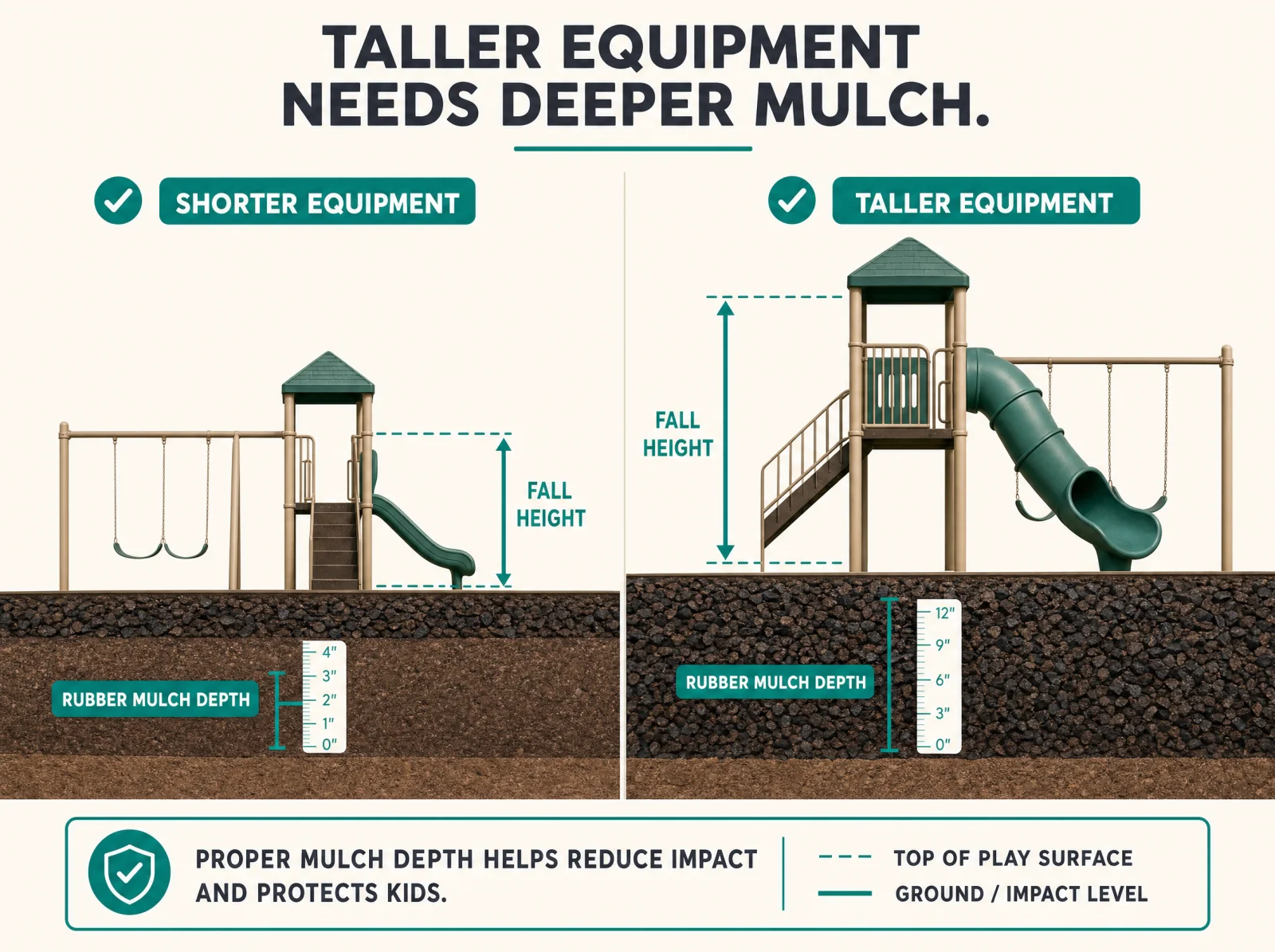
The same relationship across the whole range, rather than at the one height you picked. Loose fill is the only playground surface whose protection you can lose by doing nothing, because it displaces out of the landing zones as it gets used.
Bought once
When rubber mulch pays back what wood mulch keeps costing
Rubber is the more expensive bag and the cheaper decade. It does not decompose, so the order above is the whole spend, while wood is a subscription you renew every spring. The crossover is the only number that decides it, and it moves with your own area and price.
200 sq ft at 3 in, held for 10 years
WOOD RATE SET IN THE OPTIONS PANEL ABOVE
Rubber, bought once
$528
66 bags at $8, and no second order for roughly a decade.
Wood, re-bought every year for 10 years
$800
$80 a year at the rate in the options panel, topped up as it breaks down.
$240
$528
costs $288 more
$400
$528
costs $128 more
$800
$528
saves $272
$1,200
$528
saves $672
Rubber overtakes wood in year 7
Everything after year 7 is money you would otherwise have spent on wood. Over 10 years that is about $272 back in your pocket, before the labor of spreading a fresh load every spring.
Where it goes
Where rubber mulch belongs, and where it does not
Everything rubber is good at comes from the same property: it does not rot. That makes it excellent on a surface you want to stay put and useless anywhere the point is feeding the soil. Two of the rows below are the wrong material, not a shallower depth.
Landscape beds
3 in
Good fit
Ornamental plantings where you want color to hold and nothing to decompose into the soil.
Walkways and paths
2 in
Good fit
Light foot traffic over a contained, draining base. Rake it back into the worn line twice a year.
Pet runs
3 in
Good fit
Nothing rots into mud underneath, and the surface rinses. Drainage under it matters more than depth.
Tree rings
3 in
Keep it off the trunk
Hold the ring back a hand's width from the bark, the same as any mulch. Rubber will not break down if you get it wrong.
Play areas
3-9 in
Tested product only
Depth comes from the equipment's critical fall height and the product's own certified value, not from this table.
Vegetable beds
n/a
Use compost instead
Rubber contributes nothing to food-growing soil. This is a job for compost or an organic mulch.
Open slopes
n/a
Contain it first
Light loose fill on a grade with no edge ends up at the bottom of the grade. Terrace it or pick a heavier material.
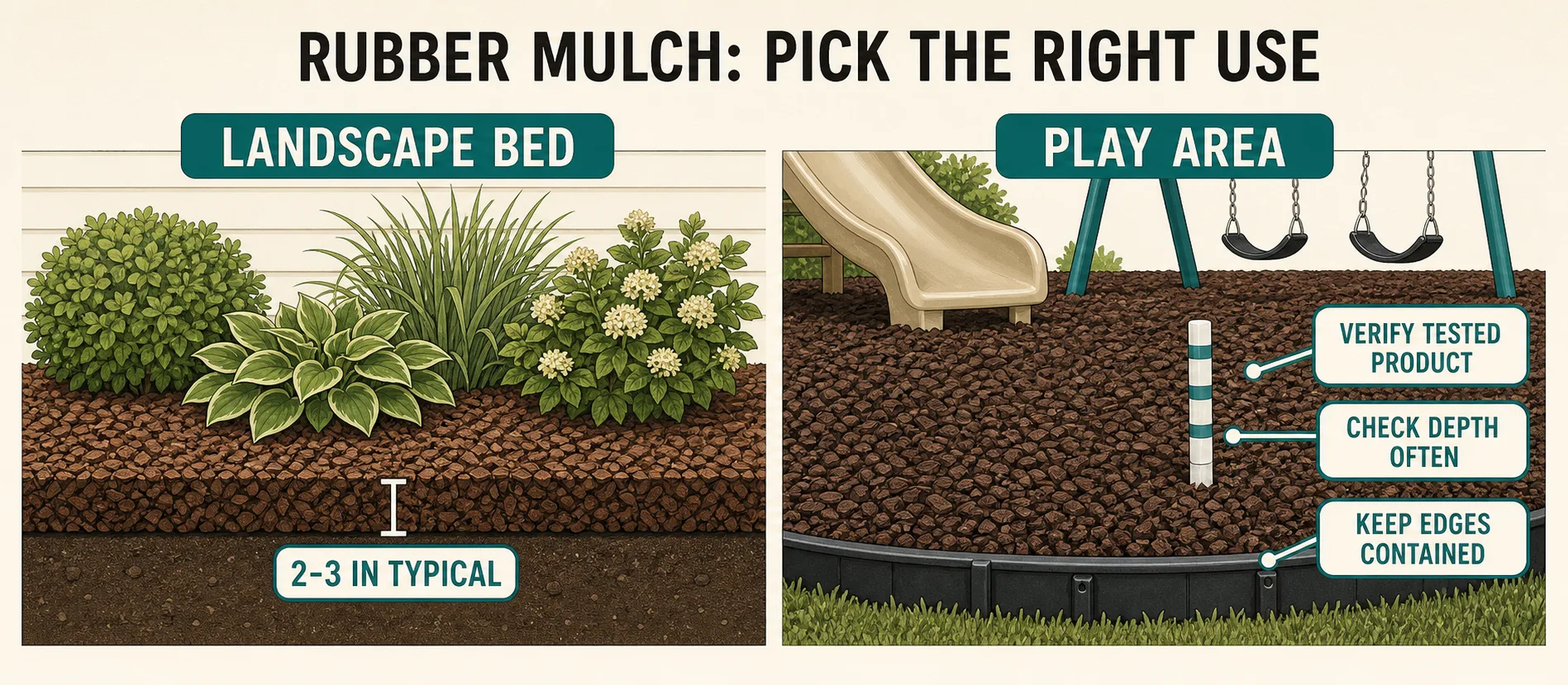
Same material, two different projects. The bed is finished when it looks right; the play area is finished when a tested product is installed at a verified depth and stays there.
After the first summer
What goes wrong with rubber mulch once it is on the ground
Rubber is unforgiving in one specific way: you buy it once, so a mistake in the order is a mistake you live with for a decade. These six are the ones that cost real money.
One depth for every job
A bed and a play area are not the same project, and at 8 in the same area costs nearly three times what it does at 3 in.
Pick the use first, let the depth follow it, and check the bag count afterwards rather than the other way round.
A generic play-area depth
Depth is only meaningful against the equipment's critical fall height and the product's own tested value. A number from a blog is not a certification.
Take the fall height off the equipment, size the depth from it, then confirm the product's certified critical height before anything is installed.
Buying by bag count alone
Bag volume varies from 0.75 to 2 cubic feet and price per bag says nothing about volume, so two quotes can differ by a third of the material.
Order against cubic feet. Read the volume off the label, then divide the calculator's cubic feet by that number rather than by 0.8.
Forgetting how heavy it lands
Rubber is close to twice the weight of wood for the same volume, so a play-area order arrives as pallets and not as a car boot full of bags.
Check the weight and pallet figures before booking delivery, and ask the yard where a pallet can actually be set down.
No containment edge
Loose rubber migrates under foot traffic and floats in heavy rain, so the installed depth quietly drops below what was ordered.
Edge the whole perimeter while the excavation is open, and inspect the traffic lanes each season rather than after a complaint.
Ignoring surface heat
Dark rubber in full sun runs far hotter than the air, which is a real problem on a play surface and invisible on the day it is installed.
Site it with shade in mind, and check the surface on the hottest afternoon before anyone uses it barefoot.
Numbers two and four are the same mistake seen from opposite ends: a play surface is a specified product with a certified depth and a delivery weight, not a bag of decorative cover. The section at the top of this page draws both halves of that.
Spreading and topping up
Buying and spreading rubber mulch without redoing it
Seven things worth settling before the pallet arrives. None of them are in a particular order, because none of them depend on each other, but the first one is the one that changes the invoice.
Confirm the bag volume before you order
This calculator starts from a 0.8 cu ft bag, which is the common shelf size, but rubber is bagged at anything from 0.75 to 2 cubic feet. One line on the label changes the bag count by a third.
Order by weight as well as by bag
Rubber runs about 35 lb a bag against roughly 20 lb for wood, so a load that fits a car in wood needs a pallet jack in rubber. The results panel prints pallets for exactly that reason.
Treat the play-area depth as a planning number
For play equipment, use the CPSC Public Playground Safety Handbook and the surfacing manufacturer's tested instructions. The installed depth belongs to the certified product, not to a generic table.
Contain it before you spread it
Loose fill leaves an open edge within weeks and rubber nuggets are light enough to float in a downpour. Set the edging while the excavation is still open, then rake material back into the traffic lanes on a schedule.
Check the surface temperature on a hot afternoon
Dark rubber in full sun gets much hotter than the air around it. Site it under shade where children play barefoot, and take a reading on the worst afternoon of the year rather than the day you install it.
Give it a base that drains
Rubber does not hold water, so everything under it has to move it. Prepare a stable, draining subgrade and keep runoff away from the house. Use our sand calculator only where your installation plan actually calls for a sand layer.
Use organic mulch where soil is the point
Rubber adds nothing to soil. In beds you are trying to feed, compare wood mulch or pine straw instead, and keep rubber for the surfaces you want to stay put.
Bag yield
Rubber mulch coverage per bag, by installed depth
Coverage is one bag divided by the depth, so it halves every time the depth doubles. The bar is the same 0.8 cu ft of rubber in every row; only the depth it is spread to changes.
2 in
Walkways and light decorative cover
4.8
21
3 in
your depth
Landscape beds, pet runs and tree rings
3.2
31
4 in
A thicker decorative layer, or a 7 ft fall
2.4
42
6 in
A 10 ft fall over play equipment
1.6
63
8 in
The play-area preset in the calculator above
1.2
83
Certified critical height
Rubber mulch depth by playground fall height
Unlike wood mulch, rubber is sold as a rated playground surface, and the depth follows the equipment rather than the look. Deeper rubber cushions a longer drop, so the table below scales one against the other. It is the planning table the calculator uses.
3 in
5 ft
Residential play, low equipment
4 in
7 ft
Backyard swing sets and slides
6 in
10 ft
Commercial or taller equipment
9 in
12 ft
Maximum-height structures
Planning guidance only. Confirm the specific product's certified critical height, the value an IPEMA-certified lab measures under ASTM F1292, before anything is installed under equipment.
Playground answers
Rubber mulch questions: depth, heat, weight and color
Eight answers in the order they come up, from the first sketch on a napkin to the phone call where someone asks for a certified critical height in writing.
How much rubber mulch do I need per square foot?
One 0.8 cubic foot bag covers about 3.2 square feet at 3 inches deep, before the ordering allowance. A 200 square foot bed at that depth works out to 66 bags, 1.94 cubic yards and roughly 2,310 lb, which is already more than a pallet.
How deep does rubber mulch go under playground equipment?
Depth follows the equipment's critical fall height, not the look. This calculator plans 3 inches for a 5 ft fall, 4 inches for 7 ft, 6 inches for 10 ft and 9 inches for 12 ft, then asks you to confirm the tested product's certified critical height under ASTM F1292.
Does rubber mulch get hot in the sun?
It can. Dark loose rubber in full sun runs far hotter than the air around it, which matters wherever children play barefoot. Plan shade, check the surface on a hot afternoon before anyone uses it, and treat surface temperature as a siting decision rather than a product defect.
How much does rubber mulch weigh?
About 35 lb for a 0.8 cubic foot bag, which puts a cubic yard at roughly 1,180 lb and a ton at about 57 bags. Bulk rubber ships close to a ton on a pallet, which is why this calculator reports pallets alongside bags.
Will rubber mulch color fade?
Color life varies by product and exposure. Ask the supplier what the color warranty covers and how long it runs, then look at an installed job of similar age in similar sun before you commit to a bright color.
Can I put rubber mulch in a vegetable garden?
Keep it out of food-growing soil. Rubber does not break down into anything a plant wants, and this calculator is aimed at ornamental beds, paths, pet areas and play-area planning. Use compost or an organic mulch where you are trying to improve soil.
Does rubber mulch need edging?
Yes. Loose fill migrates under foot traffic, and rubber nuggets are light enough to float and scatter in heavy rain. Edging plus a periodic rake back into the traffic lanes is what keeps the installed depth at the number you ordered to.
Is rubber mulch cheaper than wood mulch?
Not up front. It costs more per bag than wood does for the same volume, but wood is topped up every year and rubber is not. The payback section on this page crosses the two over at your own area, your own bag cost and the wood rate you enter.
Three jobs priced
Rubber mulch cost for a play area, a bed and a dog run
All three through the same chain as the calculator above, at its own 5% ordering allowance and the $8 to $10 a bag the color menu spans. Type any of them in and the figures match.
Backyard play area · 400 sq ft · 8 in
350bags
- Bag cost
- $2,800 to $3,500
- Volume
- 10.37 yd³
- Weight
- 12,250 lb
- Pallets
- 6.1
The reason this page reports pallets. A play surface this size lands as six pallets on the driveway, which is a delivery problem long before it is a budget problem.
Front yard beds · 300 sq ft · 3 in
99bags
- Bag cost
- $792 to $990
- Volume
- 2.92 yd³
- Weight
- 3,465 lb
- Pallets
- 1.7
Three quarters of the play area's footprint at a third of its depth, so under a third of the material. Depth, not area, is what moves a rubber mulch order.
Dog run · 150 sq ft · 3 in
50bags
- Bag cost
- $400 to $500
- Volume
- 1.46 yd³
- Weight
- 1,750 lb
- Pallets
- 0.9
The smallest of the three, and the only one you can still carry in bags. It is also the one job where the whole point is that nothing rots into mud underneath.
Bags, weight, pallets
From area and depth to bags, weight and pallets of rubber mulch
Eight steps against your own numbers. The last two are the ones a generic mulch calculator stops short of, and they are the ones that decide how the material actually arrives.
Area
200 sq ft
20 by 10 ft, as entered
Depth in feet
0.25 ft
3 in divided by 12
Bare volume
50.00 cubic feet
Area multiplied by the depth in feet
Ordering allowance
× 1.05
5% for edge fill, small touch-ups and an uneven subgrade
Loose volume
52.50 cubic feet
Divided by 27 that is 1.94 yd³
Bags
66
Loose volume divided by the 0.8 cu ft bag, rounded up to a whole bag
Weight
2,310 lb
66 bags at 35 lb each, which is about 1.16 tons
Pallets
1.2
Weight divided by the 2,000 lb a bulk pallet carries
What the estimate assumes, and where it stops
A 0.8 cu ft bag at 35 lb
The common shelf size and a typical filled weight. Bulk rubber varies with nugget size and moisture, so treat the weight as a delivery planning figure rather than a specification.
A 5% ordering allowance by default
Enough for edge fill, small touch-ups and a subgrade that is not perfectly flat. It is not a maintenance budget: loose fill displaces out of play landing zones and needs topping up on its own schedule.
A ton to the pallet
Bulk rubber ships close to a ton per pallet, so the pallet count is the weight divided by that. Confirm the actual pallet weight with the supplier before you plan where a forklift can reach.
Planning depth, not a certified depth
The fall-height table is CPSC and ASTM F1487 style planning guidance. The number that governs an installation is the tested product's own certified critical height, measured under ASTM F1292.
Disclaimer
These estimates are for planning purposes only. Actual costs vary by location, material availability, and project complexity. Always get at least 3 local quotes. This calculator does not replace professional advice.
Sources