Pine Straw Calculator
Count bales of pine straw (pinestraw) by bed size, depth and bale type, with cost.
Bed and Bale
Common beds
Mixed pine straw
38 sq ft per bale
typical garden-center bale. Holds 8-10 months before it wants a top-up.
Bales to buy
6
Mixed bales at 3" deep, with the 10% allowance for edges and tucking already in the count.
- Bales on the order
- 6
- Price per bale
- $6.00
- Holds before a top-up
- 8-10 months
- Install cost, material only
- $36
Bales only. Delivery, staples, edging, pre-emergent, fabric and labour are all extra, and this is the install alone: the yearly figure is in the programme below. Estimates only, not professional advice.
Last updated August 5, 2026 by our expert review team.
Refresh cycle
Your pine straw year: the install, then the top-ups
Pine straw is the cheap mulch per bale and the fast one to break down, so almost nobody buys it once. A bed gets topped up on a cycle instead. The honest number is therefore bales a year and dollars a year, not bales today, and that is the number that decides whether pine straw really undercuts the bark or rubber you are weighing it against.
First 12 months
Mixed bales hold 8-10 months, so the shaded spans are when this bed comes due.
Months from the day the bed goes in.
Every settled year after that
$36 to $45 a year
6.0 to 7.5 bales a year at 2", which is $0.18 to $0.23 per sq ft per year. This is the figure to hold against another mulch, not the install.
Timing comes from the 8-10 month life this page already lists for mixed bales, and the top-up depth is the 2" the calculator already uses for its refresh figure. Fractional bales a year are real: a bed on a 8 to 10 month cycle does not tidily bill once a January. Nothing here assumes a settle rate or a decomposition rate, because this page does not carry one.
Second season
Pine straw mistakes that show up in the second season
None of these is visible on spreading day. All five are visible a year later, and four of them cost bales rather than looks.
Spreading a layer too thin to matter
Needles settle 20 to 30% in the first weeks. Start at 2" for a refresh and 3" for a bed you want to look full.
Piling straw against trunks and siding
Moisture held against bark invites rot. Pull the straw back 3 to 4 inches from every trunk and stem, and leave a clear strip at the foundation.
Straw over a bed that was never weeded
Pull the weeds and put down pre-emergent before the first bale is opened. Straw hides a weedy bed for about a month, then loses.
Buying on price per bale alone
Slash bales are the cheapest on the pallet and hold 6-8 months. Longleaf holds 12-14 months, so the cheap bale is often the dearer year.
Treating a slope like a flat bed
Add roughly 20% more bales on grades over 10 degrees and pin the mat with landscape staples every 3 feet. Unpinned straw ends up in the gutter.
- This bed
- 200 sq ft
- Covers per bale
- 38 sq ft
- Bales for the install
- 6
- Bales per top-up
- 5
- Top-ups in year one
- 1
- A settled year
- $36 to $45
Every figure here moves with the calculator above, including the top-up count, which follows the bale type rather than the calendar.
Bale coverage
Pine straw coverage per bale, by depth and bale type
Coverage falls away fast as the layer gets deeper, and the needle length shifts it again. Every figure below is the same one the calculator uses, so the table and the bale count cannot disagree.
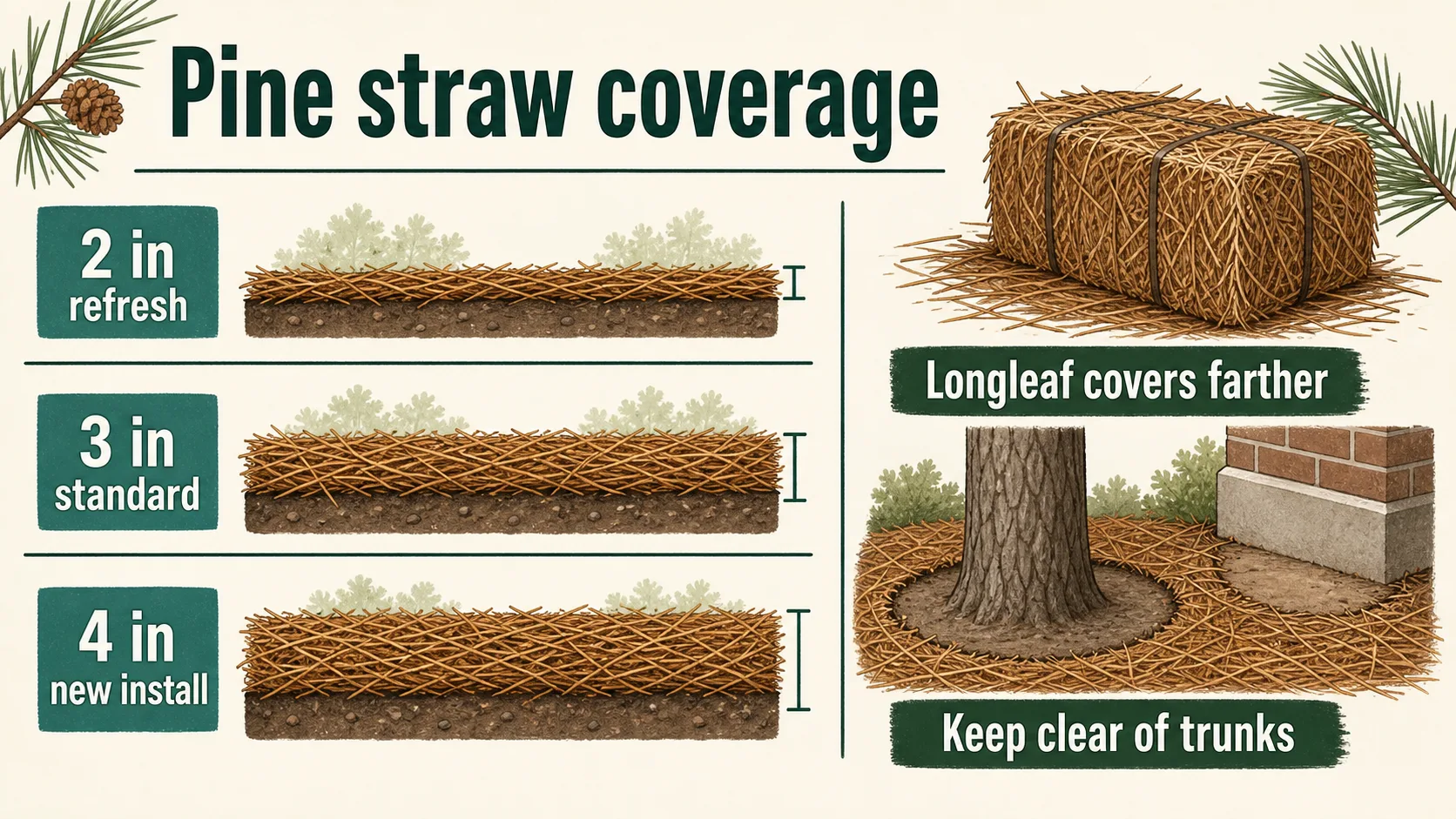
The depth you pick roughly doubles the order between the thinnest and the thickest layer drawn here. The clearance ring on the right is not tidiness: bark and masonry have to dry between rains.
The first three rows are coverage in sq ft. Longleaf carries a 1.12x coverage factor and slash a 0.92x factor against the mixed bale, which is why the cheapest bale on the pallet is not the cheapest bed.
Bed by bed
Pine straw cost by bed size: three worked beds
Each runs through the same arithmetic as the calculator above, so you can type any of them in and get the identical bale count. The settled-year line uses that bale type's own refresh interval.
Foundation run
11
bales to put it in
$77 install
- Bed
- 400 sq ft
- Depth
- 3"
- Bale
- Longleaf
- Top-up
- 8 bales
- A settled year
- $48 to $56
Two 40 ft runs along the house, 5 ft out. Longleaf because it is the bed people see from the kerb and it holds colour longest.
Shade garden top-up
18
bales to put it in
$108 install
- Bed
- 800 sq ft
- Depth
- 2"
- Bale
- Mixed
- Top-up
- 18 bales
- A settled year
- $130 to $162
Under mature oaks, over straw that has already broken down. It goes in at top-up depth, so the install and every top-up after it are the same bale count, which is the whole shape of pine straw as a running cost.
Hillside bank
10
bales to put it in
$70 install
- Bed
- 250 sq ft
- Depth
- 4"
- Bale
- Longleaf
- Top-up
- 5 bales
- A settled year
- $30 to $35
Bank between the drive and the line, staples every 3 ft. Order about 20% over the figures here for wind and runoff loss.
Bale arithmetic
How this pine straw calculator turns a bed into bales
Bed area, plus a tenth for edges and tucking, divided by what one bale of that type covers at that depth, rounded up. The reverse mode runs the same line backwards from the bales already on the pallet.
adjusted area = length × width × 1.10base coverage = 50 at 2 in, 25 at 4 in, straight line betweencoverage per bale = round(base × type factor)bales = ceil(adjusted area ÷ coverage per bale)cost = bales × price per baletop-up bales = ceil(adjusted area ÷ coverage at 2 in)settled year = top-up cost × 12 ÷ months the bale holdsThe tenth goes on before the division, never after, and the answer rounds up because nobody sells two thirds of a bale. Coverage between 2 and 4 inches is interpolated in a straight line rather than stepped, so a bed at an in-between depth does not jump. The last line is the only one that is not part of the bale count: it drives the yearly programme under the calculator, and it reads the refresh interval off the bale type you picked.
Not included: delivery, landscape staples, edging, fabric, pre-emergent, bed prep, disposal of the old layer, and labour.
Depth and needle
Picking a pine straw depth and a bale to match the bed
Two decisions, and the coverage table only settles the first half of each. Depth follows what is already on the ground. Bale type follows how exposed the bed is and how often you are willing to be back out there.
How deep
There is still straw down there. Rake the old layer to fluff it, then lay enough over it to read as new. This is the depth the programme prices every top-up at.
The default for a bed you want to look full and suppress weeds for a season. Most foundation beds and island beds live here.
New bed on bare soil, a bank, or a bed with a weed history. Roughly double the bales of a top-up, so it is worth being sure the bed needs it.
Which bale
Longleaf
holds 12-14 months · about $7 a bale
Longest needle, mats together, and the only one worth pinning to a bank. It is the dearest bale and usually the cheapest year.
Mixed
holds 8-10 months · about $6 a bale
What the garden centre stacks by the door. Fine for a shaded flat bed where nothing is trying to blow it around.
Slash
holds 6-8 months · about $5 a bale
Shortest needle and lowest sticker price. It moves in wind and comes due soonest, so it suits a sheltered bed you were going to redo anyway.
Spreading day
Spreading pine straw so it is still there next spring
Not a sequence, so not numbered. Each one is a habit that decides whether the bed still looks laid rather than blown.
Longleaf earns its extra dollar on exposed beds and slopes. It mats together, holds colour, and buys you months before the next top-up.
Match the depth to the job: 2" over straw that is still there, 3" for a bed you want to read as full, 4" only for a new bed or a bank.
Tuck the edges by hand once the bulk is down. A hand-tucked edge is what keeps needles out of the lawn, the walk and the drain.
Buy the whole job from one supplier when the bed faces the street. Bale size and needle colour both vary between sources, and the seam shows.
On a slope, spread in two passes and mist the first pass lightly. The lower layer grips once it has settled. For a flat bed, compare against wood mulch with our mulch calculator.
Keep straw off trunks, siding and foundations. Leaving a clearance ring lets bark and building materials dry out between rains.
Playgrounds and pet runs are the one place pine straw is the wrong answer. Size those with the rubber mulch calculator instead.
Garden centre
Pine straw questions people ask at the garden centre
Nine answers in the order they tend to come up, starting with the one the coverage table exists to settle.
How many square feet does one bale of pine straw cover?
About 50 sq ft at 2 inches, 35 sq ft at 3 inches, or 25 sq ft at 4 inches. Longleaf bales cover roughly 12% more than that and slash bales about 8% less.
How many bales per 100 sq ft?
Plan on 2 bales for a light 2-inch refresh, 3 bales for a standard 3-inch bed, or 4 bales for a heavy 4-inch new bed, overage included.
Longleaf vs slash pine straw?
Longleaf has longer needles, mats together on slopes, and holds 12 to 14 months. Slash costs a dollar or two less per bale and holds 6 to 8 months, so it is the dearer bale over a year.
How often do you need to replace pine straw?
Rarely all at once. A bed gets topped up instead, and the interval follows the bale: 12 to 14 months for longleaf, 8 to 10 for a mixed bale, 6 to 8 for slash. The programme above turns that into bales and dollars for your own bed.
How deep should pine straw be?
Use 2 inches over straw that is still in place, 3 inches for most garden beds, and 4 inches for new beds, slopes, or high-weed areas.
Can I apply pine straw over old pine straw?
Yes, and it is the normal way to do it. Rake and fluff the old layer first, then add enough new straw to bring the total back to about 3 inches.
Does pine straw attract termites or snakes?
Pine straw is not a termite food source. Keep a clear strip at the foundation and avoid tall, loose piles where pests can shelter.
Pine straw vs mulch, which is better?
Pine straw is lighter, cheaper per bale and far easier on slopes. Wood mulch lasts longer in flat beds, so it wins on refresh cost. Compare quantities with our mulch calculator.
When is the best time to spread pine straw?
Spring gives fresh colour before the growing season. Fall protects roots and keeps beds tidy through winter. Most beds settle into one of the two and stay there.
Disclaimer
These estimates are for planning purposes only. Actual costs vary by location, material availability, and project complexity. Always get at least 3 local quotes. This calculator does not replace professional advice.
Sources