Rock Calculator
Calculate landscape rock coverage from tons, cubic yards, bed size, and depth.
Rock Coverage
Depth preset
Estimates only. Not professional advice.
Ground it covers
80
sq ft of decorative rock average at 3 in deep.
- Bulk stone
- $45 to $90
- Bagged instead
- $240
- Delivery
- $90 typical, local yard
- Stone cost per sq ft of bed
- $0.56
1.00 tons is about 2,000 pounds. A half-ton pickup is already over its payload, so this is a delivery.
Decorative rock average at 100 lb per cubic foot, stone only. Fabric, edging, pins and labour are separate.
Last updated August 11, 2026 by our expert review team.
Pallet or truck
What your rock will cost: bags against a bulk load
Two ways to buy the same stone, priced side by side for the bed you just entered. Everything here reads off the calculator above, so change the depth or the rock type and both columns move with it.
Bagged
$240
40 bags at $6 each
Bulk load
$158
1.00 ton plus $90 delivery
Bulk wins by about $82 on this bed, and that is after the $90 delivery. Bagging this much rock means 40 bags to lift twice.
1.00 ton is about 2 half-ton pickup loads at 3 in deep. Yards usually have a one-ton minimum on delivered stone.
Same pile, priced by rock type
Bars are the yard price of the stone alone, at each type's bulk density for the volume above. Lava rock is the light one, so it costs the most per ton and yet buys the most ground.
What the panel assumes
- Bag size
- 0.5 cu ft
- Bag price
- $6
- Delivery
- $90
- Your volume
- 0.74 cu yd
- Your weight
- 1.00 ton
Bag prices hold steady across the country. Bulk prices do not, because most of a bulk price is the haul. A yard twenty minutes further out can undo the whole saving, so get the delivered figure rather than the per-ton one.
Spread and settle
Landscape rock habits that change the number you order
Not a sequence, so not numbered. Each of these moves the quantity on the ticket rather than the look of the finished bed.
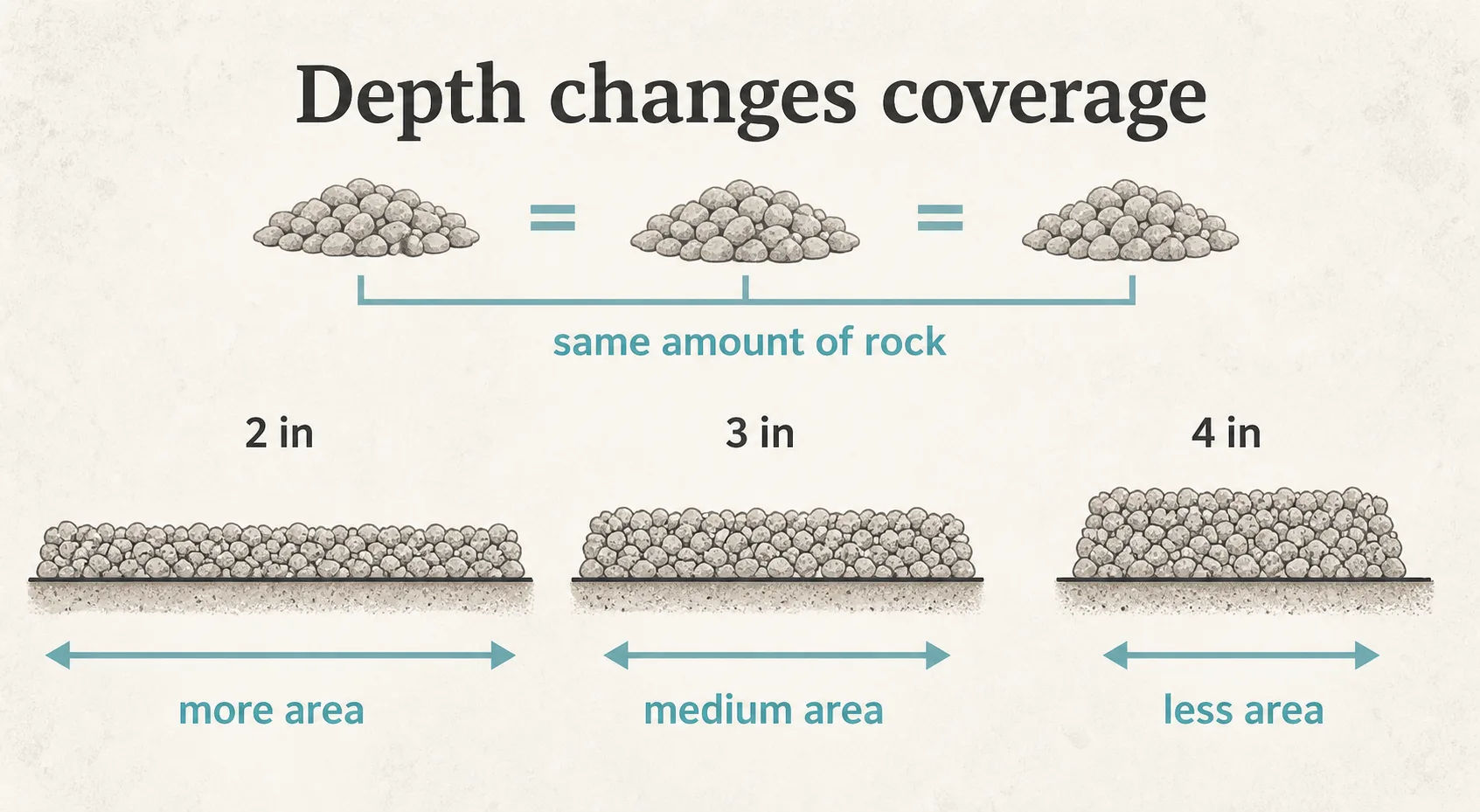
Pick the depth before you pick the quantity. Doubling a rock bed from 2 to 4 in halves the ground the same load covers, and no rounding trick gets it back.
Use cover-area mode the moment a supplier quotes you one ton, one bulk bag or one cubic yard. It answers the question you are actually standing there asking.
Buy for the finished depth, not the delivered pile. Rock settles into fabric and into every low spot in the subgrade, so a bed measured tight comes up thin along the edges.
Curves, tapers and hand spreading all eat rock. Ten percent covers a clean rectangle; fifteen is closer for a bed that follows a lawn edge.
For a named material rather than a generic rock, compare the stone calculator, the river rock calculator and the pea gravel calculator.
Compacted base under pavers or a drive is a different calculation. Use the crusher run calculator or the crushed stone calculator instead.
Plan footprint
How much ground a ton of rock covers, by stone size
Everything else on this page is a cross-section problem. This one is not: it is about how far a fixed weight of rock reaches across the ground once the depth is settled. The squares below are plan views of one ton, drawn to one scale at the depth you entered.
The dashed square is the rock type set in the calculator, which is chosen by material rather than by size, so it will rarely line up with a rung on the ladder. Squares are a convenience for comparing area; nobody lays a square bed.
Trade coverage figures published at 2 in, restated here for the depth set above. Bigger stone is normally laid deeper than smaller stone, so in practice the gap between the top and the bottom of this ladder is wider than a single depth makes it look.
Your rock at your depth
- Rock type
- Decorative rock
- Depth entered
- 3 in
- One ton covers
- 80 sq ft
- At 1 in less
- 120 sq ft
- At 1 in more
- 60 sq ft
A step is 1 in either way. It is the smallest change anyone makes to a rock bed and it is worth a quarter to a third of the order.
Depth each size wants
- Stone under 1 in
- 2 in
- Stone 3/4 to 1 in
- 3 in
- Larger decorative rock
- 4 in
- Drainage edge
- 6 in
The table beside this reads the same ladder as the drawing, so the two can never fall out of step. Both move the moment you change the depth in the calculator.
Scale house
Rock calculator questions that come up at the scale house
Eight answers in roughly the order they arrive, starting with the two conversions every yard ticket forces you to make.
How many square feet does a ton of rock cover?
Around 120 at 2 inches, 80 at 3 inches and 60 at 4 inches, for a mid-weight decorative rock of about 100 pounds a cubic foot (1,600 kg per cubic metre). The pattern is worth more than the numbers: coverage and depth are inversely proportional, so doubling the depth always halves the area.
How many square feet does a cubic yard of rock cover?
About 162 at 2 inches, 108 at 3 inches and 81 at 4 inches. Cubic yards are pure volume, so density never enters it, which is why a yard figure is the more stable one to plan against when you can get a quote in yards.
Why do supplier coverage charts disagree with each other?
Because they are quoting weight, and weight per unit of volume moves with stone size, shape, moisture and how much void space the pile carries. A washed 2 inch river stone and a dusty crushed granite can differ by a third per ton with the same label on the bin.
Should I buy bagged rock or bulk rock?
The panel near the top of this page prices both for the bed you entered. As a rule of thumb the crossover sits near a third of a ton, which is roughly 40 square feet at 2 inches. Below that the delivery fee dominates; above it, bagging becomes lifting the same rock twice.
How deep does landscape rock need to be to stop weeds?
Three to four inches over woven landscape fabric. Clemson's fact sheet notes that even an inch of small stone suppresses some weeds, but under about 2.5 inches enough light reaches the soil for seeds to germinate, and a thin layer shows the fabric within a season.
How do I calculate rock for a curved or odd-shaped bed?
Break the bed into rectangles and triangles, run each one through the calculator, then add the results. Use 15 percent for the cushion rather than 10, because curved edges lose more rock to spillover than a straight edge does.
How much does a cubic yard of rock weigh?
Lava rock lands near 1,350 lb, decorative and crushed stone near 2,700 lb, with river rock in between. That matters for pickup: most half-ton trucks are already at their payload with well under a full yard of dense stone in the bed.
Can I use this rock calculator for compacted base stone?
No, and the difference is large. Base material is ordered loose and finishes compacted, so it needs a compaction allowance this page does not apply. Use the crusher run calculator or the crushed stone calculator for base under pavers, drives or footings.
Short loads
Six ways a rock order comes up short
None of these is expensive to avoid and all of them are expensive to fix, because the fix is a second delivery of the same material.
Ordering to the exact figure with no cushion
A short load is a second delivery fee that can rival the rock. Every bed has low spots a tape measure never finds, which is what the order cushion on this calculator is for.
Using one depth for every stone size
Two inches that looks finished in pea gravel leaves 5 to 8 inch cobble sitting proud with soil showing between it. Depth has to scale with the stone, so set it per bed rather than per project.
Comparing a bagged price to a bulk price per unit
Bagged rock is priced per half cubic foot and bulk is priced per ton. Convert one to the other before deciding, which is exactly what the panel near the top of this page does.
Booking a delivery before checking access
A tandem needs room to turn and clear headroom to tip. No access means the load lands wherever the truck can reach it and moves the rest of the way by wheelbarrow.
Laying rock straight onto bare soil
Rock works its way down into soil and weeds come straight back up through the gaps. Woven fabric first, overlapped at the seams and pinned, before any stone lands on it.
Treating a ton and a cubic yard as interchangeable
They are only equal for one density. A ton of lava rock is more than two cubic yards; a ton of crushed stone is well under one. Check which unit the quote is in before comparing two yards.
Cubic feet first
The arithmetic behind every rock coverage number here
Everything on this page runs through cubic feet. Area times depth gives the volume, the cushion is added to the volume, and the bulk density of the material turns that into a weight. Cover-area mode runs the identical chain backwards from a weight you already have.
cu ft = area × depth ÷ 12order = cu ft × (1 + cushion)cu yd = cu ft ÷ 27tons = cu ft × density ÷ 2,000area = cu ft ÷ (depth ÷ 12)coverage per ton = 2,000 ÷ density ÷ (depth ÷ 12)bags = ceil(cu ft ÷ 0.5)cost = tons × price per tonThe cushion is applied to the volume, before the density, so it buys real stone rather than rounding a weight. Cover-area mode deliberately ignores it, because the question there is what the pile already on the drive will reach, not what to order. Bag counts use the half cubic foot bags decorative rock is sold in; they are there to tell you when bagging stops making sense, not to recommend it.
Not included: fabric, pins, edging, sod stripping, disposal, delivery or labour.
Lava rock is the outlier and the reason a generic rock calculator needs a material picker at all: at half the density of the rest, one ton of it buys twice the ground.
Three depths
Rock coverage at three depths, four beds priced end to end
Every one of these runs the same arithmetic and the same yard prices as the calculator, so you can type any of them in and get the identical answer. The last two are worth reading together: half the area, and it still weighs more.
Front bed refresh
1.10
tons
$50 to $99 of rock
- Bed
- 20.0 × 6.0 ft
- Depth
- 2 in
- Material
- Decorative rock
- Volume
- 0.81 cu yd
- Cushion
- 10%
A top-up over an existing bed. Thin enough that a bagged order is still competitive on the day.
Shrub bed, hidden soil
2.38
tons
$166 to $333 of rock
- Bed
- 24.0 × 8.0 ft
- Depth
- 3 in
- Material
- River rock
- Volume
- 1.96 cu yd
- Cushion
- 10%
3 in is the depth that reliably hides fabric under rounded stone. River rock is the priciest of the common picks.
Side yard path
1.60
tons
$56 to $120 of rock
- Bed
- 40.0 × 3.0 ft
- Depth
- 3 in
- Material
- Pea gravel
- Volume
- 1.22 cu yd
- Cushion
- 10%
Long and narrow, so most of the perimeter is edge. Edging here is not decorative, it is what keeps the path on the path.
Drainage edge
1.73
tons
$60 to $129 of rock
- Bed
- 30.0 × 2.0 ft
- Depth
- 6 in
- Material
- Crushed stone
- Volume
- 1.28 cu yd
- Cushion
- 15%
6 in doing a job rather than a look. Half the area of the path above at twice the depth, and it still outweighs it.
Delivery day
Spreading a rock bed, in the order it actually happens
Numbered because the order is real. Each step is far cheaper to do in sequence than to come back to with rock already spread over it.
- 01
Cut and set the bed edge first, with a hose laid on the ground for the curves. Everything after this is easier to do than to redo.
- 02
Strip the sod and take the subgrade down by the full finished depth, so the rock sits flush rather than proud of the lawn.
- 03
Roll woven landscape fabric with the seams overlapped and pinned. Skip this and the rock migrates into the soil within two seasons.
- 04
Tell the driver where the pile goes before the truck arrives, on plywood or a tarp if it is landing on a drive you care about.
- 05
Barrow the rock out in several piles across the bed rather than one heap, then rake out. One heap means moving the same stone twice.
- 06
Check depth with a stick pushed to the fabric, not by eye. Eyes read a raked surface as deeper than it is, every time.
- 07
Hose the finished bed to wash off the quarry dust, and walk the margins once to pull any stone that ended up over the edging.
Disclaimer
These estimates are for planning purposes only. Actual costs vary by location, material availability, and project complexity. Always get at least 3 local quotes. This calculator does not replace professional advice.
Sources
- 01Clemson HGIC: Mulch, including stone and gravel depthshgic.clemson.edu
- 02Colorado State University Extension: Mulchingextension.colostate.edu
- 03Utah State University Extension: Water-Wise Landscaping, Mulchextension.usu.edu
- 04Engineering ToolBox: Densities of Common Materialsengineeringtoolbox.com
- 05USGS: Crushed Stone Statistics and Informationusgs.gov