Polished Concrete Floor Cost Calculator
Price grinding, densifying and sealing an existing slab by polish level and floor size.
Floor and finish
The swatch below the calculator shows this level, 32 GU at ≈ 400 grit.
Estimates only. Not professional advice.
Installed polished concrete cost
$7,590to$11,550
Level 2 (Standard) on 1,320 sq ft of floor, finished to a satin finish and sealed with a penetrating sealer.
- Grinding and polishing
- $6,600 to $10,560
- Sealer, 5-7 years
- $990
- Measured before allowance
- 1,200 sq ft
- Installed estimate
- $7,590 to $11,550
Not in this number
Slab prep is priced separately, because it depends on what is on the concrete rather than how much of it there is. On the condition you set, a bare, sound, dense slab needs no prep adder at all.
Last updated August 13, 2026. Gloss levels checked against the Concrete Polishing Council appearance chart by our expert review team.
Gloss units and grit
What each polished concrete gloss level actually looks like
Polish level is a look before it is a price, and it is the one thing a quote cannot show you. The swatch reflects a ceiling light the way a real floor does at each of the four levels, and it follows whichever level you picked in the calculator.
- What you see in it
- Faint sheen, visible up close
- Where it belongs
- Retail, restaurants, most homes
- Aggregate showing
- Cream only, the paste layer stays
Candidacy before quote
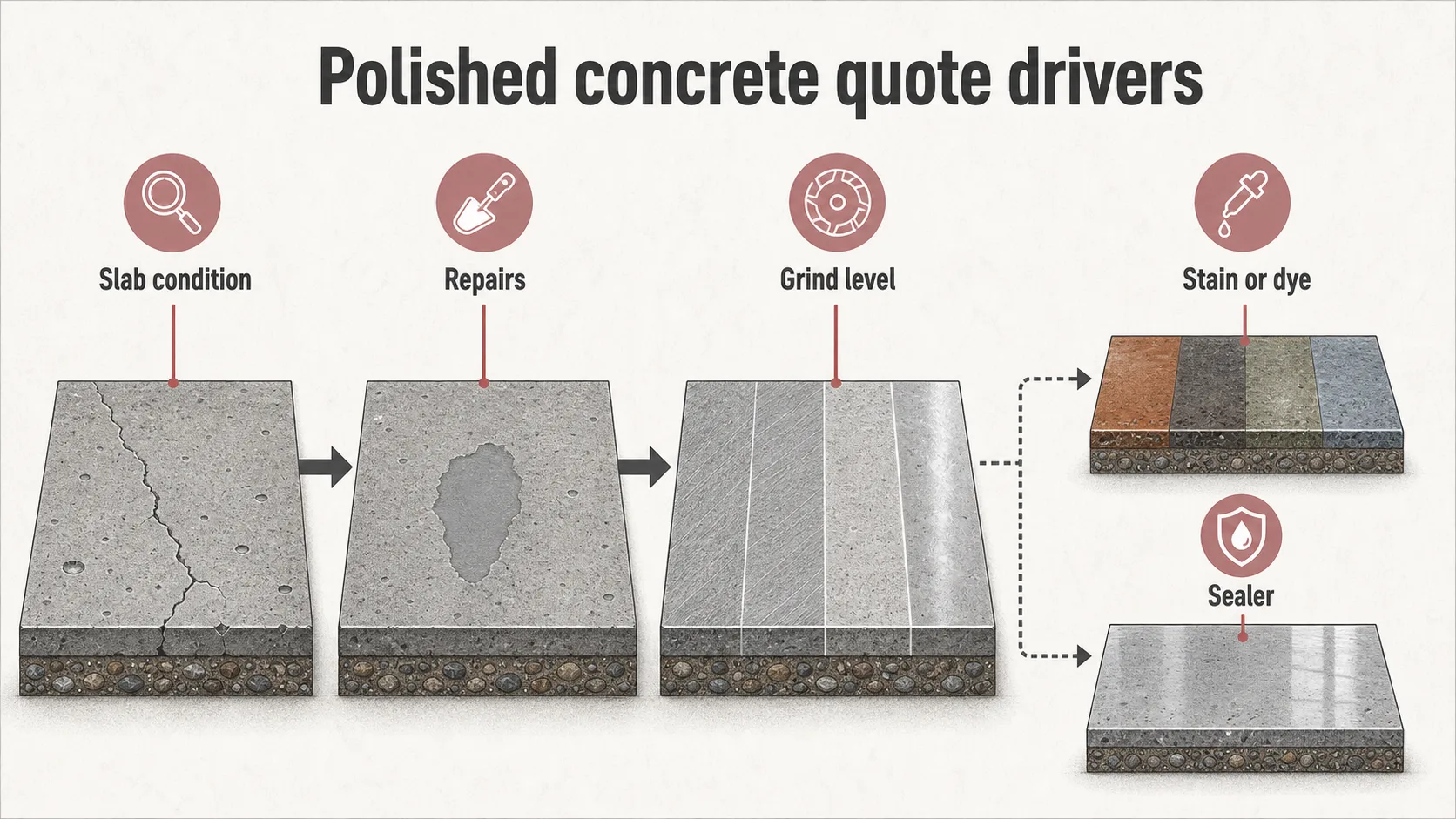
Polished concrete slab candidacy: what prep adds before grinding starts
Grinding exposes what is in the slab instead of covering it, so the concrete you already own sets the price more than the floor area does. Set the four condition answers in the calculator's slab-condition panel and this repricing follows them.
Candidacy
Great candidate
A sound, bare, dense slab is the ideal polishing surface, so there is minimal prep before grinding.
Prep adder
$0
On top of the estimate above, never inside it.
On the slab now
Bare concretenothing on top
none
$0
Cracks and damage
Soundno real cracks
none
$0
Surface hardness
Normaltypical / unsure
none
$0
Moisture
Above grade or barrieredno extra moisture allowance
none
$0
A 4 ft by 4 ft test patch costs $150 to $300 and settles every row above it. It is the only honest way to see what your aggregate looks like before you commit the whole floor. If the slab is past saving, a polishable overlay or a coated floor is the usual answer instead.
Living room, shop, basement
Three polished concrete floors, priced line by line
The first two grind a slab that was already there. The third pours the slab first, which is why its per-unit number is more than double the others while its polish line is the cheapest of the three.
600 sq ft
$4,950
$8.25/sq ft
Open-plan living room
Level 2 satin, penetrating sealer, gray dye
Polishing $3,600, penetrating sealer $450, water-based gray stain $900. Resealing every 5 years works out at $90 a year. Comparable hardwood would cost $7,200 to $9,000 with $600/year maintenance.
2,500 sq ft
$27,800
$11.12/sq ft
Retail store
Level 3 high gloss, densifier, topical guard
Polishing $25,000, densifier $750, topical guard $1,250, logo stencil $800. The reflective finish cut lighting by 25%, about $1,200 a year, so the lighting alone pays back in 3 to 4 years.
1,200 sq ft
$27,300
$22.75/sq ft
New basement slab with radiant heat
New slab, Level 2 satin, acid stain
New 4 inch slab plus radiant tubing $17,400. Level 2 polish $7,200, sealer $900, acid stain $1,800. Radiant under polished concrete heats about 40% more efficiently than forced air over carpet, saving $400 to $600 a year.
Totals are installed prices from completed jobs, not the calculator's own output. Yours will land inside the range above the same floor area gives you.
Diamond passes
Grit, densifier and guard: the steps a polished concrete floor lives on
None of these change the estimate above. All of them change whether the floor still looks like the swatch in five years.
Cream polish (Level 1-2, $3 to $8/sq ft) grinds only the top paste layer. Aggregate polish (Level 3-4, $8 to $18/sq ft) exposes stone and sand, requiring 8 to 10 diamond passes vs 4 to 5. See the ConcreteNetwork polishing guide for detailed level comparisons.
Apply lithium silicate densifier after the 400-grit step. It hardens the surface 30 to 40% and eliminates dusting permanently.
Annual maintenance costs just $0.10 to $0.25/sq ft: dust mop daily, wet mop weekly. Compare to hardwood at $0.75 to $1.50/sq ft/year for periodic refinishing.
Polished concrete reflects 30 to 70% more light than carpet, reducing lighting costs 20 to 30% in commercial spaces.
Polished concrete conducts heat 5x better than wood. Add radiant heating ($8 to $12/sq ft) for an efficient cold-climate floor system. Learn the basics at cement.org.
Water-based dyes ($1 to $2/sq ft) add color without hiding aggregate. Acid stains ($1.50 to $3/sq ft) create permanent marbled patterns. Compare with epoxy flooring for a different decorative approach.
Considering laminate over concrete? Our laminate flooring calculator estimates planks, underlayment, and costs.
Installed rates by level
Polished concrete cost per square foot by finish level
The whole spread runs about six to one, and every step up the axis is more diamond passes rather than more material. The bars are the same rates the calculator prices from.
Installed cost per sq ft, covering grinding, densifier and sealer on a slab that is already sound. Slab prep and a new pour sit outside these bars.
Haze, dust, telegraphing
Where polished concrete jobs go wrong
A polished floor cannot be stripped and redone the way a coating can. Every one of these is cheap to avoid before the grinder starts and expensive to argue about afterwards.
Skipping the densifier step
Without densifier ($0.20 to $0.40/sq ft), polished concrete dusts, stains easily, and wears 3 to 5x faster. Apply between the 400 and 800 grit steps.
Polishing concrete that is too young
Concrete needs 28+ days to reach 3,500+ PSI. Grinding too early gouges the surface and pulls aggregate loose. Wait 60 to 90 days for best results.
Choosing the wrong sealer
Topical sealers ($0.50/sq ft) can yellow and peel. Penetrating sealers ($0.75/sq ft) last 5 to 7 years and don't change appearance. Use penetrating for kitchens and baths.
Expecting uniform color from an existing slab
Patches, repairs, and pour lines become more visible when polished. Budget $1 to $2/sq ft for dye or stain if uniform color matters.
Not testing a sample area first
Every slab is different. Reputable contractors polish a 4x4ft test section ($150 to $300) to reveal the actual result and hidden problems.
The first two are the expensive ones. A slab ground before it has cured, or polished without a densifier, does not fail today. It dusts and dulls over the first two winters, by which point the only fix is grinding the whole floor again.
Before the grinder
What people ask before polishing a concrete floor
Eight questions that decide whether the slab under your feet is worth grinding, answered against the same rates this calculator uses.
How much does polished concrete cost?
Ranges from $3 to $18/sq ft by finish level. Most residential projects fall at $5 to $8/sq ft for a Level 2 satin finish.
Is polished concrete cheaper long-term?
Over 20 years, polished concrete totals $8 to $11/sq ft including maintenance. Hardwood totals $16 to $27/sq ft with refinishing. Compare with our epoxy flooring cost calculator for another durable option.
Cream vs aggregate polish?
Cream grinds the top paste layer for a clean, uniform look. Aggregate cuts deeper to expose stone, creating a terrazzo effect at $4 to $8/sq ft more.
Can existing concrete be polished?
Yes, if the slab is 28+ days old with 3,500+ PSI strength. Existing coatings must be removed first ($1 to $3/sq ft). Need a new slab? Use our concrete bags calculator.
Is densifier necessary?
Absolutely. Without it, polished concrete dusts, stains easily, and wears 3 to 5x faster. Products cost $0.20 to $0.40/sq ft.
How long does polished concrete last?
The concrete lasts indefinitely. Polish needs refreshing every 5 to 10 years in commercial use ($1 to $3/sq ft), 15 to 20 years residential.
Is polished concrete slippery when wet?
Friction is comparable to standard tile (0.5 to 0.6 COF). For wet areas, use a slip-resistant guard or stop at 800-grit instead of 3000.
Works with radiant heat?
Yes, polished concrete is ideal for radiant heating. It conducts heat 5x better than wood and won't expand or gap. Budget $8 to $12/sq ft for the heating system.
Rates in these answers are quoted per square foot, the way the trade quotes them.
Room by room
Which polished concrete level belongs in your space
Almost nobody needs Level 4. The jump from satin to semi-polished is bought for the way a room reads under its own lighting, and the jump above that is bought for the way it photographs.
Warehouse
Level 1$3 to $5/sq ft
Functional and dust-free, and nobody is looking at the shine
Restaurant
Level 2$5 to $8/sq ft
Enough grip when wet, and it mops clean at close
Retail store
Level 2$5 to $8/sq ft
Reads clean under store lighting without the mirror upkeep
Office lobby
Level 3$8 to $12/sq ft
Reflects the light fittings, which is the look a lobby is buying
Luxury home
Level 4$12 to $18/sq ft
Exposed aggregate and dye, treated as a finish rather than a floor
Museum or gallery
Level 4$12 to $18/sq ft
Maximum light return, and no coating to yellow under display lamps
What it does well
Lasts 20+ years with dust mopping and an occasional wet mop
No coating to peel, so nothing to strip and recoat later
Low VOC: the floor is the slab you already own, not a new material
Returns 30 to 70% more light than carpet, which cuts lighting load
Takes radiant heat better than any wood floor
What it asks of you
Hard underfoot, so standing all day in a kitchen is a real complaint
Cold in winter unless there is radiant heat under it
Slippery wet above 800 grit without a slip-resistant guard
Every patch, pour line and repair shows more, not less
Grinding is a rented-machine job at best, and a contractor job in practice
Inside the estimate
Every line in the polished concrete estimate, and what sets it
Four lines, each one a rate per unit of floor times the priced area. The priced area is the measured floor plus the allowance, and every rate below is the one your current selections produce.
Priced area
Length times width, plus the 10% allowance for irregular rooms and edges.
+10%
1,320 sq ft
Grinding and polishing
Polish level. Multiple grinding passes, better shine, satin finish.
$5 to $8
$6,600 to $10,560
New concrete slab
Nothing, because you are polishing the slab you already have.
none
$0
Sealer
Penetrating Sealer, rated 5-7 years before it is reapplied.
$0.75
$990
Stain or dye
Off, so the floor keeps the colour of its own aggregate.
none
$0
Outside the estimate
Slab prep: coating removal, crack repair, densifying a soft slab. The section near the top of this page prices it from your own answers.
Grinding a slab that has to be opened up from a troweled-smooth finish rather than a bare one.
Furniture moving, dust containment and disposal of the slurry the grinder produces.
Radiant tubing under a new slab, at $8 to $12/sq ft on top of the pour.
Why the ranges are wide
Each polish level is a band, not a price, because the number of diamond passes it takes to reach a given gloss depends on how hard the slab is. A dense slab hits satin in four passes and a soft one takes six.
That is the same variable the candidacy section asks about, which is why a soft slab pushes you toward the top of the band and a hard one toward the bottom.
Coating a slab instead of grinding it is a different job with different failure modes. The epoxy flooring cost calculator prices that one.
Disclaimer
These estimates are for planning purposes only. Actual costs vary by location, material availability, and project complexity. Always get at least 3 local quotes. This calculator does not replace professional advice.
Sources