Framing Calculator
Estimate studs, plates, headers, openings, waste, board feet, and lumber cost.
Wall Details
Studs to buy
38
2x4 (92-5/8" pre-cut), which is 18 full height plus 16 jacks and cripples, with the 10% waste allowance already in it.
- Top plate, doubled
- 40 LF
- Bottom plate, doors out
- 17 LF
- Headers to build
- 3
- Header stock
- 21 LF
- Lumber, before labour
- $189 to $297
Studs at $3.50 to $5.50 each, plate stock priced by the 8 ft section. Sheathing, fasteners, hardware, blocking and labour are all extra. Estimates only, not professional advice.
Last updated August 5, 2026 by our expert review team.
Stud layout
Wall framing layout: the stud count is never length divided by spacing
Every rough framing estimate starts as wall length over spacing, plus one. That number is the field, and the field is only part of a wall. Openings hand back two studs and take four or six in return, and the corners want their own. Here is the same wall drawn to scale so the extra framing can be counted rather than trusted.
Drawn to one scale on both axes from the length, height and spacing you set, so the bays really are that wide. Header depth is the exception and is drawn nominally, because it follows from span and load rather than from anything on this page: size it with our beam calculator. Window heads are set level with the door head, which is the usual layout and is why the sills line up.
Each opening is centred in a bay, which is why exactly two layout lines fall inside it. Those two come back as the cripples above the header, so nothing on the layout is ever really skipped.
Naive against actual
Length over spacing gives 16. The wall needs 34, which is 18 more, or 2.1× the naive count.
- Length ÷ spacing, plus one
- 16
- Openings take out
- −6
- Corners and partitions
- +2
- King studs
- +6
- Full height studs
- 18
- Jack studs
- +6
- Cripple studs
- +10
- Studs the wall needs
- 34
- Waste at 10%
- +4
Plumb and line
Framing errors that get found at drywall
Every one of these is decided at the layout stage or in the first hour of nailing. None of them is cheap once the rock is hung.
Counting studs as length divided by spacing
That gives the field only. Corners, partition intersections, kings, jacks and cripples all sit outside it, and on a wall with three openings they roughly double the count. The reconciliation at the top of this page is the same wall counted both ways.
Forgetting the double top plate
A single top plate cannot transfer loads across stud bays. Building code requires a doubled top plate with staggered joints on load-bearing walls, so plan the overlap before cutting the second layer.
Leaving out king and jack studs at openings
Without king and jack studs the header has no support. Every door and window in this takeoff gets two king studs and two trimmer (jack) studs, which is what the drawing marks at each opening.
Using 24 in centres on a load-bearing wall without engineering
Wider spacing on a load-bearing wall may violate building code. Check with your local inspector. 16 in on centre is the safe default for any structural wall.
Forgetting the cripples above an opening
The top plate sags without support above the header. Cripples carry the plate load down to the header, and they land on the same layout lines as the studs the opening removed.
Nailing studs without crowning them
Bowed studs make a wavy wall that only shows up once the drywall is on. Sight down each stud before it goes in and face every crown the same way.
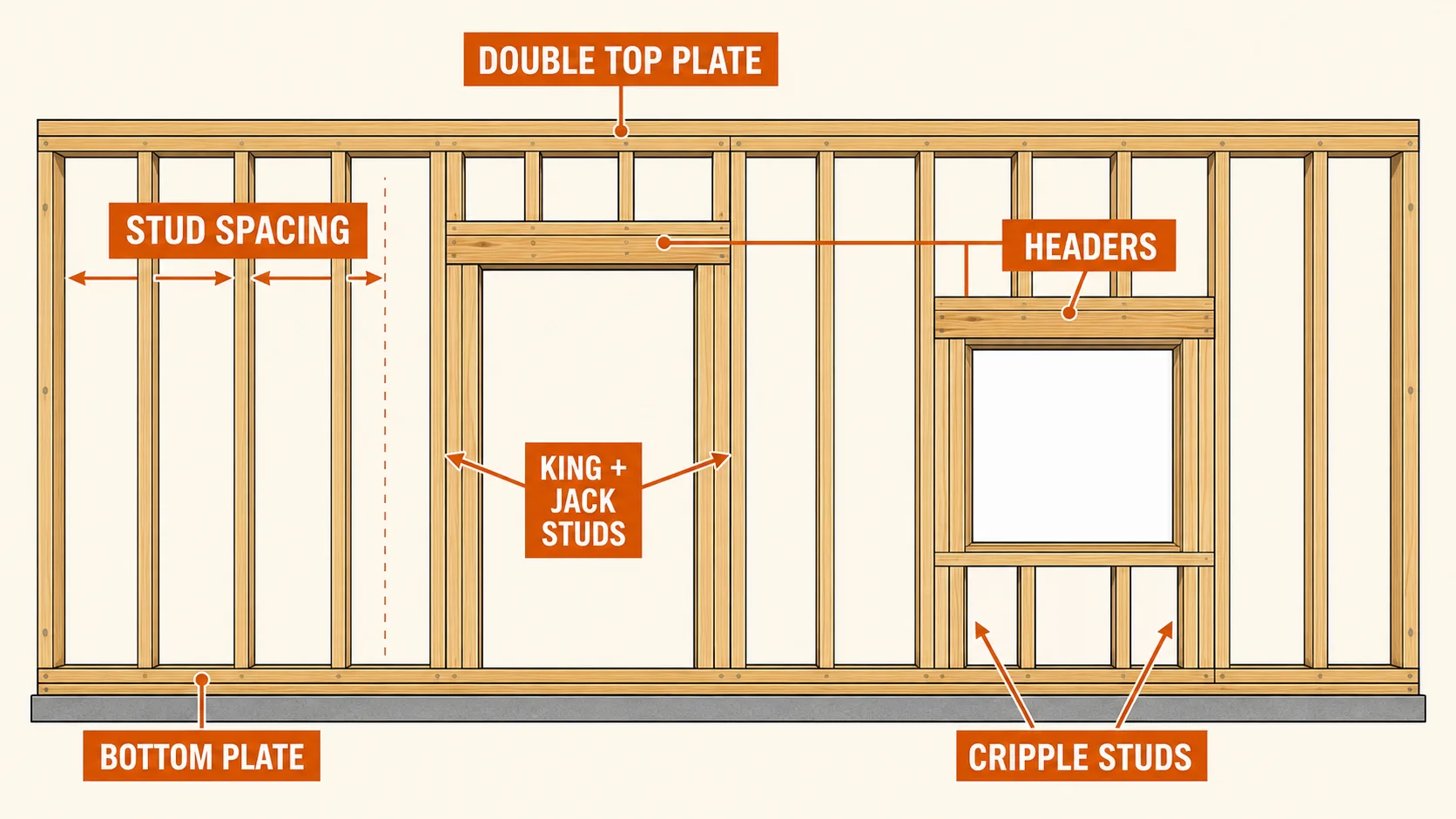
Every part the questions below name, in one wall. The takeoff assumes ordinary door and window framing, so verify header sizing and spacing against local code or an engineer on anything load-bearing.
Rough openings
Framing questions asked at the layout stage
Eight answers in the order they tend to arrive, starting with the wall length everyone reaches for first.
How many studs for a 20-foot wall?
16 studs at 16" OC spacing plus end studs, or about 18 total before doors and windows.
16 or 24 inch stud spacing?
16" OC is standard for load-bearing walls. 24" OC works for non-load-bearing interior partitions with 2x6 studs.
What is a king stud vs jack stud?
King studs run full height beside openings. Jack studs (trimmers) support the header and are nailed to the king studs.
How much does framing lumber cost?
2x4 pre-cut studs cost $3.50 to $5.50 each. 2x6 studs cost $5.50 to $8.50. Prices fluctuate with lumber markets.
Do I need a header above every opening?
Yes for load-bearing walls. Non-load-bearing walls can use a flat 2x4 instead of a built-up header.
What is a cripple stud?
Short studs above or below openings that maintain the spacing pattern and support the top plate or window sill.
How do I frame a corner?
Use 3 studs in an L-shape or 2 studs with blocking. This provides nailing surfaces for drywall on both walls.
2x4 vs 2x6 exterior walls?
2x4 holds R-13 insulation. 2x6 holds R-19 or R-21. Energy codes in cold climates often require 2x6 exterior walls.
Framed walls
Stud count by wall length: four framed walls
Each one run through the same arithmetic as the calculator above, so you can type any of them in and get the identical count. The figure in ink is what the wall needs before waste, and the line under it is what length over spacing would have told you.
Closet partition
16
studs the wall needs
10 by length ÷ spacing
- Wall
- 12 × 8 ft
- Spacing
- 16 in
- Openings
- 1 + 0
- Full height
- 12
- Jacks, cripples
- 4
One opening and no windows, and the layout still lands well past the field count. The shorter the wall, the more one door dominates it.
Bedroom wall
34
studs the wall needs
16 by length ÷ spacing
- Wall
- 20 × 8 ft
- Spacing
- 16 in
- Openings
- 1 + 2
- Full height
- 18
- Jacks, cripples
- 16
Three openings on a short wall is where the gap gets embarrassing at the lumber desk.
Long exterior wall
48
studs the wall needs
24 by length ÷ spacing
- Wall
- 30 × 8 ft
- Spacing
- 16 in
- Openings
- 1 + 3
- Full height
- 26
- Jacks, cripples
- 22
More wall spreads the openings out, so the gap shrinks as a share even as it grows in studs.
Garage, 24 in centres
19
studs the wall needs
13 by length ÷ spacing
- Wall
- 24 × 10 ft
- Spacing
- 24 in
- Openings
- 1 + 0
- Full height
- 15
- Jacks, cripples
- 4
Wider centres cut the field count, and the opening framing stays exactly the same.
Counts are before the waste allowance, which the calculator adds on top. Openings are counted as doors plus windows, in that order.
Takeoff math
How this framing calculator counts studs and plates
The field count comes off the spacing, the openings are priced as a fixed set of parts, and the plates come off the wall length rather than a second measurement. Waste goes on at the end, and the studs are rounded up because a yard will not sell you nine tenths of one.
field = ceil(length ft × 12 ÷ spacing) + 1full = field − 2/opening + 2 corners + 2 kings/openingjacks = 2 per openingcripples = 2 per door + 4 per windowstuds = ceil((full + jacks + cripples) × (1 + waste))top plate = length × 2bottom plate = length − 3 ft per doorplate stock = ceil((top + bottom) × (1 + waste))headers = doors + windowsheader stock = headers × 3.5 × 2stud bf = studs × height × width × 1.5 ÷ 144plate bf = plate stock × width × 1.5 ÷ 12cost = studs × rate + ceil(plate ÷ 8) × rate × 2Openings are the part worth understanding. Each one removes two studs from the field and puts six or eight back: two kings outside, two jacks under the header, and two cripples above it, plus two more under a window sill. The bottom plate loses 3 ft at each door, because that is where it is cut out, while the top plate runs the full length twice. Header stock is counted as two plies of 3.5 ft per opening, which is the material, not the size: sizing a header is a span and load question and it belongs in our beam calculator.
Not included: sheathing, house wrap, blocking, fire blocking, nails, hangers, hold-downs, sill sealer, anchor bolts, or labour.
A rough opening runs bigger than the door or window that goes in it, which is where the two pairs of numbers above differ. The takeoff works from the nominal 3 ft width when it deducts the bottom plate.
Lumber list
Framing lumber price per stud and per plate
Four line items on one axis. The plate rows are the stud rate doubled, which is how a 8 ft plate section is priced, so the two rows marked as yours add up to the estimate in the readout at the top of the page.
2x4 Stud
your size$3.50 to $5.50
38 × · $133 to $209
2x6 Stud
$5.50 to $8.50
38 × · $209 to $323
2x4 Plate (8 ft)
your size$7.00 to $11.00
8 × · $56 to $88
2x6 Plate (8 ft)
$11.00 to $17.00
8 × · $88 to $136
Material only, at the counter. Stud prices move with the lumber market, so treat the spread as the width of a quote rather than a price. Plate quantity is your plate stock divided into 8 ft sections and rounded up.
Crown and nail
Framing habits behind a flat, quiet wall
Not a sequence, so not numbered. Each of these is a habit that separates a wall that still reads flat under a straightedge from one that does not.
Double the top plate and overlap the joints between the two layers by at least 4 ft, so the plate reads as one continuous member across every stud bay.
Pre-cut studs measure 92-5/8 in for a reason: with a single bottom plate and a double top plate they land a 8 ft wall without a single cut.
Crown every stud before it is nailed. Sight down the narrow face, mark the high side, and set every crown the same way so the wall planes out flat.
Use 2x6 studs on exterior walls in a cold climate. The extra cavity depth takes R-19 where a 2x4 wall takes R-13, and the change has to happen at framing, not later.
Price the lumber by volume rather than by piece with our board foot calculator, which is how a yard quotes anything that is not a stock stud.
Size the header over each opening for its span and load with our beam calculator. This page counts the header stock, it does not size the member.
Sheathe from the takeoff you already have: our plywood calculator turns the same wall into sheets for walls and subfloors.
Order the rock at the same time as the lumber with our drywall calculator, because the stud spacing you pick here decides the sheet layout.
Disclaimer
These estimates are for planning purposes only. Actual costs vary by location, material availability, and project complexity. Always get at least 3 local quotes. This calculator does not replace professional advice.
Sources