Raised Bed Soil Calculator
Estimate cubic yards, bags and blend components for rectangular, circular or L-shaped beds.
Bed Details
Bed Shape
Length (ft)
Width (ft)
Bed Depth (inches)
Soil to order
1.3
cubic yards of topsoil + compost (60/40), which is 35.2 cu ft with the 10% settling allowance already in it.
- Blend
- Topsoil + Compost (60/40)
- Settling allowance
- 10%
- Bagged, 18 bags at 2 cu ft
- $90 to $144
- Bulk delivered, material only
- $46 to $72
Topsoil + Compost (60/40) at $35 to $55 per cu yd in bulk, or $5 to $8 a 2 cu ft bag. Delivery, the frame, any liner and labour are extra. Estimates only, not professional advice.
Last updated August 5, 2026 by our expert review team.
First season
Raised bed soil mistakes that show up in the first season
Almost every one of these is settled at the ordering stage, before a barrow moves. A bed you have already planted is the worst place to find out the blend was wrong.
Filling with topsoil alone
Dense topsoil can drain poorly in a raised bed. Blend it with plant-based compost or order a raised-bed blend from a local supplier.
Ordering the bed volume and nothing more
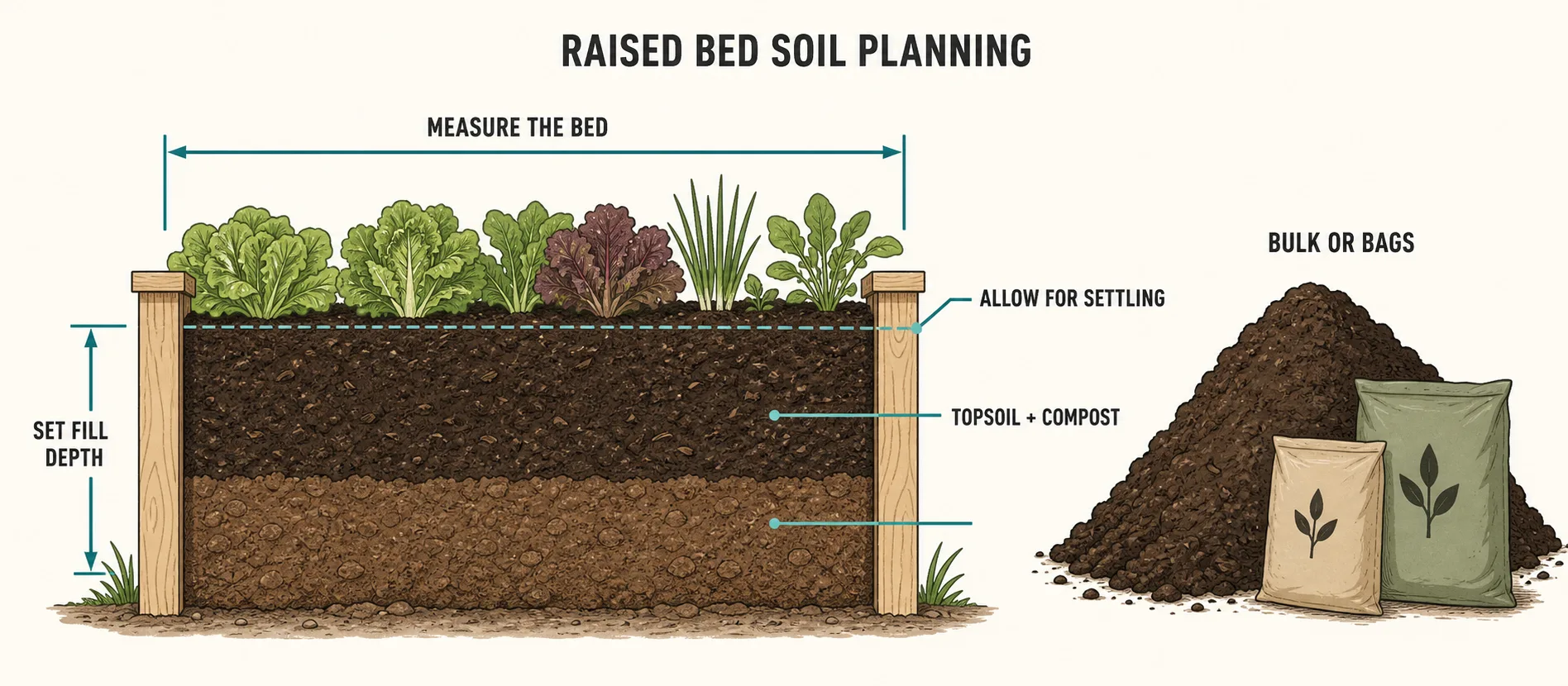
Fresh soil settles after filling. Use a modest allowance for a new bed, then check the soil level before each growing season.
Filling a deep bed without a plan
Separate the planting depth from any base layer. Organic base materials settle as they break down, so keep the root zone deep enough for your crop.
Sealing the bottom of the bed
Never line the bottom with plastic sheeting. Most beds over soil do not need a bottom barrier. A bed on pavement needs a permeable liner.
Buying bags to the exact figure
Always round up when buying bagged soil. Leftover soil goes in garden borders, pots, or topdressing the lawn. Running short mid-project means another trip to the store.
At the counter
- Cubic feet in a cubic yard
- 27
- Standard bag
- 2 cu ft
- Bags to a bulk unit
- 14
- Bulk delivery minimum
- 1 to 2 cu yd
- Planning depth
- 12 in
Bag counts round up, which is why the calculator never returns a fraction of a bag.
The blend
Your raised bed soil mix, broken into what you buy
A single volume figure is no use at the garden centre, because raised bed soil is a recipe and not a product. The list on the right comes off the blend set in the options panel, so the parts always add back to the order, and the drawing beside it is the bed in section at the depth you set.
The dashed line on the plan is where the section is cut, across the width. Plan and section are each to scale, the section drawn 2.0 times larger, because a bed this much wider than it is deep would otherwise put the fill on a single line.
Shopping list
Topsoil + Compost (60/40)
60% topsoil, 40% plant-based compost
Screened topsoil
21.1
cu ft, or 0.78 cu yd loose
11 bags at 2 cu ft, or 22 at 1 cu ft
Plant-based compost
14.1
cu ft, or 0.52 cu yd loose
8 bags at 2 cu ft, or 15 at 1 cu ft
Each component rounds up to a whole bag on its own, so the bag counts here can total one more than the single-blend count in the readout above.
Settling
Fresh mix loses height through its first season as the organic fraction breaks down and the fines wash into the gaps, so a bed filled level with the rim in spring sits low by midsummer. How far it drops depends on the blend, and this site does not publish a rate for it. What the calculator does instead is order 10% extra, the allowance you set in the options panel, and the band above the rim in the section is that allowance expressed as depth.
Delivered rates
Raised bed soil cost per cu yd by blend
Four blends on one axis, so the step from plain topsoil to a compost-led mix is the real step and not a chart trick. The right-hand figure is that rate applied to the bed you just measured.
Screened Topsoil
Use when amending good native soil
$25 to $45
$33 to $59
Topsoil + Compost (60/40)
60% topsoil, 40% plant-based compost
your blend$35 to $55
$46 to $72
Topsoil + Compost (50/50)
50% topsoil, 50% plant-based compost
$40 to $65
$52 to $85
Compost + Soilless Mix
For beds on hard surfaces
$50 to $80
$65 to $104
For your bed the same soil comes to $46 to $72 delivered loose, against $90 to $144 for the same volume in 18 bags. Bulk wins once a bed clears the delivery minimum; bags win on a single small bed where the delivery fee is the whole saving.
Volume method
How this raised bed soil calculator sizes the fill
Footprint times fill depth, plus the allowance you set, then split into components by the blend. Every figure on this page runs through the same arithmetic, which is why the worked beds below match what you get by typing them in.
rectangular: length × width × (depth ÷ 12)circular: π × (diameter ÷ 2)² × (depth ÷ 12)L-shape: (L₁ × W₁ + L₂ × W₂) × (depth ÷ 12)order = bed volume × (1 + allowance)cubic yards = order ÷ 27bags = ceil(order ÷ bag volume)component = order × its share of the blendFootprint is measured inside the frame, and the fill depth is what you actually intend to fill rather than the height of the boards. The allowance is applied to the whole bed volume before it is divided by the blend, so the components stay in proportion whatever allowance you set. Bag counts round up per bag size, because no supplier sells two thirds of a bag.
Not included: the frame itself, any liner, hardware, delivery, a base or drainage layer under the root zone, fertiliser, and labour.
Figures the calculator holds
- One cubic yard
- 27 cu ft
- Larger bag
- 2 cu ft
- Smaller bag
- 1 cu ft
- Bag price used
- $5 to $8 per 2 cu ft bag
- Settling allowance default
- 10%, an assumption you can change
- Allowance the input accepts
- 0 to 30%
- Fill depth default
- 12 in
Before ordering
Raised bed soil questions people ask before ordering
Eight answers in roughly the order they come up, starting with the bed size most people are actually filling.
How much soil for a 4x8 raised bed?
A 4x8 bed filled 12 inches deep holds 32 cubic feet before a settling allowance. With the default 10% allowance, order about 1.3 cubic yards or 18 bags of 2-cu-ft soil.
What soil mix should I use in a raised bed?
A practical starting point is roughly one-half to two-thirds topsoil with one-third to one-half plant-based compost. Avoid filling the bed with compost alone.
How deep should a raised bed be?
Match the depth to what you want to grow and the soil beneath the bed. Shallow-rooted crops need less depth than root crops. A 12-inch fill is a useful planning default.
Bulk soil vs bagged?
Bulk is $25 to $80 per cubic yard delivered. Bagged costs $5 to $8 per 2 cu ft bag ($67 to $108 per cu yd equivalent). Bulk saves 40 to 60% for larger beds.
How much does raised bed soil cost?
$30 to $100 per cubic yard for bulk delivery depending on mix quality. A standard 4x8x1 ft bed costs $35 to $100 for soil.
Should I put anything under the soil?
Most beds over soil do not need a barrier. Remove vegetation and loosen the surface first. For beds on pavement, choose a permeable liner instead of plastic.
How often should I add soil to raised beds?
Check the soil level each spring. Top off a settled bed with a modest layer of compost or the same raised-bed blend.
Can I fill the bottom with something cheaper?
Deep beds can use a separate base layer, but keep enough quality soil for the plants you plan to grow. Organic base materials settle as they break down.
Worked beds
Raised bed soil by bed size: four worked beds
Priced as topsoil + compost (60/40) with the 10% allowance you have set, and run through the same arithmetic as the calculator, so typing any of them in gives the identical answer.
Small herb bed
0.16
cubic yards
$6 to $9
- Bed
- 4 × 2 ft, 6 in
- sq ft
- 8
- cu ft
- 4.4
- Bags at 2 cu ft
- 3
Shallow and small enough that bags win outright. Round up and use the spare on pots.
Standard veggie bed
1.3
cubic yards
$46 to $72
- Bed
- 4 × 8 ft, 12 in
- sq ft
- 32
- cu ft
- 35.2
- Bags at 2 cu ft
- 18
The familiar raised bed, and the one most suppliers quote a blend against.
Large garden bed
1.96
cubic yards
$68 to $108
- Bed
- 4 × 12 ft, 12 in
- sq ft
- 48
- cu ft
- 52.8
- Bags at 2 cu ft
- 27
Past the bulk delivery minimum, so this is where a yard order starts paying.
Circular flower bed
1.15
cubic yards
$40 to $63
- Bed
- 6 ft across, 12 in
- sq ft
- 28
- cu ft
- 31.1
- Bags at 2 cu ft
- 16
Measure the diameter at the widest point, not a chord across one side.
Filling order
How to fill a raised bed with soil, in the order the work happens
Six steps, and the order is the point. Doing three before two is how a bed ends up with a compost cap sitting on undisturbed turf.
- 01
Measure inside the frame, not around the outside, and decide the depth you will actually fill rather than the height of the boards.
- 02
Clear the ground under the bed. Strip the turf and weeds and loosen the surface so roots can pass into the soil below.
- 03
Order the blend as separate components. Topsoil and compost arrive as separate piles or separate bags, which is what the shopping list above is counting.
- 04
Mix the components before they go deep. A bed filled in layers ends up with a compost cap over a dense base instead of one growing medium.
- 05
Fill in lifts and water each one. Water is what shows you where the level really is, and it is cheaper than discovering it after planting.
- 06
Top off the following spring, then mulch the surface. Our mulch calculator sizes that layer separately.
Bed care
Raised bed soil habits that keep a bed productive
None of these changes the volume you order. Each one changes whether the soil you ordered is still worth planting into in three seasons.
Start with roughly one-half to two-thirds topsoil and one-third to one-half plant-based compost. Your local supplier may have a raised-bed blend that is ready to use.
For deep beds, estimate the root-zone soil separately before adding any lower-cost base layer. Use our fill dirt calculator for non-planting fill projects.
After planting, top your beds with 2 to 3 inches of mulch to retain moisture and suppress weeds. Our mulch calculator can help with that estimate.
Bulk delivery is 40 to 60% cheaper than bagged soil for beds over 1 cu yd. Most suppliers deliver a minimum of 1 to 2 cu yd.
Fresh soil settles after filling. Use the optional allowance for a new bed, then top off with compost as the soil level drops over time.
Most beds over soil do not need a bottom barrier. For a bed on pavement, use a permeable liner that keeps soil in while allowing water to drain.
Disclaimer
These estimates are for planning purposes only. Actual costs vary by location, material availability, and project complexity. Always get at least 3 local quotes. This calculator does not replace professional advice.
Sources