BTU Calculator
Size cooling and heating BTU from room dimensions, glass, sun, insulation and climate.
Room Details
Quick fill a room type
Cooling load
5,600 BTU/hr
A 180 sq ft room with 2 windows and a ceiling at 8 ft, in a moderate climate.
- Room air conditioner to buy
- 6,000 BTU
- Furnace or heater to buy
- 10,000 BTU
- Cooling draw
- 1,641 W
- Heat output needed
- 410 W
- Equipment class that fits
- Window or portable unit
- Running cost, 8 hr a day
- $13.44 a month
- Cooling load per sq ft of floor
- 31.1 BTU
Planning estimate only, not professional advice. Equipment sizing belongs to a room-by-room Manual J load calculation, and a window count is a proxy for glass area rather than a measurement of it.
Last updated August 6, 2026 by our expert review team.
Heat gains
Where your room's BTU load actually comes from
Drawn to scale from the inputs above. Floor area is only the first segment, and on most rooms it is not the largest one. Every figure is signed, so the bar and the ledger add up to the number on the readout and nothing is hidden in a multiplier.
Floor area
180 sq ft × 20 BTU per sq ft
+3,600
64%
Moderate sun
1.00× on the subtotal so far
0
0%
Ceiling at 8 ft
at or below the datum, so nothing is added
0
0%
Average insulation
1.00× on the subtotal so far
0
0%
Moderate climate
1.00× on the subtotal so far
0
0%
Occupants
600 BTU each, first two already in the floor area
0
0%
Cooking area
not a cooking area, so nothing is added
0
0%
2 windows
1,000 BTU per window
+2,000
36%
Rounding to the nearest 100 BTU
the calculator's last step, and the whole-BTU display above
0
0%
Cooling load on the readout
the signed rows above, added up
5,600
100%
Nothing on this room reduces the load, so every segment is a gain and the bar ends where the readout does.
What one more is worth
Run on the room you entered, so the percentage factors come out as real BTU rather than as a rule of thumb.
- One more window+1,000
- One more occupant+600
- A cooking area in the room+4,000
- Ceiling 2 ft higher+400
- Heavy sun instead of what you picked+400
- Poor insulation instead of what you picked+1,100
Six windows carry 6,000 BTU. Six occupants carry 2,400. That gap is why glass, not people, decides most room sizing.
Room envelope
ACCA MANUAL J · DOE ENERGY SAVER
- Floor area
- 180 sq ft
- Air volume
- 1,440 cu ft
- Ceiling over the datum
- none, at 8 ft
- Glass openings counted
- 2
Worked loads
How many BTU for a bedroom, a living room, a kitchen and an open plan
Four rooms run through the same arithmetic as the calculator above, so any of them can be typed in and it returns the identical figure. Watch which segment dominates: it is floor area in only one of the four.
Shaded bedroom
3,900
BTU/hr of cooling
5,000 BTU unit
- Room
- 10 × 12 ft
- Ceiling
- 8 ft
- Windows
- 2
- Envelope
- Good
- Climate
- Moderate
- Floor area share
- 62%
Good walls and a north wall between them take a fifth off the floor-area figure. The two windows put most of it back.
Sunny living room
12,900
BTU/hr of cooling
14,000 BTU unit
- Room
- 20 × 15 ft
- Ceiling
- 9 ft
- Windows
- 4
- Envelope
- Average
- Climate
- Warm
- Floor area share
- 47%
Sun, a raised ceiling and a warm climate compound, because all three multiply the same subtotal before the glass is even counted.
Kitchen in a hot climate
9,500
BTU/hr of cooling
10,000 BTU unit
- Room
- 12 × 12 ft
- Ceiling
- 8 ft
- Windows
- 2
- Envelope
- Average
- Climate
- Hot
- Floor area share
- 30%
The smallest room here and not the smallest load. Appliance heat is a flat gain, so it hurts a small room far more than a big one.
Open plan, poor envelope
21,200
BTU/hr of cooling
24,000 BTU unit
- Room
- 30 × 20 ft
- Ceiling
- 10 ft
- Windows
- 6
- Envelope
- Poor
- Climate
- Cold
- Floor area share
- 57%
Past roughly 400 sq ft of open space a single unit stops being the right answer. Treat this one as a screen and get a whole-house load.
Envelope
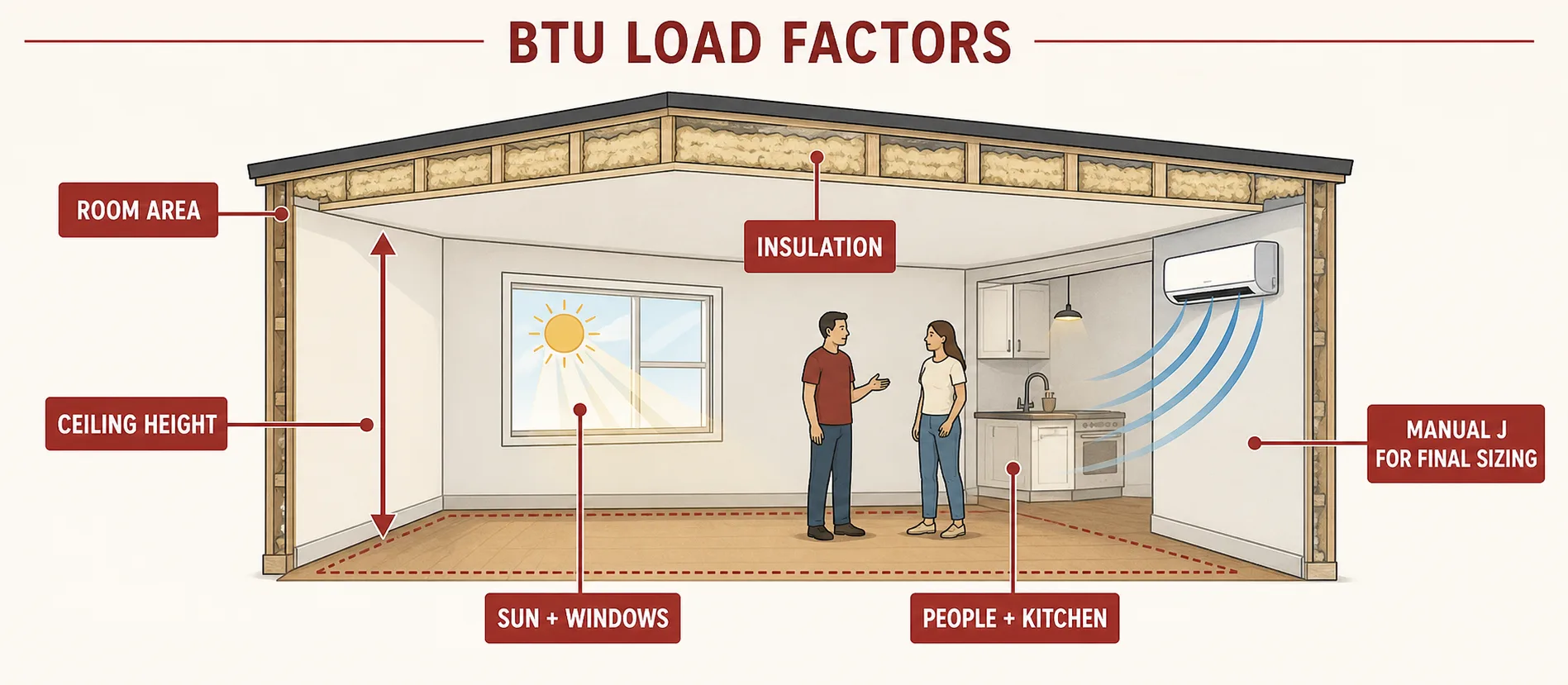
The eight things that move a room's BTU load
One sets the base, four multiply the running subtotal and three add a flat amount. That last distinction is the whole reason a small kitchen can out-load a big bedroom, and the right-hand column prices each one against the room you entered.
Floor area
20 BTU for every square foot of floor. This is the starting figure, never the finishing one.
on your room +3,600
Sun exposure
A multiplier from 0.90× in heavy shade to 1.10× in heavy sun. It stands in for orientation and shading, which a room-level estimate cannot see.
on your room 0
Ceiling height
Nothing at or below 8 ft, then 12% more for every 2 ft above it. You are cooling volume, not floor.
on your room 0
Insulation quality
1.30× for a poor envelope down to 0.80× for an excellent one. The widest single swing on the list.
on your room 0
Climate zone
1.20× in a hot zone down to 0.80× in a cold one, standing in for the outdoor design temperature.
on your room 0
Occupants
600 BTU for each person over two. Two are already inside the floor-area rate, which is why a couple adds nothing.
on your room 0
Windows
1,000 BTU each, flat. A count is a proxy for glass area, so two patio doors counted as two windows will be understated.
on your room +2,000
Cooking area
A flat 4,000 BTU when the room holds appliances. Range, oven and dishwasher heat all end up in the room air.
on your room 0
Latent margin
What size AC your BTU load actually buys
Room air conditioners are sold in twelve sizes, not in hundreds of BTU, so the load is only half the answer. The rung it lands on decides how long the unit runs, and run time is what pulls the humidity out.
A load of 5,600 BTU/hr lands on the 6,000 BTU rung. The two rungs either side of it are what a salesperson will offer you instead.
one rung down
5,000
BTU/hr rating
Short of the load by 600 BTU, so it runs flat out and never quite gets there on a design day.
the fit
6,000
BTU/hr rating
7% of headroom over the load. That is the rung this calculator recommends.
one rung up
8,000
BTU/hr rating
43% over the load. Reaches setpoint sooner, cycles shorter and leaves more moisture in the room.
Heating is a separate ladder. This room needs 1,400 BTU/hr of output, which lands on the 10,000 BTU rung, and that ladder runs in much coarser steps than the cooling one.
Small bedroom
12 × 10 ft
3,400 BTU · 1 window
5,000
Average bedroom
15 × 12 ft
5,600 BTU · 2 windows
6,000
Living room
20 × 15 ft
9,000 BTU · 3 windows
10,000
Master suite
20 × 20 ft
12,000 BTU · 4 windows
12,000
Open floor plan
30 × 20 ft
18,000 BTU · 6 windows
18,000
Average insulation, moderate sun, moderate climate, a ceiling at 8 ft and two occupants, with the window count shown. The amber rule is your own load, on the same axis.
Rule of thumb
BTU sizing questions that come up before you buy
Eight answers, starting with the rule of thumb everybody arrives with and why it is only ever the first line of the estimate.
How many BTU do I need per square foot?
About 20 BTU per square foot is a common cooling starting point for room air conditioners. Treat it as a rough screen, then adjust for sun, windows, ceiling height, insulation, and climate.
What size AC do I need for a 12x12 room?
A 12x12 room is 144 sq ft. With average conditions, a 5,000 to 6,000 BTU room AC is often in range, but sunny windows or a kitchen can push the load higher.
How do I convert BTU to tons?
Divide BTU by 12,000. For example, 24,000 BTU equals 2 tons. Central AC systems are rated in tons while window units use BTU.
Does ceiling height affect BTU requirements?
Yes. Every 2 feet above standard 8-foot ceilings adds roughly 12% to your cooling load. Rooms with 10-foot ceilings need 12% more BTU than identical 8-foot rooms.
Why does insulation matter for BTU sizing?
Insulation changes how quickly heat moves in or out of the room. A poor envelope carries a 1.30 multiplier and an excellent one 0.80, which is the widest single swing in this estimate.
Should I oversize my AC for extra cooling?
No. An oversized AC can cool the air quickly but shut off before it removes enough moisture. That can waste energy and leave the room uncomfortable.
How many BTU do I need for heating?
Heating BTU depends on climate zone, insulation, air leakage, and the temperature rise you need. Use this estimate for early planning, then confirm with a qualified HVAC pro.
What is the difference between cooling and heating BTU?
Cooling BTU measures heat removal. Heating BTU measures heat output. The same room usually needs different BTU values for each because heating fights larger temperature gaps in winter.
Exposure
BTU sizing checks worth making before you order a unit
Not a sequence, so not numbered. Each one is something worth settling while the purchase is still reversible.
This is a planning screen, not an equipment order. Sizing that goes on a purchase order should come from a room-by-room Manual J load calculation.
An oversized unit cools the air fast, satisfies the thermostat and shuts off before it has pulled much moisture out. In humid weather that is the difference between cool and clammy, and it is why the small unit that runs longer often feels better.
A window count is a stand-in for glass area. Six small casements and two patio doors both read as glass to this estimate, and the doors are the larger load by a wide margin.
Fix the ceiling before you buy the bigger box. If the room sits under an unfinished attic, our attic insulation calculator will usually cost less than the next rung up the equipment ladder.
Before you accept the poor setting, find out what is actually in the walls. Our insulation calculator turns a target R-value into a thickness you can check against what is there.
Seal the gap around a window unit cabinet. Outdoor air pulled around the outside of the case is load you have already paid to remove.
For one room, a ductless system modulates and runs at part load most of the day, which is why it holds humidity better than a window unit of the same rating. Our mini split calculator sizes and prices that route.
Cooling BTU and heating BTU are two different answers for the same room. Size each on its own and never average them, because winter fights a much larger temperature gap than summer does.
Once a space passes roughly 400 sq ft or opens into another room, a single-room estimate stops working. Move to a whole-house figure with our furnace size calculator.
Short cycling
BTU sizing errors that show up as clammy air and a high bill
Six of these, and five are decided before anybody looks at a model number. The first one is measured against your own room.
Sizing off floor area alone
On the room in the calculator above, floor area accounts for 64% of the gains. Glass, ceiling volume, sun and appliance heat are the rest, and they are the half that varies from house to house.
Rounding up to be safe
Going one rung up the equipment ladder is not a safety margin, it is a humidity problem. The unit reaches setpoint sooner, runs shorter cycles and removes less water, and it costs more to buy.
Counting windows and stopping there
A count says nothing about area, orientation or glazing. West glass in August is a different load from the same area facing north, and no room-level estimate can tell them apart.
Leaving the cooking area unticked
A range, an oven and a dishwasher dump 4,000 BTU of flat gain into the room. On a 144 sq ft kitchen that is more than the floor area contributes.
Reusing the cooling number for heat
Heating is driven by volume, air changes and the temperature rise you need, not by solar gain. The calculator returns both figures for the same room and they are rarely close.
Treating a garage like a room
An uninsulated slab, an uninsulated door and no conditioned neighbours put a garage outside what these factors describe. Use the poor setting, then add margin, then get a load done.
Derivation
How this BTU calculator builds the cooling and heating figures
Cooling walks one chain in a fixed order: a rate on floor area, four multipliers, then three flat gains. Heating ignores that chain entirely and works from air volume, air changes and the temperature rise your zone needs.
base = floor area × 20 BTU per sq ft× sun (0.90 to 1.10)× ceiling (1 + 12% per 2 ft over 8 ft)× insulation (0.80 to 1.30)× climate (0.80 to 1.20)+ 600 BTU per occupant over two+ 4,000 BTU for a cooking area+ 1,000 BTU per windowcooling = rounded to the nearest 100 BTUheating = volume × temp rise × insulation factor × air changes ÷ 60tons = cooling BTU ÷ 12,000watts = BTU × 0.293071monthly cost = BTU ÷ (SEER × 1,000) × 8 hr × 30 days × rateTwo things in that list deserve to be said plainly. The order of the multipliers matters to the attribution but not to the total, because multiplication commutes, which is why the stack at the top of this page can show a signed BTU figure for each one. And every factor is a stand-in: sun stands in for orientation and shading, a window count stands in for glass area, and insulation quality stands in for an assembly R-value. A Manual J load replaces all three with measurements, which is why it is the thing that goes on a purchase order and this is the thing that tells you whether the quote is plausible.
The model itself is imperial. Every metric figure on this page is converted out of it, so the 20 BTU per sq ft rate above is the coefficient the calculator actually applies.
Deliberately absent, because this page does not carry them: a glass area in square feet, an orientation, a shading coefficient, a duct loss, a latent-to-sensible split, and any local design temperature. Nothing here quotes one.
Disclaimer
These estimates are for planning purposes only. Actual costs vary by location, material availability, and project complexity. Always get at least 3 local quotes. This calculator does not replace professional advice.
Sources
Related Calculators
Furnace Size Calculator
Furnace BTU size by home & climate
CFM Calculator
Room airflow & ventilation sizing
Heat Pump Cost Calculator
Install and operating cost
Insulation Calculator
R-value requirements
Attic Insulation Calculator
Attic R-value sizing
Spray Foam Calculator
Spray foam material estimates
Insulation Cost Calculator
Insulation project budgets
Cellulose Insulation Calculator
Cellulose material estimates
Mini Split Calculator
Ductless AC sizing