Insulation Cost Calculator
Estimate insulation cost by location, material, labor, and target R-value.
Project Details
Installed insulation cost
$1,352
for 500 sq ft of exterior wall at R-20, which takes 7 in of fiberglass batts.
- Fiberglass Batts plus 10% waste
- $1,043
- Standard Installation
- $309
- Removal and vapor barrier, not added
- $0
- Energy saving, first year
- $34
- Installed, per sq ft
- $2.70
Over 25 years of service life that is $844 of energy saving against $1,352 spent. Rebates and credits are not netted off. Estimates only, not professional advice.
Last updated August 5, 2026 by our expert review team.
Cost per R
Insulation cost by material at your target R-value
Six materials on one axis. The bar is what a sq ft of material costs once it is thick enough to reach R-20, which is a different ranking from cost per sq ft off the shelf.
Fiberglass Batts
your material$1.52 · 7 in
$1,043
Cellulose Blown
R-3.5 per in$1.60 · 6 in
$1,100
Open Cell Spray Foam
R-3.7 per in$2.40 · 6 in
$1,650
Closed Cell Spray Foam
R-6.5 per in$2.00 · 4 in
$1,375
Rigid Foam Board
R-5.0 per in$1.20 · 4 in
$825
Mineral Wool
R-3.3 per in$1.98 · 7 in
$1,364
Material only, at the thickness each one needs for R-20. The right-hand column adds your 10% waste and the 1.25x access factor for exterior wall work, so the row for your material matches the material line in the results panel. Labor, removal and the vapor barrier sit on top of it.
- Cheapest material at this R
- Rigid Foam Board$1.20 per sq ft of material
- Cheapest that fits the bay
- Closed Cell Spray Foam$2.00 per sq ft, 3.1 in thick
- Thinnest route to this R
- 3.1 inClosed Cell Spray Foam at R-6.5 per in
- Access factor here
- 1.25xExterior Wall work against open attic work at 1.00x
Stud bay
Will R-20 insulation fit in the wall you have?
An attic has as much depth as you care to pay for. A wall does not: the bay is 3.5 in deep and that is the end of the argument. Cost per sq ft cannot tell you this, because the material that runs out of room is often the cheap one.
Depth runs top to bottom and is to scale. The bay is drawn narrow on purpose, so the width is not to scale and carries no dimension. The heavy line at the bottom is the sheathing or subfloor closing the bay.
Fiberglass Batts cannot reach R-20 in this bay. It stops at R-11.2, and the fill would be compressed rather than installed.
The verdict
R-20 does not fit in 3.5 in of fiberglass batts, which stops at R-11.2. Two ways out. Switch to a denser material in the same bay: Closed Cell Spray Foam reaches it. Or keep this fill and add 1.8 in of rigid board outside the framing, which is not capped by bay depth and covers the studs as well as the bays.
- Most R this bay holds
- R-11.23.5 in of fiberglass batts at R-3.2 per in
- Deepest R available in this bay
- R-22.8Closed Cell Spray Foam, the densest option on this page
- Rigid board outside the framing
- 1.8 inOn top of the bay fill, at R-5.0 per in
- Framing you told us about
- 2x4 wall bayChange it under advanced options. It moves this check, never the price.
Fiberglass Batts
R-3.2
R-11.2 in 3.5 in
6.3 in · over by 2.8 in
Cellulose Blown
R-3.5
R-12.3 in 3.5 in
5.7 in · over by 2.2 in
Open Cell Spray Foam
R-3.7
R-13.0 in 3.5 in
5.4 in · over by 1.9 in
Closed Cell Spray Foam
R-6.5
R-22.8 in 3.5 in
3.1 in · fits
Rigid Foam Board
R-5.0
R-17.5 in 3.5 in
4.0 in · over by 0.5 in
Mineral Wool
R-3.3
R-11.5 in 3.5 in
6.1 in · over by 2.6 in
Thickness is the target R-value divided by the material's R per in, taken from the same figures the estimate above prices. The estimate rounds that up to the next whole inch before pricing, because that is how the product is sold. Studs conduct heat around whatever is in the bay, so a wall never performs at the bay figure, and a continuous layer outside the framing is the part of the assembly that addresses it.
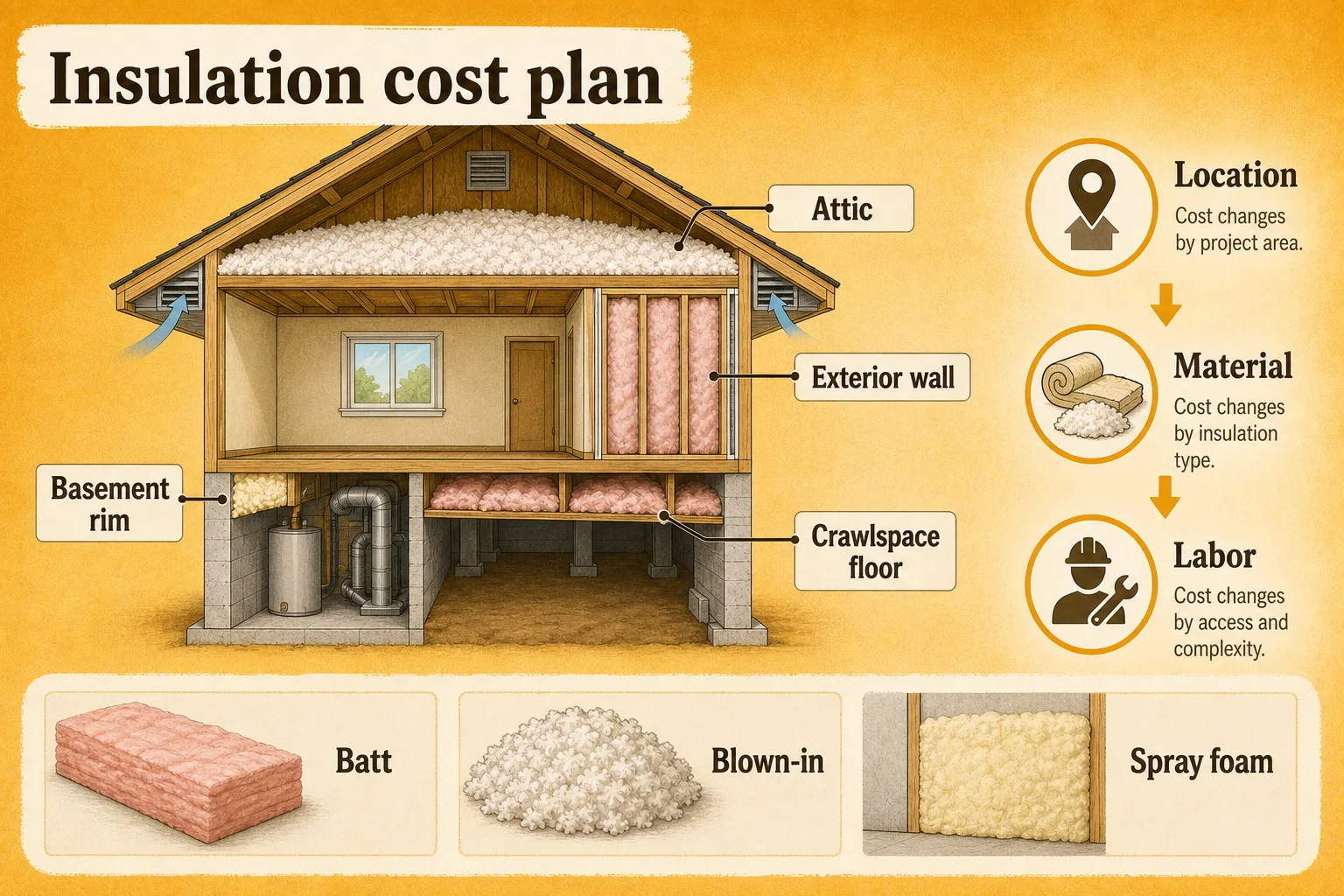
Four locations and three material families, with the access problem that sets the price in each. Read it as the reason one house needs three quotes rather than one.
Priced work
Insulation cost by project: three jobs priced out
Three real shapes of job, with the payback each one returned. Note that the wall job targets R-15 rather than R-20, which is the bay depth talking rather than the budget.
Exterior wall retrofit
$2,080
before rebates
- Saving
- $380/yr
- Payback
- 3.8 yr
800 sq ft of wall, R-0 to R-15, dense-pack cellulose, Zone 5
A 1960s ranch with empty 2x4 bays. R-15 is close to the ceiling for a blown fill in that depth, which is why the target stops there rather than at the R-20 a new wall would be built to.
Basement rim joist, DIY
$230
materials
- Saving
- $120/yr
- Payback
- 1.9 yr
120 linear ft, R-15, fiberglass batts plus canned foam at the edges
The cheapest real payback in the house. Seal the joist edges with foam first, then cut batts to the bay, because it is the air leak rather than the R that makes the floor above feel cold.
Whole home upgrade
$6,750
before rebates
- Saving
- $1,100/yr
- Payback
- 5.0 yr
2,200 sq ft, attic plus walls plus crawlspace, mixed materials
Quote the attic, the walls and the crawlspace as three separate lines. They have different depth limits, different access and different rebate categories, and a single blended number hides all three.
Before you buy
Insulation cost decisions worth making before you order
Not a sequence, so not numbered. Each one changes the number in the results panel by more than shopping around on price does.
Compare materials on cost per R-1, not on cost per sq ft. Fiberglass batts work out near $0.20 per R-1 of face area and mineral wool near $0.26, and the extra buys fire resistance and sound absorption rather than R.
Book an energy audit before you choose anything. A blower door test and thermal imaging run $200 to $400 and they tell you where the heat actually goes, which is often the attic hatch and the top plates rather than the walls. Size the heating side afterwards with our BTU calculator.
Federal 25C insulation credits ended for property placed in service after December 31, 2025. Utility and state rebates are separate programs with their own dates, so check those before you subtract anything from a budget.
On exterior walls, dense-pack cellulose and closed cell foam air seal and insulate in one pass, which is worth more than the R difference on paper. Price the foam route with our spray foam cost calculator before you rule it out.
DIY batt work in open framing is the one job on this page where the saving is reliable. Materials at $$0.65 to $$0.85 per sq ft against a standard installed price is a 50 to 60% cut, and the skill is cutting to fit rather than stuffing.
Bundle insulation with the other envelope work to reach the larger utility rebate tiers. The Energy Star seal and insulate guide lists which measures are usually bundled together.
Access
Why insulation cost changes with the part of the house
The same material at the same R-value costs different money in an attic, a wall and a crawlspace. Two things drive it: how much depth is available, and how hard the space is to work in.
Attic
R-49
1.00x
Loose fill goes over the top of the joists, so nothing caps the depth. Depth is not your constraint here, cost per R is.
Exterior Wallyour job
R-20
1.25x
Sheathing closes the back of every bay. Whatever will not fit between the studs has to go outside the framing or not go on at all.
Interior Wall
R-13
0.90x
Drywall on both faces, so the bay is the whole budget. Interior walls are usually insulated for sound rather than for an R-value target.
Floor/Crawlspace
R-25
1.15x
Joist bays are deeper than stud bays, which is why a floor takes an R-value a wall cannot. The subfloor is still a hard stop.
Basement
R-15
1.20x
Board usually goes on the face of the masonry rather than inside a bay, so the limit is how far into the room you are willing to build, not the framing.
The cost factor multiplies both material and labor in the estimate, with open attic work as the 1.00x baseline. Targets are the calculator's starting points for each location, not a code requirement: the right R-value depends on your climate zone.
Depth first, then price
An attic is the cheapest R in the house because nothing limits how deep the fill can be, so the lowest cost per R wins outright and the answer is usually a blown material. A wall is the opposite problem. The bay is fixed, so the question becomes how much R you can buy into 3.5 in, and the cheap materials are the first to run out of room. That is the whole reason closed cell foam earns its price on a wall retrofit and wastes your money in an attic.
Floors and crawlspaces sit in between. Joist bays are deeper than stud bays, so depth is rarely the binding constraint, but working overhead in a crawlspace is slow and that shows up in the labor line rather than the material line. Basements are their own case, because the insulation usually goes on the face of the masonry rather than inside a framed bay, which means the limit is how far into the room you are willing to build.
Whichever you are pricing, air sealing comes first. Insulation slows heat moving through a material; it does nothing about air moving around it. Sizing the heating and cooling side afterwards with our BTU calculator is how you find out whether the envelope work bought you a smaller system too.
Estimating desk
Insulation cost questions that come up before the quote
Ten answers, starting with the one the section above exists to settle.
Can a 2x4 wall hold R-20 insulation?
Not with fiberglass, cellulose or mineral wool. A 2x4 bay is 3.5 in deep, and at R-3.2 per inch fiberglass tops out around R-11 in that space however hard you push it. Closed cell spray foam at R-6.5 per inch is the only material on this page that reaches R-20 inside a 2x4 bay. The other route is a cheaper fill in the bay plus rigid board outside the framing.
How much does home insulation cost by type?
Fiberglass batts run $1.10 to $1.50 per sq ft installed, cellulose $1.45 to $2.00, open cell foam $2.15 to $3.00 and closed cell foam $2.75 to $4.50. Those ranges include materials and labor, which is why they sit well above the material rates in the chart on this page.
What is the cheapest insulation per R-value?
Fiberglass batts, at roughly $0.20 of material per R-1 of face area, with cellulose just behind. That ranking only holds where you have the depth to spend, which is why an attic and a 2x4 wall reach different answers. Compare quantities with our insulation calculator.
Does exterior foam board change what a wall can hold?
Yes, and it is the usual answer when the bay runs out. Rigid board at R-5 per inch goes over the studs rather than between them, so bay depth does not cap it and it covers the framing as well as the cavities. It also moves your window trim, siding and flashing details, so it belongs in a re-side plan rather than an insulation-only one.
Is professional install worth it over DIY?
DIY saves 40 to 60% on batt work in open framing. Spray foam and dense-pack are different jobs: both need equipment to hit the right density, and a poor install loses 20 to 40% of the rated R-value in voids and compressed spots.
What tax credits are available for insulation?
The federal 25C insulation credit ended for property placed in service after December 31, 2025. State, local and utility programs run on their own schedules, so treat any incentive as a separate line you confirm rather than money already in the estimate.
How do I calculate insulation ROI?
Divide the project cost by the estimated annual energy saving. Keep credits and rebates out of that first number until you have confirmed you qualify, then run it again with them in.
Should I insulate walls or attic first?
The attic, in almost every case. It is cheap per R because nothing limits the depth, and an uninsulated attic loses 25 to 30% of a home's heat. Budget that side with our attic insulation cost calculator, then come back for the walls.
How much can I save on energy bills?
Insulation and air sealing together cut heating and cooling costs 15 to 25%. On a home spending $2,000 a year that is $300 to $500, which is the number the payback line in the results panel is built on.
Does insulation cost more in an older house?
Usually 20 to 40% more. Non-standard framing, balloon framing, knob-and-tube wiring and no sheathing access all slow the work down, and dense-pack cellulose is often the only material that can be installed without opening the walls.
The arithmetic
How this insulation cost calculator prices a job
Area plus waste, times a material rate scaled to the thickness your target R-value needs, times an access factor for where the work is. Labor and the two adders are separate lines on top.
thickness = ceil(target R ÷ R per inch)area = entered area × (1 + waste)material = area × rate × (thickness ÷ 3) × accesslabor = area × labor rate × install × accessadders = area × (0.85 removal + 0.25 barrier)total = material + labor + adderspayback = total ÷ annual savingMaterial rates are quoted at 3 in of thickness, so the estimate scales them linearly by the thickness your R-value actually needs, and it rounds that thickness up to a whole inch because that is how the product is sold. The saving model assumes the assembly was around R-5 before you started, which is a bare or badly degraded assembly, and it prices the improvement rather than the absolute heat loss. Rebates and tax credits are never netted off, because eligibility moves by date and by state.
Not included: air sealing, ventilation baffles, framing changes, drywall repair, electrical work, permits, disposal beyond the removal line, and any exterior board the fit check above suggests.
After the drywall
Insulation cost mistakes you only find out about later
Every one of these is decided while you are still choosing a material. None of them is cheap to fix once the wall is closed up.
Buying an R-value the bay cannot hold
A 3.5 in bay stops at R-11 with fiberglass no matter what the packaging says. Check the fit before you price the job, then either change material or plan a continuous layer outside the framing.
Compressing a thicker batt into a shallower bay
Compression costs R roughly in proportion to the squeeze, and it leaves gaps at the edges where the batt bunches. Cut to the bay, or buy the batt made for it.
Comparing materials per square foot instead of per R
Batts at $0.65 per sq ft deliver R-3.2 per inch. Rigid board at $0.90 delivers R-5.0, so it needs 36% less thickness for the same R. Price to your target, not per unit of area.
Skipping the energy audit
A $200 to $400 audit with a blower door and a thermal camera finds the leaks that bypass insulation entirely. Plenty of houses turn out to need air sealing more than they need R.
Counting rebates before checking eligibility
Federal, state and utility programs all move. Treat every incentive as a follow-up item rather than as money already in the base payback figure.
Getting the vapor retarder on the wrong face
Cold climates want the retarder on the warm side of the assembly. Hot humid climates should not have an interior one at all. A retarder in the wrong place traps moisture in the sheathing.
Under-budgeting removal
Removal runs $0.85 to $2.00 per sq ft, and water damage, rodent contamination or suspected asbestos all push it higher. Decide before the quotes come in, not after.
Disclaimer
These estimates are for planning purposes only. Actual costs vary by location, material availability, and project complexity. Always get at least 3 local quotes. This calculator does not replace professional advice.
Sources