Cellulose Insulation Calculator
Estimate cellulose bags for a loose-fill attic or a dense-pack wall, with the settled depth.
Cavity and target
What is already up there. The panel orders for the difference, not the target.
Estimates only. Not professional advice.
Bags of cellulose to buy
39
Loose-fill over 1,000 sq ft of attic floor to add R-30, with the 5% cushion already in the count.
- Area covered
- 1,000 sq ft
- Material on the truck
- 975 lbs
- Weight of fibre per sq ft
- 0.91 lb/sq ft
- Estimated material cost
- $702
Bare material at your bag price. Coverage charts differ by brand, so check the chart on the bags you actually buy.
Last updated August 11, 2026. Checked against the federal loose-fill labeling rule and the CIMA density guidance by our expert review team.
Pounds per cubic foot
Blown depth against settled depth in a cellulose cavity
A cellulose bag sells you a weight, not a depth. The label prints the depth to blow to and the shallower depth you will actually keep, and because the weight between them never changes, the fibre has to get denser as it drops. A wall dodges the whole problem by starting above that density, which is what dense-pack means.
Both halves of the bay hold the same weight of fibre and the hatch pitch is set from the density, so each half draws the same number of lines. Only the bay is shown, so the two states can sit side by side; a layer this deep also runs over the joists in a real attic.
What the section assumes
16 CFR 460.12 · ASTM C739
- Framing drawn
- 2x8 at 16 in o.c.
- Bag weight
- 25 lb
- Cellulose R-value
- R-3.7 per in
- Settling drawn
- 9%
Stop the hose at 8.1 in because that is the number you want to end with, and the ceiling settles again from there to finish at R-27.3 instead of R-30.
Loose or packed
Loose-fill cellulose in an attic against dense-pack cellulose in a wall
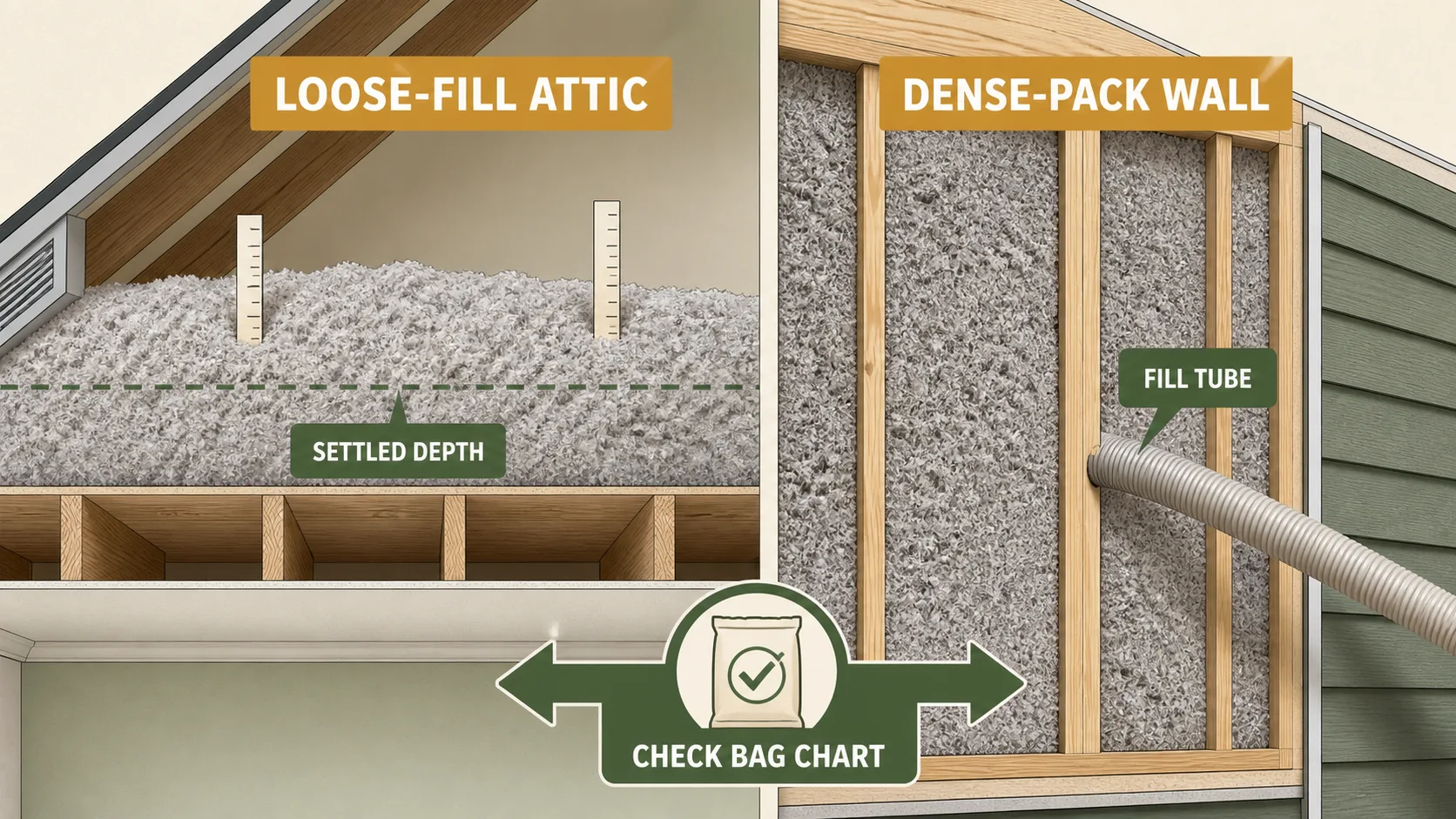
These are not two settings of one calculation. An open attic floor is ordered off a coverage chart and finished to a depth. A closed wall cavity is ordered off volume and finished to a density, and getting the two the wrong way round is the single most expensive mistake on this page.
Loose-fill attic floor
Open framing, nothing holding the material in. Order from the bag coverage chart at the R-value you still need, blow to the installed depth on that chart, and expect the layer to drop to the settled figure over the first year or two. Depth rulers are the record.
Dense-pack wall cavity
Closed framing, fed through a tube from a hole in the sheathing or the drywall. Order from cavity volume times a density near 3.5 lb/ft³. The installer works the tube backwards out of the bay until the machine stalls against the pack.
Dense-pack sloped ceiling
The same tube work as a wall, but with a ventilation gap that has to survive it. Cathedral bays are packed against a baffle, and the depth you can count on is the rafter depth minus that gap, not the full rafter.
Wet-spray new construction
Damp fibre sprayed into open bays before the drywall goes on, then scrubbed flush. Priced like dense-pack rather than like an attic, and it needs the wall left open long enough to dry, so it is a contractor sequence rather than a weekend one.
Slump and voids
Cellulose mistakes that only show up after the hose is packed away
None of these cost anything at the till. Every one of them is sealed under a foot of fibre or behind a wall by the time the first cold night finds it.
Stopping the hose at the settled depth
The chart prints two depths and the smaller one is where you finish, not where you stop. Blow to the settled number and it settles again from there, so the ceiling ends up short of the target by roughly the settling fraction.
Staple depth rulers to the joists before the blower starts and fill to the blow line printed for your R-value. The rulers are the only way to check it a year later.
Blowing a wall cavity at attic density
Loose-fill poured into a closed cavity has nowhere to go but down. It slumps over the first winter and leaves an uninsulated strip along the top plate, which is the coldest part of the wall.
Walls get packed, not poured. Around 3.5 lb/ft³ is above the density the fibre would settle to on its own, so it cannot slump. That needs a tube and real machine pressure.
Ordering for the target instead of the shortfall
An attic already reading R-19 that wants R-49 needs R-30 of new cellulose. Ordering for R-49 buys half again too much, buries the baffles and the hatch detail, and still costs the same to blow.
Push a ruler into the existing layer in several spots, average it, and enter what is missing. The bag count moves further on that one number than on anything else in the panel.
Filling the eaves solid
Cellulose blown into the soffit closes the intake vents. The attic stops breathing, the deck holds moisture, and the top of the layer takes on water it was never meant to carry.
Baffles at every rafter bay first, then a dam around the hatch and any chimney or flue. Both are half an hour of work and neither can be done once the floor is covered.
Blowing over a wet or matted layer
Cellulose holds water and gives it back slowly. Covering a damp layer traps it against the ceiling, and a matted layer underneath has already lost most of the R-value you are counting on.
Fix the roof leak and the bath fan discharge, pull anything soaked, and let the bay dry before a bag is opened. Existing R-value is worth nothing if the material is wet.
Treating cellulose as the air seal
Dense-pack slows air through a cavity, but a loose attic layer does not close a top-plate gap or an open chase. Air moving through the layer carries heat past it whatever the depth says.
Caulk and foam the ceiling penetrations while you can still see them. Every leak you can reach is cheaper to close now than to find again through 14 in of fibre.
Comparing cellulose against the other loose-fill materials before you order? The blown-in insulation calculator runs fiberglass and rock wool through the same depth arithmetic.
Four orders
Cellulose insulation bag counts for four jobs, worked out
All four run through the same arithmetic as the panel above, at 25 lb bags, $18 a bag and the same 5% cushion, so you can set your own ceiling beside them.
Attic top-off
46 bags
$828 · 8.9 in
1,200 sq ft · R-19 already up there, R-49 wanted · settles to 8.1 in
The commonest cellulose job there is. The shortfall is R-30, not the R-49 on the label, and the layer ends up deep enough to bury the joists so the depth rulers have to go in first.
Bare ceiling
48 bags
$864 · 11.2 in
900 sq ft · Nothing in the bays, R-38 wanted · settles to 10.3 in
A smaller ceiling that still takes more bags than the one above it, because coverage per bag falls away as the depth climbs. Doubling the R-value more than doubles the order.
Cold-zone attic
62 bags
$1,116 · 8.9 in
1,600 sq ft · R-30 already there, R-60 wanted · settles to 8.1 in
Same shortfall as the first job over a larger floor, so the bag count scales straight with the area. This is the one where a rented blower beats carrying bags up a ladder.
Dense-pack wall
46 bags
$828 · 3.5 in
1,050 sq ft · 2x4 retrofit, packed at 3.5 lb/ft³ · R-13 in the bay
Priced from cavity volume rather than a coverage chart, because a wall is filled to a density and not to a depth. Almost always an installer job: the tube and the pressure are the skill.
Bags per thousand
Cellulose coverage by R-value: bags, blow depth and settled depth
This is the chart printed on the side of the bag, and the federal labeling rule sets the columns: an installed thickness, a settled thickness, the bags it takes and the minimum weight of fibre that has to end up on each square foot.
Depths in in, at 25 lb bags. Every row loses between 6 and 10% of its blown depth on the way to the settled figure, and the weight column does not move while that happens.
R-13 to R-60
Ordering cellulose
What people ask before ordering cellulose insulation
Eight answers, opening with the one that costs the most R-value when it is guessed: why the bag prints two depths and which of them you are supposed to hit.
Why does a cellulose bag list two different depths?
Federal labeling rules make a loose-fill bag print both an initial installed thickness and a minimum settled thickness for each R-value. The weight per square foot is the same either way, so the depth shrinks and the density climbs. Blow to the installed figure and finish at the settled one.
How much does loose-fill cellulose settle?
Manufacturer coverage charts build in roughly 8 to 10% between the blow line and the settled depth, and field figures of 15 to 20% are quoted for material blown loose or fluffed by hand. Dense-pack settles under 5% because it is already packed past the point where it can slump.
What density should dense-pack cellulose be blown at?
About 3.5 pounds per cubic foot, or roughly 56 kg per cubic metre. That is deliberately above the density loose fibre would settle to on its own, which is what stops a closed wall cavity slumping and opening a gap along the top plate.
Can I pour loose-fill cellulose into a wall cavity?
No. Loose fibre in a closed cavity settles and leaves an uninsulated strip at the top of the wall. Retrofit walls need dense-pack through a fill tube at machine pressure, which is why wall work is usually installed rather than done from a rental blower.
Do I enter the R-value I want or the R-value I still need?
Enter both. The panel subtracts the existing R-value from the target and orders for the difference. An attic reading R-19 that wants R-49 is an R-30 job, and ordering for the full R-49 buys about half again too much material.
Can I blow cellulose over existing fiberglass batts?
Yes, if the batts are dry and not matted. Cellulose fills the gaps around wiring and framing that cost a batt layer a good part of its rated value. Do not add a second vapor retarder between the layers, and air seal the ceiling first.
Is cellulose safe around recessed lights and chimneys?
Only with clearance. Build a dam or a metal shield to keep material off any recessed light that is not rated IC, and off masonry chimneys and metal flues. Borate treatment gives cellulose a Class I fire rating but it does not remove the clearance requirement.
How is cellulose different from spray foam?
Cellulose is a recycled fibre sold by the bag and installed to a depth or a density. Foam is sold by the board foot and installed to a thickness, and it air seals as it cures. Price the foam route with the spray foam calculator.
Hose and hopper
Blowing cellulose insulation: hopper, hose and depth rulers
The order is the easy half. What decides whether the ceiling reads the R-value you paid for is a handful of things that all have to happen before the machine starts.
Depth rulers first. Staple a marked card to a joist in each corner and one in the middle before the hopper is loaded, so you can read the blow line from the hatch instead of guessing at it through a dust cloud.
Rent the machine with the bags. Most yards lend the blower free against a bag count, and the free machine is usually the small one, so ask what it does per hour before you plan the day around it.
Two people, always. One feeds the hopper and one runs the hose, and the one in the attic works backwards from the far gable to the hatch so nothing is walked on after it is placed.
Baffles and a hatch dam go in before the hose does. Loose fibre against a soffit vent closes the intake, and the same job on a top-up is covered in our attic insulation calculator.
Open the bags into the hopper whole and let the machine break them up. Hand-fluffing gives an inconsistent feed, and feed rate is what sets the density coming out of the hose.
Pricing cellulose against foam before you commit? The board-foot arithmetic is completely different, and our spray foam calculator runs it. For a straight material comparison use the insulation calculator.
The arithmetic
Where each cellulose figure on this page comes from
Two separate calculations sit behind the panel, and they share almost nothing. The attic one works a coverage chart backwards from an R-value. The wall one works a volume forwards from a density.
For an attic, the shortfall is the target minus what is already up there. That shortfall is looked up in the coverage chart, interpolated between the printed R-values, and turned into bags per thousand square feet and an installed depth. The settled depth is the shortfall divided by R-3.7 per inch, which is why it always lands below the blow line. For a wall, area times cavity depth gives the volume, and volume times density divided by bag weight gives the bags. The density figures in the ledger above are derived from those same numbers and feed nothing back into them.
added R = target R − existing Rbags = area ÷ 1,000 × chart bags × (1 + cushion)settled depth = added R ÷ 3.7wall bags = area × depth ÷ 12 × density ÷ bag weightweight per sq ft = chart bags × bag weight ÷ 1,000density = weight per sq ft ÷ (depth ÷ 12)- Cellulose R-value
- R-3.7 per in
- Chart R-values
- 13, 19, 22, 30, 38, 44, 49, 60
- Default bag weight
- 25 lb
- Default cushion
- 5%
- Dense-pack target
- 3.5 lb/ft³
- Loose-fill attic range
- 1.0 to 1.6 lb/ft³
The cost figure is bare material at the bag price you entered. Machine rental, delivery, baffles, hatch dams, air sealing and labour are not in it, and dense-pack wall work is normally quoted installed rather than as bags. Coverage charts differ by brand and by bag size, so treat this as the planning number and check the chart on the bags you buy.
Disclaimer
These estimates are for planning purposes only. Actual costs vary by location, material availability, and project complexity. Always get at least 3 local quotes. This calculator does not replace professional advice.
Sources
- 01FTC R-Value Rule, loose-fill label charts (16 CFR 460.12)law.cornell.edu
- 02CPSC Cellulose Insulation Standard (16 CFR Part 1209)ecfr.gov
- 03ASTM C739, Loose-Fill Cellulosic Thermal Insulationastm.org
- 04ENERGY STAR Recommended Home Insulation R-Valuesenergystar.gov
- 05CIMA: Cellulose for Homeownerscellulose.org
- 06Greenfiber SANCTUARY coverage chartgreenfiber.com