Attic Insulation Calculator
Estimate loose-fill bags and added depth to bring an attic up to its climate zone R-value.
Attic top-up
What is already on the ceiling. The panel orders for the difference, not the target.
Estimates only. Not professional advice.
Bags to order
27
Blown fiberglass over 1,200 sq ft of attic floor, adding R-41 to the R-19 already there, with the 5% cushion in the count.
- Attic floor area
- 1,200 sq ft
- Coverage rate used
- 20.7 bags per 1,000 sq ft
- Price per bag
- $64
- Estimated material cost
- $1,728
Bare material at your bag price. Coverage charts differ by brand, so the chart on the bags you actually buy is the final check on both the count and the depth.
Last updated August 12, 2026. Checked against the ENERGY STAR zone targets and the two manufacturer coverage charts by our expert review team.
Joist tops
Thermal bridging: when attic insulation stops at the joist tops
Fill an attic level with the framing and about a tenth of the ceiling is bare wood running from the warm side to the cold one. The section below is drawn from your own numbers at one scale on both axes, across a real joist field rather than a single bay, so you can see whether the finished layer buries the framing or stops on top of it.
Three bays of a flat ceiling, drawn at one scale across and up. Depths here come from R-2.8 per in, so they read a little differently from the coverage-chart figure in the panel above.
What the section assumes
Owens Corning AttiCat label
- Framing drawn
- 2×10 at 16 in o.c.
- Share of ceiling that is wood
- 9.4%
- Through the joist
- R-12
- Through the fill beside it
- R-26
An unbroken blanket. The fill clears your 2×10 joists by 12.2 in, so the framing is no longer a path of its own and the rated depth is what the whole ceiling gets.
Bill and payback
Attic insulation payback: what the top-up gives back each year
An attic is worth roughly a quarter of what a house spends heating and cooling itself, and a top-up recovers the share of that quarter you are currently missing. The bars read your own attic and R-values from the panel. Your yearly bill sits in its ordering options, because it moves the payback and nothing else.
Saved each year
$308
Going from R-19 to R-60 closes 68% of what the attic is still losing.
- Installed cost estimate
- $2,040
- Saved over 10 years
- $3,080
- Net at 10 years
- $1,040
- Pays for itself in
- 7 years
Ten years of savings at each zone target
From R-19
The attic is treated as 25% of the conditioning load and the saving scales with the R-value jump, so it is an order of magnitude rather than a quote. Installed cost is carried at $1.70 per sq ft, which is a blown-in job with labour in it and sits above the bare material figure in the panel. Fuel prices, air leakage and duct losses all move the real answer.
Buried and forgotten
Attic insulation mistakes that get sealed under a foot of fill
None of these cost anything at the till. Every one of them is under the new layer by the time the hatch closes, and the next person to see it is whoever pulls it out.
Ordering for the target instead of the shortfall
An attic already reading R-19 that wants R-60 needs R-41 of new material, not R-60. Order for the full target and you buy about half again too much, bury the baffles and the hatch detail, and still pay the same to get it up the ladder.
Push a ruler into the existing layer in five or six places, average it, and enter that. Nothing else in the panel moves the bag count as far as this one number.
Filling level with the joist tops
Stop at the top of the framing and roughly a tenth of the ceiling is bare wood running straight from the warm side to the cold side. The rated depth is there in the bays and the ceiling still loses heat in stripes you can see on a frosted roof.
Keep going until the fill covers the joists by a few inches. The section above shows the cover for your own joist size, and the last few inches are the cheapest R-value on the job.
Blowing before the ceiling plane is sealed
Air moving through a loose layer carries heat past it whatever the depth says, and every bypass you can reach today is under a foot of fibre tomorrow. Top plates, chases, wiring holes and the hatch are all open until the hose starts.
Caulk and foam the penetrations first, weatherstrip the hatch, and box any chase before a bag is opened. It is the half day that decides whether the depth is worth what it cost.
Packing the eaves solid
Loose fill drifts down the slope and closes the soffit intake. The attic stops breathing, the underside of the deck holds moisture through the winter, and the outer edge of the new layer takes on water it was never meant to carry.
A baffle in every rafter bay before the blower runs, stapled high enough to clear the finished depth. They cost a few dollars each and they cannot be fitted once the floor is covered.
Burying a fixture or a flue that has to stay clear
A recessed light that is not IC rated, a bath fan housing, a masonry chimney or a metal flue all need air around them. Fill packed against any of those is a fire risk that nobody can see afterwards.
Build a rigid dam with a clear gap around each one and mark it before you start blowing. Replacing an old can light with an IC rated unit is usually cheaper than building a dam around it.
Covering wet, matted or contaminated fill
Insulation only works dry and lofted. Adding depth over a soaked layer traps the water against the ceiling board, and a matted layer has already lost most of the R-value you entered as existing.
Fix the roof leak and the bath fan duct first, pull anything soaked or rodent fouled, and let the bay dry. If it is vermiculite, stop and get it assessed rather than disturbing it.
Sealing the ceiling plane is the half day that decides whether the depth is worth what it cost. Pricing that work with labour in it is what the attic insulation cost calculator is for.
Zone targets
Attic insulation R-value targets by climate zone, and what each one costs in bags
ENERGY STAR sets a different retrofit target depending on whether the attic is bare or already holds three to four inches, which is the difference between insulating a ceiling and topping one up. Below that, what each target costs in depth and in bags.
Retrofit guidance, not code. The 2021 IECC is stricter in places and local amendments are stricter again, so check what your building department has adopted before a permit job.
ENERGY STAR
Depths in inches, at the installed figure rather than the settled one. Cellulose reaches the same R-value in less depth and takes more bags to do it, which is the trade between a lighter ceiling and a cheaper one.
R-13 to R-60
Before the first bag
Attic insulation questions asked before the first bag is opened
Eight answers, opening with the two that decide whether the order is right: what you can leave in place, and what your climate zone is actually asking for.
Can I add new attic insulation over the old layer?
Usually yes. The existing layer has to be dry, free of mould and rodent contamination, and not vermiculite. Blow the new material straight over it and do not compress it, because a compressed layer loses part of the R-value you are already counting on.
What R-value does my attic need?
ENERGY STAR puts a bare attic at R-30 in zone 1, R-49 in zones 2 and 3, and R-60 in zones 4 to 8. An attic that already holds 3 to 4 inches of fill is given a lower retrofit target, from R-25 in zone 1 up to R-49 in the cold zones.
Why does the calculator ask what is already up there?
R-values add. A top-up only supplies the difference between the target and the layer on the ceiling, so an attic reading R-19 that wants R-60 is an R-41 job. Ordering for the full R-60 buys about half again too much material.
How deep does R-49 attic insulation have to be?
About 17 inches of blown fiberglass or about 14 inches of loose-fill cellulose, measured once the material has settled. Cellulose reaches the same R-value in less depth because it is denser, which also means more weight sitting on the ceiling.
Should attic insulation cover the ceiling joists?
Yes. At 16 inches on centre the joists are about 9 percent of the ceiling area, and a 2x10 is worth roughly R-12 through its depth against R-26 for the same thickness of fiberglass beside it. Fill level with the joist tops leaves that wood as a heat path.
Do I still need to read the bag label?
Yes. Loose-fill labels are set by federal rule and print the minimum bags per 1,000 square feet, the minimum installed depth and the settled depth for each R-value. Coverage differs by brand, so the label on the bags in your cart is the final word on the order.
Can attic insulation block the soffit vents?
It should never touch them. Loose fill drifts into the eave and closes the intake, the attic stops breathing, and the roof deck holds moisture. Fit a baffle in every rafter bay and dam the hatch before any material goes down.
What if my attic has vermiculite insulation?
Do not disturb it. The EPA advises treating vermiculite as though it contains asbestos and getting a professional assessment before any work in the attic, including adding a new layer over the top.
Ladder and lights
Attic insulation tips worth the trip up the ladder
An attic is a bad place to discover you forgot something. Everything below is the sort of thing you can only do before the floor is covered, or before you are on your knees in the dark at the far gable.
Light it before you climb it
Two clamp lights at opposite gables beat a head torch, because the thing you need to see is the joist you are about to step between. Lay a couple of planks across the framing as you go and never put weight on the ceiling board.
Staple depth rulers first
Marked cards on a joist in each corner and one in the middle let you read the finished depth from the hatch instead of guessing through a dust cloud, and they are still readable in five years when somebody asks what is up there.
Work backwards to the hatch
Start at the far gable and blow towards the opening so nothing is walked on after it is placed. Loose fill that has been knelt on is compressed fill, and compressed fill is worth less than the depth suggests.
Let the label have the last word
This page plans the order. The bag in your cart carries the coverage chart that legally governs it: minimum bags per 1,000 sq ft, minimum installed depth and settled depth at each R-value. Check that chart before you leave the yard.
Two people, one machine
One feeds the hopper on the ground, one runs the hose in the attic, and the rental blower usually comes free against a bag count. Ask what the machine does per hour before you plan the day around it.
Know which calculator you actually need
Topping up an existing attic floor is what this page does. If you are pricing loose fill by material rather than by attic, the blown-in insulation calculator compares them, and the attic insulation cost calculator builds the fuller budget with labour in it.
Bag maths
The arithmetic behind your attic insulation bag count
The panel never works from a rule of thumb. It reads the manufacturer coverage chart for the material you picked, interpolates between the printed R-values, and rounds the order up so nobody drives back to the yard with two joist bays left bare.
Length times width gives the insulated ceiling area, which is the flat you can stand over and not the roof slope above it. The target R-value minus what is already on the ceiling gives the shortfall, and that shortfall is what gets looked up. The chart returns bags per thousand square feet and an installed depth for that exact R-value. Bags are scaled to your area, multiplied by the cushion and rounded up to a whole bag. Cost is bags times the price you entered. The joist size and the household bill in the options panel feed the two tools further up the page and never touch this.
- Blown fiberglass coverage
- Owens Corning AttiCat label
- Cellulose coverage
- Greenfiber SANCTUARY attic chart
- Fiberglass R-value used to draw depth
- R-2.8 per in
- Cellulose R-value used to draw depth
- R-3.5 per in
- Chart R-values
- 13, 19, 22, 26, 30, 38, 44, 49, 60
- Default cushion
- 5%
- Attic share of conditioning load
- 25%
- Installed cost used for payback
- $1.70 per sq ft
The cost figure is bare material at the bag price you entered. Blower rental, baffles, hatch dams, air sealing, dam building around flues and labour are all outside it. Coverage charts differ by brand and by bag size, so treat this as the planning number and check the chart on the bags you buy.
Three houses
Attic insulation on a ranch, a cape and a two-storey, priced out
All three run through the same coverage charts as the panel above, at the same 5% cushion and the same default bag prices, so you can set your own ceiling beside them.
1960s ranch, zone 5
116 bags
$2,088 · 14.3 in added
1,600 sq ft · R-11 to R-60, an R-49 top-up in loose-fill cellulose
One flat ceiling, 2x6 joists, three inches of tired batt
The biggest single-floor ceiling of the three and the thinnest starting layer, so it takes the most material by a wide margin. The 2x6 joists disappear early, which is the good case: everything above the fifth inch is unbroken blanket.
Cape with knee walls, zone 4
20 bags
$1,280 · 14.5 in added
900 sq ft · R-19 to R-60, an R-41 top-up in blown fiberglass
Only the flat above the second floor is loose-fill
The sloped sections and the knee walls are a different assembly and are not in this number. Measure the flat you can actually stand over, or the order comes back half again too large.
1970s two-storey, zone 3
11 bags
$704 · 7.0 in added
1,100 sq ft · R-30 to R-49, an R-19 top-up in blown fiberglass
R-30 already in place, zone target R-49
The smallest shortfall on the list and the cheapest job by some way, because you are buying the difference and not the target. It is also the one where air sealing is worth more than the extra depth.
Ceiling plane
The attic floor as one assembly: ceiling plane, insulation and the vent path
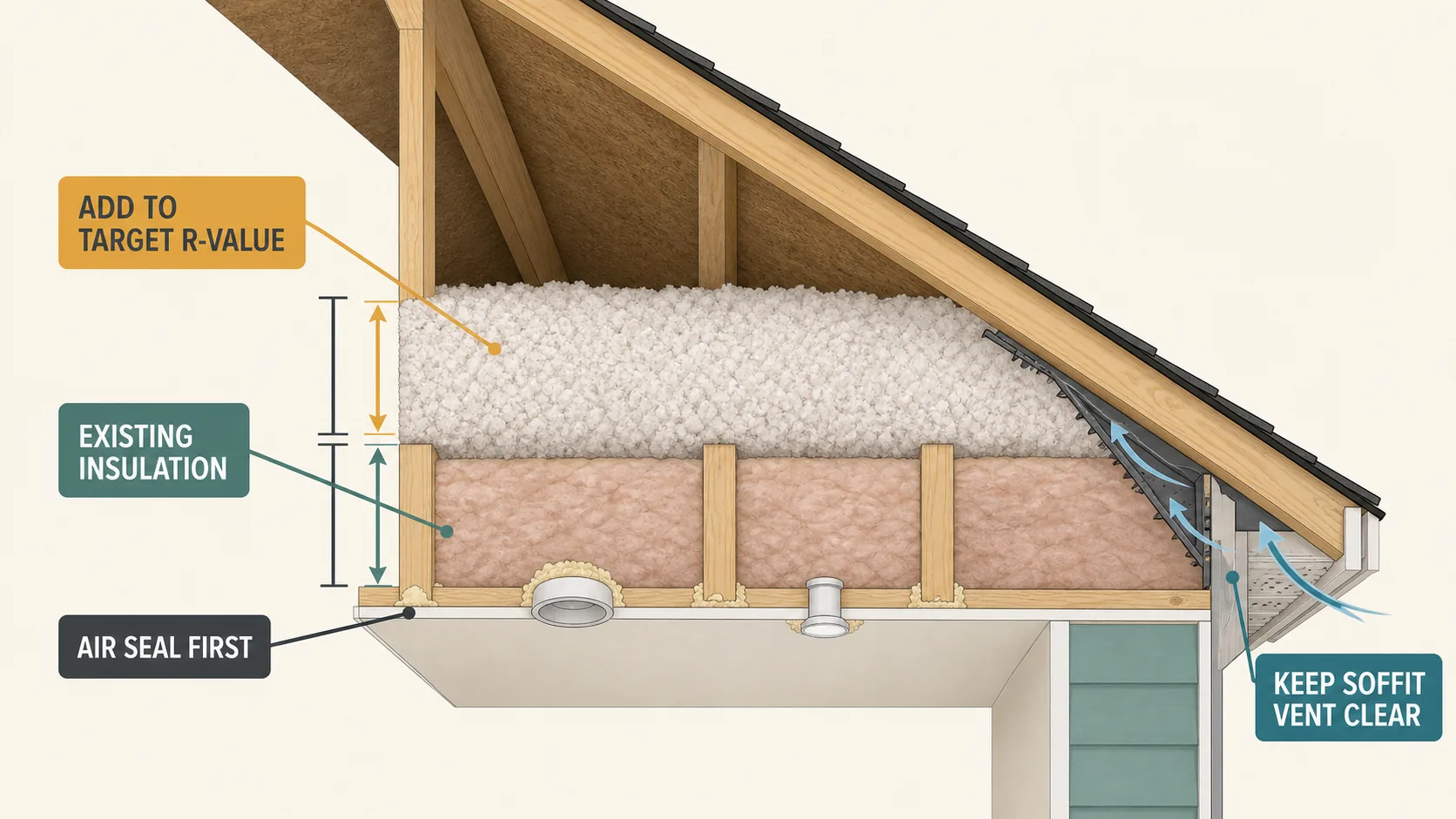
A bag count is one layer of a job with six of them. Read from the drywall upwards and the order of work falls out on its own, because each layer is only reachable until the one above it goes on.
The ceiling plane
Painted drywall is the air barrier, and it only works where it is continuous. Every hole a trade cut through it is a path for warm damp air into the attic, and sealing those is a separate job from insulating them.
The layer already there
Whatever is between the joists counts towards the target, provided it is dry and lofted. Measure it in several places rather than one, because old batt and old blown fill rarely lie at an even depth.
The new loose fill
Goes straight over the top with nothing between the layers. No second vapour retarder, no attempt to level it into the bays only. Depth is the only thing being bought here.
The cover over the framing
The inches above the joist tops are the ones that remove the wood as a heat path. They are also the cheapest inches on the job, because the machine is already running.
The vent path
Soffit intake to ridge exhaust, kept open by a baffle in each rafter bay. The insulation stops at the baffle, not at the fascia, and the gap above it is deliberate.
The things that stay clear
Hatch, unrated can lights, bath fan housings, masonry chimneys and metal flues. Each gets a dam and a marked clearance, built before the fill arrives rather than dug out afterwards.
Insulating something other than a flat attic floor? The insulation calculator handles walls, floors and cathedral ceilings, and the cellulose insulation calculator covers dense-pack cavities.
Disclaimer
These estimates are for planning purposes only. Actual costs vary by location, material availability, and project complexity. Always get at least 3 local quotes. This calculator does not replace professional advice.
Sources
- 01ENERGY STAR: Recommended Home Insulation R-Valuesenergystar.gov
- 02DOE Building America: Insulation Guidebasc.pnnl.gov
- 03FTC R-Value Rule, loose-fill label charts (16 CFR 460.12)law.cornell.edu
- 04Owens Corning: AttiCat Blown-In Fiberglassowenscorning.com
- 05Greenfiber: SANCTUARY Cellulose Insulationgreenfiber.com
- 06EPA: Vermiculite Insulation Guidanceepa.gov