Conduit Fill Calculator
Calculate NEC fill percentage for EMT, PVC, and rigid conduit by wire size and count.
Conduit Details
Include every insulated conductor that occupies space, including equipment grounds.
Before the pull
Fill is one of several checks. Ampacity adjustment, box fill, bend count and pull tension are all separate, and any of them can control the run.
Estimates only. Not professional advice.
Raceway fill
7.5%
3 conductors in 3/4 in EMT. NEC Chapter 9 Table 1 caps this run at 40%.
- Bore diameter
- 0.824 in
- Room for 12 AWG
- 16 conductors
- Area still free under the limit
- 0.1733 in²
- Gauges in this run
- 1
- Against the 40% limit
- 7.5% · passes
Last updated August 5, 2026. Reviewed against NEC Chapter 9 Table 1 by our expert review team.
Bore in section
Conduit fill drawn to scale, not just as a percentage
Nobody pulling wire thinks in percentages. They think about whether it goes. Below is your raceway in cross-section with every conductor at its true relative diameter, beside the size that would actually be right.
Your run
3/4 in EMT
Smallest that passes
1/2 in EMT
- 3 × 12 AWG
- ∅ 0.130 in
- 0.0399 in²
The white space is not spare capacity. Round conductors cannot tile a round pipe, and the limit exists so the pull has somewhere to go, not because the arithmetic runs out.
Four pulls
Conduit fill for four circuits you will actually wire
A 3 conductor 20 A circuit in 1/2 in EMT fills it 13.1%, against a 40% limit. Same limit, very different pipes below, because area is what counts and area goes up with the square of the diameter.
3 × 12 AWG · 1/2 in EMT
13.1%
limit 40% · room for 9
20 A branch circuit
Hot, neutral and ground for a bedroom or receptacle circuit. The commonest pull in the house.
4 × 12 AWG · 3/4 in EMT
10.0%
limit 40% · room for 16
Two kitchen circuits
Two 20 A small-appliance circuits sharing one raceway, so four conductors and a shared ground.
3 × 4 AWG · 1 in EMT
28.6%
limit 40% · room for 4
60 A garage sub-panel
Feeder to a detached garage. Three fat conductors, and the pipe looks far tighter than the percentage sounds.
3 × 4/0 AWG · 2 in PVC 40
29.5%
limit 40% · room for 4
200 A service lateral
Underground from the meter, so PVC Schedule 40 rather than EMT.
On the pull
Conduit fill rules that keep a pull honest
None of these are in the percentage. All of them decide whether the run passes inspection and whether the wire goes in without a fight.
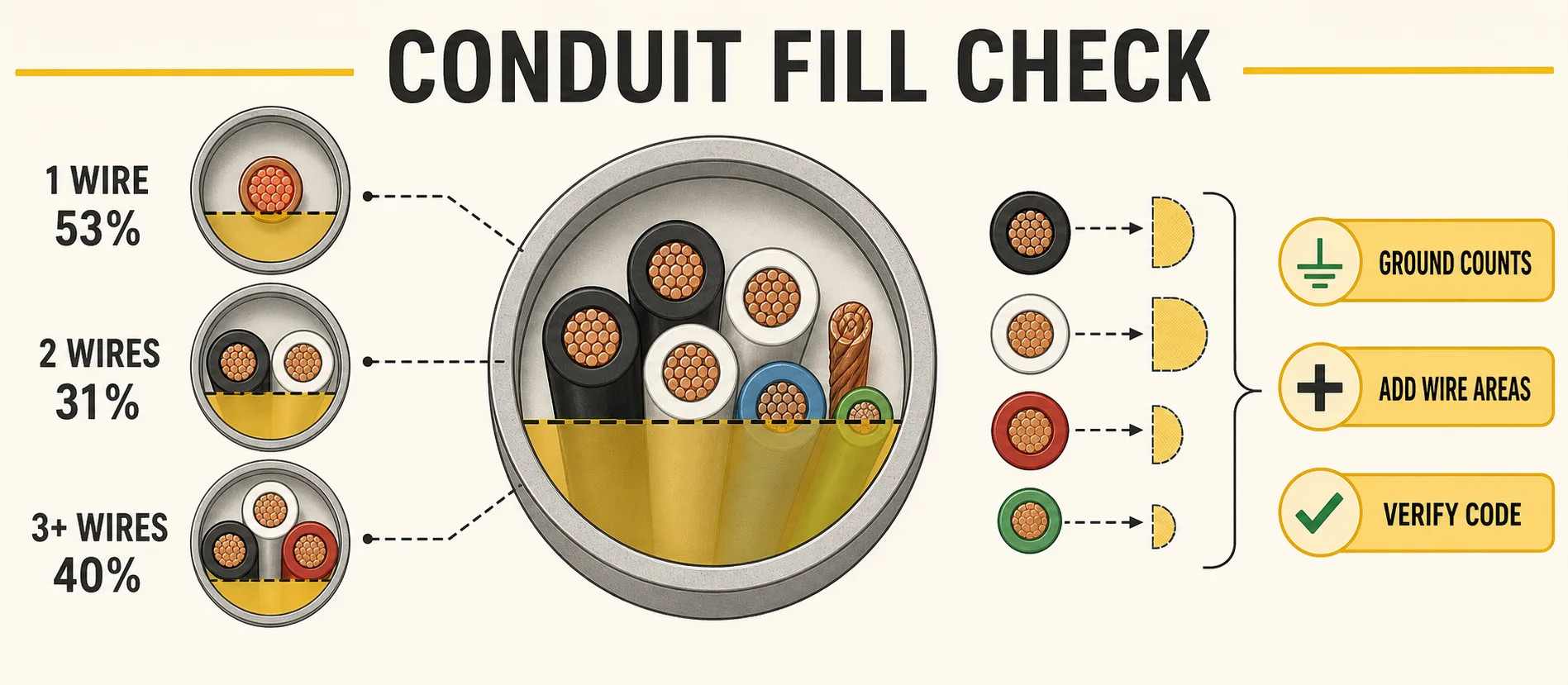
Use 40% fill for 3 or more conductors. Use 31% for exactly 2 conductors and 53% for a single conductor.
Equipment grounding conductors count toward conduit fill. Add their insulated area just like the current-carrying conductors.
When mixing wire sizes, add every conductor area separately. Do not use a single-gauge shortcut for mixed runs.
Fill percentage is only one check. Ampacity adjustment, box fill, bends, pull tension, conductor temperature rating, and local code can still control the job.
PVC Schedule 40 has slightly less internal area than EMT for the same trade size. Always match the conduit type before comparing fill.
Fill tells you whether the conductors go in. It says nothing about whether they are big enough, so size the copper first with the wire size calculator.
For underground raceway planning, estimate trench spoil separately with the excavation calculator.
For lighting layouts before circuit planning, use the recessed lighting calculator.
Rejected at rough-in
Where a conduit fill calculation goes wrong
Five failures, in the order you should check a run. Every one of them produces a number that looks fine and is not.
Counting only the current-carrying conductors
The equipment ground is insulated and takes up space like everything else.
Add a row for the ground. On a three-wire 20 A circuit it is a third of the bundle.
Calculating against the wrong raceway type
The same trade size has different room inside. At 3/4 in, PVC Sch 40 gives 0.508 in² against EMT's 0.533 in².
Set the conduit type before you read the percentage. A pass in EMT can be a fail in PVC.
Assuming 40% applies to every run
Two conductors are held to 31%, which is stricter, and a lone conductor gets 53%.
Count the conductors first, then take the limit off the ladder. Do not interpolate between them.
Using bare copper area instead of insulated area
Insulation is most of the diameter. A 12 AWG conductor occupies 0.0133 in² with its jacket on.
Use the THHN/THWN-2 areas this calculator uses, which already include the insulation.
Treating a legal fill as an easy pull
Bends, run length and pull tension all decide whether the wire actually goes, and none of them are in the fill number.
Leave headroom on long runs and multi-bend runs, and derate the ampacity separately.
Area arithmetic
How this conduit fill calculator adds up the areas
Fill is one division. Every insulated conductor contributes its own cross-sectional area, the total goes over the raceway's internal area, and the conductor count picks the ceiling it has to clear.
fill % = Σ(area × count) ÷ bore area × 100limit = 53% (1) · 31% (2) · 40% (3+)max wires = ⌊bore area × limit ÷ area⌋free area = bore area × limit − Σ(area × count)bore ⌀ = 2√(bore area ÷ π)Counted
- Every insulated current-carrying conductor, at its THHN/THWN-2 area.
- The insulated equipment grounding conductor.
- Neutrals, whether or not they carry current.
- Mixed gauges, added area by area rather than by a single-gauge shortcut.
Not counted
- Ampacity adjustment for more than three current-carrying conductors.
- Box fill at either end of the run.
- Bend count, run length and the pull tension that follows from them.
- Conductor temperature rating and local amendments.
For the copper itself rather than the pipe around it, see the wire size calculator.
From the supply house
Conduit fill questions: grounds, mixed sizes, 2-wire runs
The eight things electricians and inspectors argue about, answered against the same table this calculator reads.
What is the NEC conduit fill rule?
NEC Chapter 9 Table 1 limits raceway fill to 53% for 1 conductor, 31% for 2 conductors, and 40% for 3 or more conductors.
How many #12 wires in 3/4 EMT?
16 wires maximum (THHN insulation). This is one of the most common conduit runs in residential work.
Does the ground wire count for fill?
Yes. Equipment grounding conductors occupy space and must be included in the fill calculation.
Can I mix wire sizes in one conduit?
Yes. Add the individual cross-sectional areas of each wire and compare the total to the conduit's fill limit.
What is the difference between EMT, PVC, and rigid?
EMT is thin-wall steel (cheapest, indoor). PVC is plastic (underground, wet locations). Rigid is heavy-wall steel (highest protection, industrial).
Why is the 2-wire limit lower than 3+?
The NEC table assigns a separate 31% limit for exactly 2 conductors. Do not interpolate between the 1-conductor and 3+ conductor rules.
What happens if I exceed the fill limit?
It can fail inspection and make the pull harder, with more risk of insulation damage. Upsize the raceway or split the conductors into more than one run.
Should I use THHN or THWN wire areas?
THHN and THWN have the same outer diameter in modern dual-rated wire (THHN/THWN-2). Use the same area values for both.
Raceway types
EMT, PVC and rigid: how much room each conduit gives you
Trade size is a name, not a measurement. At 3/4 in the three raceways below hold different amounts, which is why a fill check that ignores the type can pass on paper and fail on site.
EMT
∅ 0.824 in
0.533 in²
16
Thin-wall steel. The default for exposed indoor work: cheap, bends with a hand bender, and the fittings are set-screw or compression.
PVC Sch 40
∅ 0.804 in
0.508 in²-4.7% vs EMT
15
Plastic. The one to use underground and in wet locations, and the one with the least room inside for the same trade size.
Rigid
∅ 0.836 in
0.549 in²+3% vs EMT
16
Heavy-wall steel with threaded joints. Highest physical protection, used where the raceway can be hit.
Areas are the internal areas this calculator uses. The 12 AWG column is the count that clears the 40% limit for 3 or more conductors.
Trade size table
Conduit fill chart: maximum conductors by trade size
A 3/4 in EMT takes 16 conductors of 12 AWG THHN at the 40% limit. Every figure below is the same calculation this page runs, at 40% for 3 or more conductors in EMT.
| EMT trade size | Area in² | 14 AWG | 12 AWG | 10 AWG | 8 AWG | 6 AWG | 4 AWG |
|---|---|---|---|---|---|---|---|
| 1/2 in | 0.304 | 12 | 9 | 5 | 3 | 2 | 1 |
| 3/4 inyour size | 0.533 | 21 | 16 | 10 | 5 | 4 | 2 |
| 1 in | 0.864 | 35 | 25 | 16 | 9 | 6 | 4 |
| 1-1/4 in | 1.496 | 61 | 44 | 28 | 16 | 11 | 7 |
| 1-1/2 in | 2.036 | 83 | 61 | 38 | 22 | 16 | 9 |
| 2 in | 3.356 | 138 | 100 | 63 | 36 | 26 | 16 |
| 2-1/2 in | 5.858 | 241 | 176 | 111 | 64 | 46 | 28 |
| 3 in | 8.846 | 364 | 266 | 167 | 96 | 69 | 42 |
| 4 in | 15.901 | 655 | 478 | 301 | 173 | 125 | 77 |
Counts assume one gauge throughout and 3 or more conductors. Two conductors are held to 31% and a single conductor gets 53%, so those runs hold fewer or more than the column shows.
Disclaimer
These estimates are for planning purposes only. Actual costs vary by location, material availability, and project complexity. Always get at least 3 local quotes. This calculator does not replace professional advice.
Sources
Related Calculators
Wire Size Calculator
AWG gauge by amps & run
Amp Calculator
Circuit load and breaker size
Recessed Lighting Calculator
Can light count
Generator Size Calculator
Backup wattage by appliance
Excavation Calculator
Trench digging
Concrete Slab Calculator
Trench and pad work
Solar Panel Angle Calculator
Optimal tilt angle