Attic Insulation Cost Calculator
Estimate attic insulation cost from your existing R-value, target R and climate zone.
Attic Details
Estimated installed cost
$4,836
blown cellulose over an standard attic floor, taking R-11 up to R-49, air sealing included.
- Material
- $2,823
- Labour
- $1,188
- Air sealing
- $825
- Cost per sq ft installed
- $4.84
Only the last figure is arithmetic: heat flow goes as 1 divided by R, so R-11 to R-49 takes out that share of the loss through the floor. The payback and the yearly figure come from an assumed $500 a year of heating and cooling per 1,000 sq ft of attic, scaled by a factor for Zone 5 (Cool). That is an assumption in this calculator, not your fuel price. Federal 25C credit is carried at $0 for property placed in service after December 31, 2025.
Estimates only. Not professional advice.
Last updated August 5, 2026 by our expert review team.
Return curve
Attic insulation: where the next R stops buying much
An attic has no depth limit worth arguing about, so the question is never how much fits. It is where to stop. Heat flow through the floor goes as 1 divided by R, so the first inches take out most of the loss and the last ones take out very little.
Plotted from R-11 because that is where your attic is now, so 100% means the loss you have today rather than the loss of a bare ceiling. This is conducted heat through the floor only: air moving through the top plates and the hatch is a separate loss that depth does not touch.
R-11 to R-30
6.0 in
63%
37%
R-30 to R-38
8.0 in
21%
29%
R-38 to R-49
your target11.0 in
22%
22%
R-49 to R-60
14.0 in
18%
18%
Depth is blown cellulose measured from the R-11 already up there, so each row is the whole fill for that rung rather than an extra layer on the row above. Rungs are the R-values this calculator's own climate table uses, plus your target if it sits between them. Turning any of this into money needs a fuel price and a local climate figure, neither of which this page carries.
- Removed getting to R-49
- 78%Of the heat now conducted through the attic floor at R-11
- Still going through afterwards
- 22%Plus whatever leaves as air, which depth does not address
- Fill this target needs
- 11.0 inBlown Cellulose at R-3.5 per inch
- One rung further, R-60
- 18%Of what is left, for 3.0 in more fill
Where the money goes
Attic insulation cost: what each line is actually buying
Six things worth knowing before the quote arrives. Not a sequence, so not numbered: the depth, the sealing, the audit and the paperwork are separate decisions that each move the total on their own.
Blown cellulose to R-49 runs $1.50 to $2.00 per sq ft installed. Fiberglass batts come in cheaper at $1.00 to $1.50, and leave 15 to 25% more gaps around wiring, bracing and joist edges, which is exactly where an attic floor leaks heat.
DIY blown-in is $0.50 to $0.85 per sq ft in material, with a free blower rental on most 10-bag purchases. On a whole attic that is $1,000 to $2,500 less than a professional install, and the bag count is the part to get right: our blown-in insulation calculator does that half.
Air sealing costs a fraction of the depth and does something the depth cannot. Insulation slows heat conducted through the floor; it does nothing about air moving through the top plates, the chases and the hatch. On a leaky attic the sealing is the part that changes the bill, and it has to happen before the new material buries the holes.
Book the energy audit before the insulation, not after. A blower door test and a thermal camera find the bypasses while they are still reachable, and audits run $200 to $400. Energy Star's problem-area guide shows what the auditor is looking at.
Federal help has changed. The 25C insulation credit ended for property placed in service after December 31, 2025, so this calculator carries it at $0. Utility and state programs are separate and still exist in many places. Check yours before you count a rebate as part of the budget.
A cathedral ceiling is not an attic floor, and it is the one case where depth is capped by the rafter bay rather than by what you want to spend. Closed cell foam at R-6.5 per inch is the usual answer there, priced in our spray foam cost calculator.
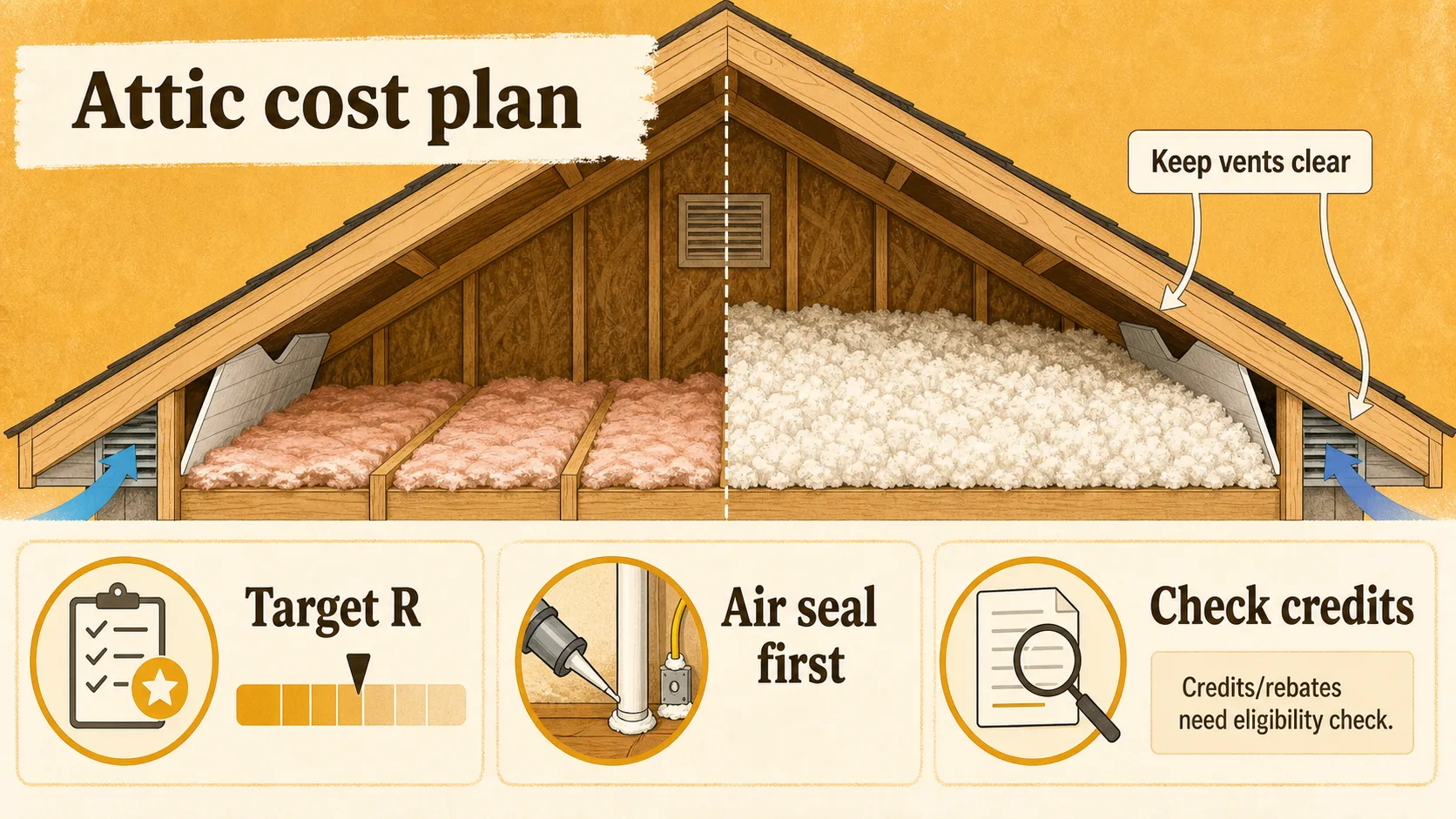
At the hatch
How far to top up attic insulation, and in what order
The order is real here, and getting it wrong costs money rather than time. Everything in steps one and two becomes unreachable the moment new material goes down.
- 01
Measure what is already up there
Push a ruler down to the drywall in the middle of a joist bay, not next to the hatch where everything is trodden flat. Depth times the R per inch of whatever it is gives you the existing R to type in, and that number decides how much of this job is worth doing at all.
- 02
Seal the bypasses while you can still reach them
Top plates, plumbing and wiring chases, the flue gap, recessed cans and the hatch itself. Once new material is blown over them they are gone, and no amount of depth fixes air moving straight through the assembly.
- 03
Pick the stopping point, not the maximum
This calculator's climate table sets R-49 for Zone 5 (Cool). The curve at the top of this page shows what the rungs above that are still worth in heat flow terms, which is much less than the rungs below it.
- 04
Get baffles in before the depth goes in
Loose fill will happily bury the soffit vents at the eaves. Baffles hold the airway open at each rafter bay, and they cost almost nothing compared with sorting out a blocked eave afterwards.
- 05
Then add the depth, and mark it
Set depth markers or write the finished depth on a rafter. It takes a minute, and it means the next person measuring this attic gets a real number instead of a guess.
Priced attics
Attic insulation cost by starting point: three top-ups priced
Same arithmetic as the calculator above, so any of these can be typed in for the identical total. The three differ mostly in where they start, which is what decides whether the money is well spent.
Ranch, R-11 up to the zone target
$4,836
installed, $4.84 per sq ft
78% of the floor loss removed
- Attic
- 1,000 sq ft
- R-value
- R-11 to R-49
- Fill
- 11.0 in blown cellulose
- Labour
- Standard Professional
- Adders
- $825
The cheapest R-value on the site, because it starts from almost nothing. Nearly four fifths of the floor loss goes in one job.
Bungalow already at R-30
$4,928
installed, $3.52 per sq ft
39% of the floor loss removed
- Attic
- 1,400 sq ft
- R-value
- R-30 to R-49
- Fill
- 8.0 in blown fiberglass
- Labour
- Basic Professional
- Adders
- $1,155
Same target, half the return. Anyone quoting this attic should be talking about air sealing and ducts before depth.
Stripped attic after a removal
$12,811
installed, $7.12 per sq ft
87% of the floor loss removed
- Attic
- 1,800 sq ft
- R-value
- R-0 to R-38
- Fill
- 16.0 in blown fiberglass
- Labour
- Standard Professional
- Adders
- $4,455
Removal is the line item that changes the answer. It buys nothing in R-value, and it is the right call only when the old material is wet, mouldy or vermiculite.
Loss removed is 1 minus the starting R divided by the finished R, so it describes conducted heat through the attic floor and nothing else. The stripped attic starts from the R-5 floor rather than R-0, because R-0 has no finite loss to compare against.
Quote traps
Attic insulation cost mistakes that show up on the quote
Every one of these is decided before anybody opens a bag, and every one of them is cheaper to catch at the quote stage than after the attic is full.
Buying the cheapest material per bag
The number that matters is cost to reach your target R, not cost per bag. Batts hold R-3.2 per inch against cellulose at R-3.5, so the cheaper bag can need more depth and more labour to land on the same R.
Leaving air sealing off the scope
A quote for depth alone is a quote to bury the holes. Ask for the sealing to be itemised, and ask which bypasses were found, because the answer tells you whether anybody went and looked.
Treating rebates as money already in hand
Federal rules, utility programmes and state schemes all change on their own timetables. Price the job on its own, then treat any incentive as a separate application that may or may not land.
Taking one quote
Pricing on identical scope varies 30 to 50%. Three itemised quotes that separate material, labour, sealing and disposal are the only way to see which one is actually cheaper.
Not mentioning the access
Low clearance, a pull-down ladder, knob-and-tube wiring and a finished floor all change the labour, and this calculator carries that as an access factor: 1.0 for an open floor up to 1.6 for a finished attic. Say it upfront or the quote gets revised on the day.
Chasing the top of the R ladder by default
Depth costs the same per inch all the way up, and each inch removes less than the one before it. Going from R-49 to R-60 takes out 18% of the loss that is left at R-49, against 63% for the first step off R-11.
Depth math
How this attic insulation cost calculator prices a top-up
Target R less existing R gives the R to add, the material's R per inch turns that into depth, and the depth prices the material. Labour, sealing and removal are separate lines on the same area.
R to add = target R − existing Rdepth = ceil(R to add ÷ r per inch)area billed = attic area × 1.10material = area billed × material rate × (depth in ÷ 3) × access factorlabour = area billed × labour rate × install factor × access factorremoval = area billed × $1.50air sealing = area billed × $0.75total = material + labour + addersThe 10% on the area is a planning cushion, not compaction: loose fill settles and batts never quite tile a joist bay. Depth is priced against a 3 inch baseline, which is why the material line moves in steps rather than smoothly as the target rises. Existing R-value is subtracted before anything else, so topping up an attic that already has R-30 in it prices the difference and not the whole depth.
Not included: baffles, a new hatch cover, dam work around the flue, rerouting wiring, duct sealing, drywall repair or disposal beyond the removal line. The payback figure in the readout comes from an assumed $500 a year of heating and cooling per 1,000 sq ft of attic, scaled by a factor between 0.6 and 1.6 for the climate zone. It is an assumption in this calculator and not a fuel price, which is why the curve at the top of the page is expressed in percentage of loss removed instead of dollars.
Per inch
Attic insulation cost by material, for the R gap you actually have
A cheaper bag is not a cheaper attic. What matters is the depth each material needs to close your gap and what that depth costs installed, so both columns below are computed against the numbers in the calculator rather than quoted in the abstract.
Fiberglass Batts
$1.20 per sq ft installedR-3.2
12.0 in
$3,949
Blown Fiberglass
$1.45 per sq ft installedR-2.5
16.0 in
$5,467
Blown Cellulose
your materialR-3.5
11.0 in
$4,836
Open Cell Spray Foam
$1.50 per sq ft installedR-3.7
11.0 in
$5,518
Closed Cell Spray Foam
$2.25 per sq ft installedR-6.5
6.0 in
$5,115
Totals carry your labour choice, access factor and adders, so the row matching your material equals the readout above exactly. Closed cell foam reaches a target in the least depth, which matters in a rafter bay and not on an open attic floor, where depth is free and the cost per sq ft is what decides it.
Before you book
Attic insulation cost questions, asked in the usual order
Nine answers, starting with the rate everyone wants and the one the curve at the top of this page exists to settle.
How much does attic insulation cost per sq ft?
Fiberglass batts: $1.00 to $1.50 installed per sq ft. Blown cellulose: $1.50 to $2.00. Spray foam: $1.50 to $2.50. A 1,200 sq ft attic runs $1,200 to $3,600.
Is R-60 worth it over R-49?
Heat flow through the floor goes as 1 divided by R, so the step from R-49 to R-60 removes about 18% of the loss that is still there at R-49, while the first step from R-11 to R-30 removes about 63% of what you started with. The depth costs the same per inch either way, which is why most top-ups stop at the zone target rather than the top of the ladder.
What is the ROI on attic insulation?
Payback depends on the fuel you burn, its price where you live, and how leaky the attic was to begin with. This page does not carry a fuel price, so the figure in the readout comes from a flat assumed heating and cooling cost scaled by climate zone. Treat it as an order of magnitude and get a real number from a local audit.
What tax credits are available?
The federal 25C insulation credit ended for property placed in service after December 31, 2025, so this calculator carries it at $0. Check your utility and state programmes before assuming any rebate.
Is DIY attic insulation cheaper?
DIY saves 40 to 60%. Material is $0.50 to $0.85 per sq ft with free blower rental on bulk purchases. Use our attic insulation calculator to get exact bag counts for your project.
Should I remove old insulation first?
Only if it is water-damaged, mouldy or vermiculite. Otherwise blow new material straight over it and keep the R-value you already paid for. Removal adds $1.00 to $2.00 per sq ft and adds no R.
How much can I save on energy bills?
R-11 to R-49 removes about 78% of the heat flowing through the attic floor, which is arithmetic. Turning that into money needs your fuel price, your climate and an honest account of air leakage and duct losses, none of which this page carries. For a broader comparison of all insulation types, see our insulation cost calculator.
Does contractor pricing vary much?
Quotes can vary 30 to 50%. Get at least 3 quotes and verify they include air sealing and ventilation baffles.
Is air sealing worth the extra cost?
Yes, and on a leaky attic it beats adding depth. This calculator prices it at $0.75 per sq ft, a small share of a top-up, and it addresses air moving through the assembly rather than heat conducted through it. Those are two different losses and depth only fixes one.
Disclaimer
These estimates are for planning purposes only. Actual costs vary by location, material availability, and project complexity. Always get at least 3 local quotes. This calculator does not replace professional advice.
Sources