Spray Foam Cost Calculator
Price spray foam by area, target R-value, foam type, and where you are spraying.
Project Details
Estimates only. Not professional advice.
Installed spray foam cost
$2,411
for 500 sq ft of wall cavities at R-20, which takes 4 in of closed cell foam.
- Closed Cell foam plus 10% overspray
- $1,320
- Crew, rig and trimming
- $871
- Prep and air sealing
- $220
- Energy saving, first year
- $38
- Installed, per sq ft
- $4.82
Payback lands at 63 years on that saving, and $1,530 over 40 years of service life. The saving model assumes the assembly was around R-5 before you started, so treat it as the floor rather than the sales figure. Rebates and credits are not netted off. Estimates only, not professional advice.
Last updated August 5, 2026 by our expert review team.
Spray thickness
Open cell against closed cell: the same R-value, two spray foam thicknesses
Both products get sold as spray foam and they behave nothing alike. Closed cell reaches R-20 in about half the depth and costs a lot more per board foot, and open cell does the same job for less money if you can give it the room. Here is what each one needs on your job, drawn to scale.
Depth runs top to bottom and is to scale, so the blocks really are that different. Widths are equal by choice and carry no dimension. The dashed rule is the depth this page assumes for a 2×6 stud bay.
Open Cell
0.5 lb/cu ft5.4 in
6 in
$1,307
Hybrid (Open + Closed)
1.2 lb/cu ft4.0 in
4 in
$1,452
Closed Cell
your foam3.1 in
4 in
$2,191
Foam plus crew, at the 10% overspray allowance and the 1.20x access factor for wall cavities, which is why the row for your foam equals material plus labor in the panel above. Prep, air sealing and the ignition barrier sit on top of all three equally, so they change the total and not the choice. Priced thickness rounds up to a whole inch, because foam is sprayed in whole-inch lifts whatever units you work in.
- Depth for the same R
- 5.4 vs 3.1 inOpen cell against closed cell at R-20, a factor of 1.8
- What the density costs
- $884Closed cell over open cell on this job, foam and crew only
- Depth you have here
- 5.5 inAssumes 2×6 framing. A 2×4 retrofit wall gives you 3.5 in instead, which is where open cell starts running out of room first.
- Cheapest foam that fits
- Open Cell5.4 in thick, and the cheaper product too
At the nozzle
Spray foam cost per square foot changes with where you point the gun
Five places in a house, all sprayed in closed cell foam, each at the R-value that part of the building is normally taken to. Two things move the bars: the R-value sets the thickness, and the access factor sets how slow the crew is.
Attic/Roof Deck
R-49 target, 1.00x access$7.30 · 8 in at R-49
$3,652
Wall Cavities
your job$4.38 · 4 in at R-20
$2,191
Basement/Rim Joist
R-15 target, 1.10x access$3.01 · 3 in at R-15
$1,506
Crawl Space
R-19 target, 1.30x access$3.56 · 3 in at R-19
$1,780
New Construction
R-25 target, 0.90x access$3.29 · 4 in at R-25
$1,643
Foam and crew only, with your 10% overspray allowance, at each area's own default R-value. Prep, air sealing and the ignition barrier are excluded so the bars compare like with like. Your job is at that default, R-20, so the highlighted row is your estimate.
An attic is the expensive bar on this chart and the cheapest R in the house at the same time, because R-49 is two and a half times the wall target and nothing up there limits how deep the foam can be. That combination is why an attic is usually the job where open cell wins and a wall is the job where closed cell earns its price.
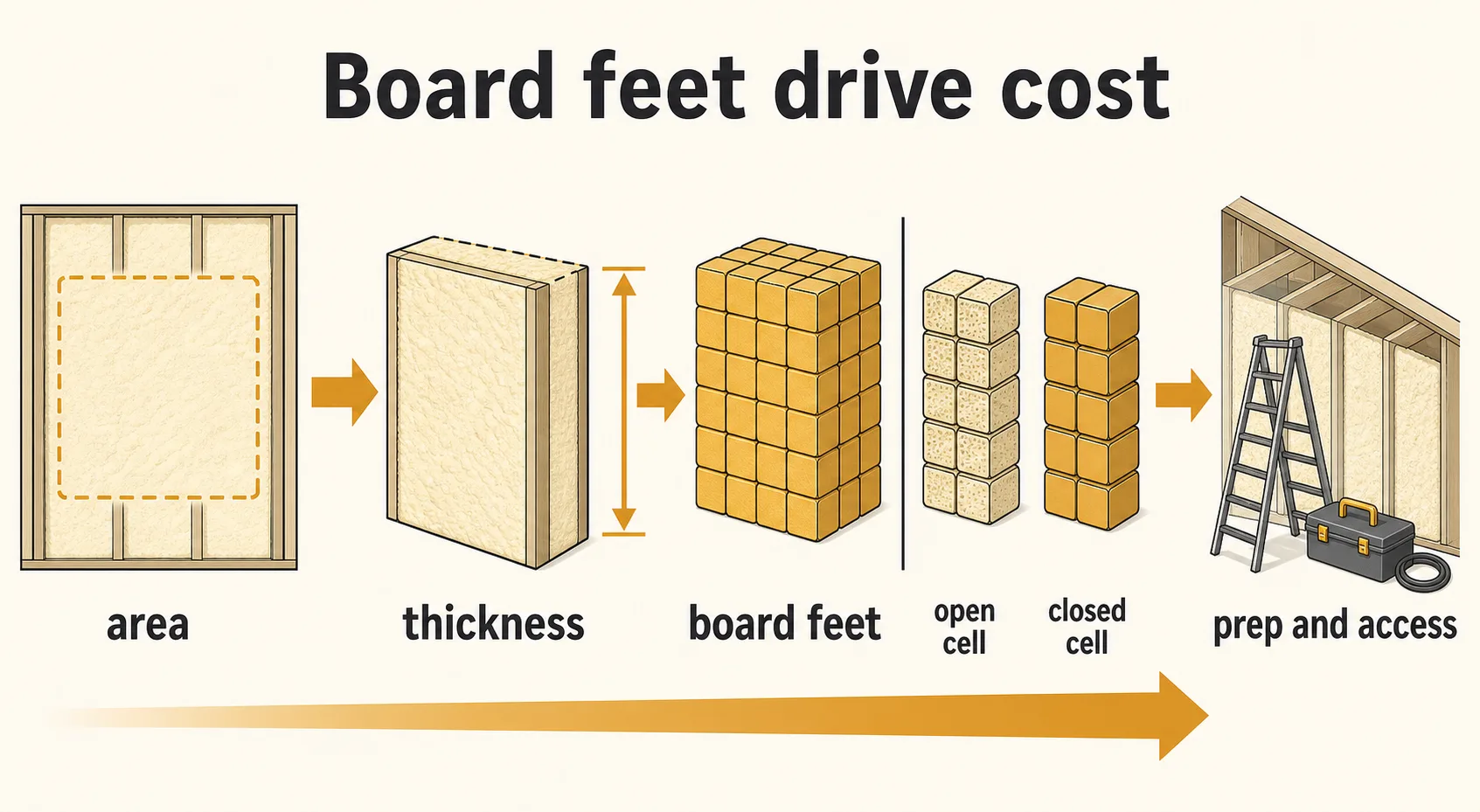
Area times thickness is the whole quantity, which is why a quote can double without the sprayed area changing at all. Spray foam is sold by the board foot, one square foot at one inch, and our board foot calculator converts that unit if a supplier quotes you in it.
Rig and hose
What a spray foam quote pays for besides the foam
A low bid usually hides a thinner lift, missing prep or an excluded code barrier rather than a better price. Read the lines below and compare bids on them, not on the final number.
Open cell, pro install
$0.28 to $0.55 per board foot
About $2.50 to $3.00 per sq ft at 3 in
Good buy wherever the depth is available and vapour control is handled another way.
Closed cell, pro install
$1.20 to $1.75 per board foot
About $3.00 to $4.00 per sq ft at 2 in
Earns the money where R per inch, air sealing or vapour control is the binding problem.
DIY kit, open cell
Sold by rated board feet
Best on small, reachable touch-ups
Compare the rated board feet after shipping and PPE, not the price on the box.
DIY kit, closed cell
600 board foot kits are common
A 600 kit covers 300 sq ft at 2 in
Cold substrate, thick lifts and poor ventilation all pull real yield under the label.
Local minimum charges, old insulation removal, ignition barriers and access can all put a real bid outside these ranges. The square foot column is for sanity checking only, because it holds a thickness inside it.
Where the money sits in a typical bid
Illustrative share of one bid, not a national average.
Foam material
Board feet times foam type times target thickness
Labor and rig setup
Crew time, heated hose, masking, trimming, cleanup
Prep and access
Old insulation removal, tight crawl spaces, roof deck work
Code and safety add-ons
Ignition barrier, ventilation, re-entry planning
Ask for these before you sign
Not a sequence, so not numbered. Any one of them can move the total.
Board feet and target thickness, area by area
Open cell, closed cell or hybrid, and where each one goes
Whether removal and substrate prep are in the number
Ignition or thermal barrier, and who supplies it
Ventilation and re-entry instructions
Minimum charge or mobilisation fee
If two bids are far apart, compare board feet first. Different target thickness is almost always the reason, and it is the one line a homeowner can check without a rig.
On the invoice
Three spray foam jobs, priced from the same rates
All three run through the arithmetic in the panel at the top of this page, at your 10% overspray allowance, so you can put your own job next to them and know the comparison is fair.
Attic roof deck, retrofit
$6,072
installed, before rebates
- Thickness
- 14 in
- Foam sprayed
- 15,400 board feet
1,000 sq ft of roof deck at R-49 in open cell, with prep and air sealing added
Depth is free at a roof deck, so the cheap foam wins outright. Enter the sprayed surface, not the house footprint, and ask whether the bid covers removing the old batts and coating the foam where it stays exposed.
New walls, closed cell
$8,944
installed, before rebates
- Thickness
- 4 in
- Foam sprayed
- 10,560 board feet
2,400 sq ft of open framing at R-20 in closed cell, air sealing added
Nearly five times the area of the attic job at less than half the R-value, and it still costs more, because closed cell is two and a half times the rate. Confirm target thickness bay by bay and whether trimming flush with the studs is included before drywall.
Basement rim joist
$1,601
installed, before rebates
- Thickness
- 3 in
- Foam sprayed
- 1,320 board feet
400 sq ft of basement rim joist at R-15 in closed cell, with prep and air sealing
Small and awkward, so the per unit area number looks high and the total does not. A rig still has to arrive, mask, spray and ventilate, which is what a minimum charge is paying for.
Dollar totals are the same in either unit mode, because a total is not a rate. The areas, thicknesses and quantities above all follow the toggle in the calculator.
Before the crew arrives
Spray foam decisions that move the price more than shopping around
Not a sequence, so not numbered. Each one changes the figure in the results panel by more than a third quote will.
Closed cell installed runs about $1.20 to $1.75 per board foot and open cell about $0.28 to $0.55 per board foot, which is the range to hold a bid against. At R-20 that is 3.1 in of closed cell against 5.4 in of open cell, so the money you save on the cheaper foam is buying you thickness to find.
Contractor markup averages 40 to 60% over material cost, and it is not padding. It covers a $40,000 spray rig, a heated hose, PPE, installer training and liability cover, none of which a DIY kit price includes.
Open cell absorbs sound 30 to 50% better than closed cell and costs far less per board foot, which makes it the right foam between bedrooms, over a home theatre and above living space even where you could afford the denser product.
Book a blower door test before and after, at $150 to $300. A good foam job should cut air changes per hour by at least 40%, and that is the part of the work you cannot see once the drywall is up.
The federal 25C credit was not allowed for property placed in service after December 31, 2025. Check current IRS guidance, utility rebates and state programs before you subtract anything from a budget.
In zones 5 to 8 an attic often does better on a hybrid: a closed cell layer at the deck for air and vapour control, then blown cellulose to reach R-49. Same R-value, roughly 40% less than all closed cell, and you can price the foam half here and the loose fill half in the other calculator.
After the foam cures
Spray foam cost mistakes that surface after the crew leaves
Every one of these is settled while you are still reading bids. None of them is cheap once the foam is on the sheathing.
Comparing bids without a thickness
A price per unit of finished area means nothing until you know the inches inside it. Ask every bidder for board feet, foam type, target R-value and installed thickness area by area.
Assuming the cheaper foam always fits
Open cell needs roughly 1.8 times the depth of closed cell for the same R-value. Check the thickness against the space you actually have before the saving goes in the budget.
Forgetting the minimum mobilisation charge
A small rim joist job prices high per board foot because the crew still brings a rig, masks, ventilates, sprays and cleans up. Compare small jobs on the total, not on the rate.
Putting open cell in a damp assembly
Open cell is vapour open and can hold water. Crawl spaces, basement rim joists and anywhere with a history of a roof leak want the closed cell product, whatever it costs per board foot.
Skipping the substrate and temperature check
Wet, dusty, oily or cold surfaces give poor adhesion, and the failure shows up months later as foam pulling away from the sheathing. Ask how the installer checks wood moisture and product temperature.
Leaving the ignition barrier out of the bid
Exposed foam usually needs code-required protection. Get it in writing whether that is a sprayed coating, drywall or another approved barrier, and who is paying for it.
Re-entering before the ventilation is done
Follow the product and installer re-entry guidance for people and pets. Curing and ventilation time is part of the job, not an optional extra you can shorten to save a day.
Ignition and thermal barrier requirements are set by your local code official, not by this page. Ask the installer which barrier the inspector expects and get the answer on the bid.
Pricing path
How this spray foam cost calculator turns R-value into money
Target R-value sets the thickness, thickness times area sets the quantity, and the quantity meets a material rate, a labor rate and an access factor. The two add-ons and the energy model are separate lines on top.
thickness = ceil(target R ÷ R per inch)quantity = area × (1 + waste) × thicknessmaterial = quantity × foam rate × accesslabor = quantity × labor rate × accessadd-ons = area × (0.50 prep + 0.40 sealing)total = material + labor + add-onssaving = area × 0.85 × 0.12 × (1 − 5 ÷ target R) × climatepayback = total ÷ savingQuantity is board feet, the trade unit for spray foam: one square foot at one inch. That is why the thickness rounds up to a whole inch before anything is priced, and why two bids on the same room can differ by half again without either being wrong. The energy model assumes the assembly was around R-5 before the work and prices the improvement rather than the total heat loss, so the payback figure is deliberately conservative and rebates are never netted off it.
Not included: ignition or thermal barriers, old insulation removal, ventilation baffles, framing changes, drywall, electrical work, permits, disposal and minimum mobilisation charges.
Asked on site
Spray foam cost questions, from the bid to the re-entry time
Nine answers, opening with the thickness question the comparison at the top of the page is built to settle.
How thick does open-cell spray foam need to be?
Divide your target R-value by R-3.7 per in. R-20 works out at 5.4 in of open cell against 3.1 in of closed cell, and the estimate rounds that up before pricing, because foam is sprayed in whole-inch lifts. The comparison at the top of this page redraws both to scale as you change the target.
How do I compare a board-foot quote to this result?
Multiply the contractor's board-foot rate by the calculator's board feet. If the bid is per finished square foot, ask what thickness is included so you are not comparing 2 inches to 4 inches.
Why does closed-cell cost more?
Closed-cell has higher R-value per inch, higher density, and can work as a vapor retarder in the right assembly. It uses more chemical material per inch than open-cell foam.
Where is open-cell usually the better buy?
Open-cell is often used for sound control and deep roof or wall cavities where vapor control is handled another way. It is not the first choice for damp crawl spaces or rim joists.
What costs are often missing from cheap bids?
Old insulation removal, masking, access cutting, ignition-barrier coating, ventilation, fire blocking, attic hatch detailing, cleanup, and minimum job charges can all be separate line items.
Can I DIY a small spray foam job?
Small kits can work for rim joist touch-ups and gaps, but full cavities need trained installers, PPE, ventilation, temperature control, and consistent lift thickness. Use the spray foam calculator for material quantity planning.
How long should the house be empty after spraying?
Follow the product and installer re-entry instructions. Many jobs require occupants and pets to stay out during spraying and curing while ventilation clears fumes.
Does spray foam qualify for tax credits?
The federal 25C credit was not allowed for property placed in service after December 31, 2025. Check current IRS guidance, utility rebates, and state programs before assuming a credit.
When should I choose a different insulation?
If the cavity is easy to fill and depth is not tight, fiberglass, cellulose, or mineral wool may be cheaper. Compare options with the insulation cost calculator, or size the quantities with the insulation calculator.
Disclaimer
These estimates are for planning purposes only. Actual costs vary by location, material availability, and project complexity. Always get at least 3 local quotes. This calculator does not replace professional advice.
Sources