Siding Calculator
Count siding squares, trim and cost from your perimeter, wall height and openings.
House Dimensions
Siding to order
16
squares of vinyl siding, which is 1,516 sq ft of coverage with the 10% waste allowance already in it.
- Walls and gables
- 1,540 sq ft
- Doors and windows out
- -162 sq ft
- Net wall
- 1,378 sq ft
- Material, before labour
- $3,032 to $7,580
Vinyl Siding at $2 to $5 per sq ft, material only. House wrap, flashing, fasteners, tear-off and labour are all extra. Estimates only, not professional advice.
Last updated August 5, 2026 by our expert review team.
Course layout
Siding courses: what lands under the soffit
Siding goes up in courses at a fixed exposure, and a wall height almost never divides by that exposure. Whatever is left over becomes the top course, right at eye level from the street. Tightening the exposure slightly on every course is how the trade gets a full board up there instead.
Two elevations of the same wall, both to scale, so the short course really is that short. Exposure is the part of each board left in view, so the lap sits hidden behind the course above it.
Under half a board reads as a mistake from the pavement, and it is the piece most likely to work loose in wind. This is the one worth tuning out.
- Widest exposure this board allows
- 7.00 inFace width less the 1.25 in minimum lap
- Exposure that lands a full top course
- 6.75 in16 courses, all the same
- Take off each course
- 0.25 inSet the gauge once and every course follows
- Lap once tuned
- 1.50 inTightening only ever adds lap, so it stays above 1.25 in
- Extra board it costs
- +3.7%Your 10% waste allowance already covers it
Material rates
Siding cost per sq ft by material
Five materials on one axis, so the step from vinyl to fiber cement is the real step and not a chart trick. The right-hand figure is the same rate applied to the wall you just measured.
Vinyl Siding
your siding$2 to $5
$3,032 to $7,580
Fiber Cement (Hardie)
$5 to $10
$7,580 to $15,160
Wood (Cedar/Pine)
$4 to $9
$6,064 to $13,644
Metal (Steel/Aluminum)
$4 to $8
$6,064 to $12,128
Engineered Wood (LP SmartSide)
$3 to $7
$4,548 to $10,612
Material only. Professional installation adds roughly $2 to $6 per sq ft on top, more where there is tear-off, staging or a lift involved.
Takeoff sketch
What a siding takeoff measures, elevation by elevation
The body of the house is the easy part. Gables, the trim that makes the install work, and the openings you decide to measure rather than average are where an order goes wrong.
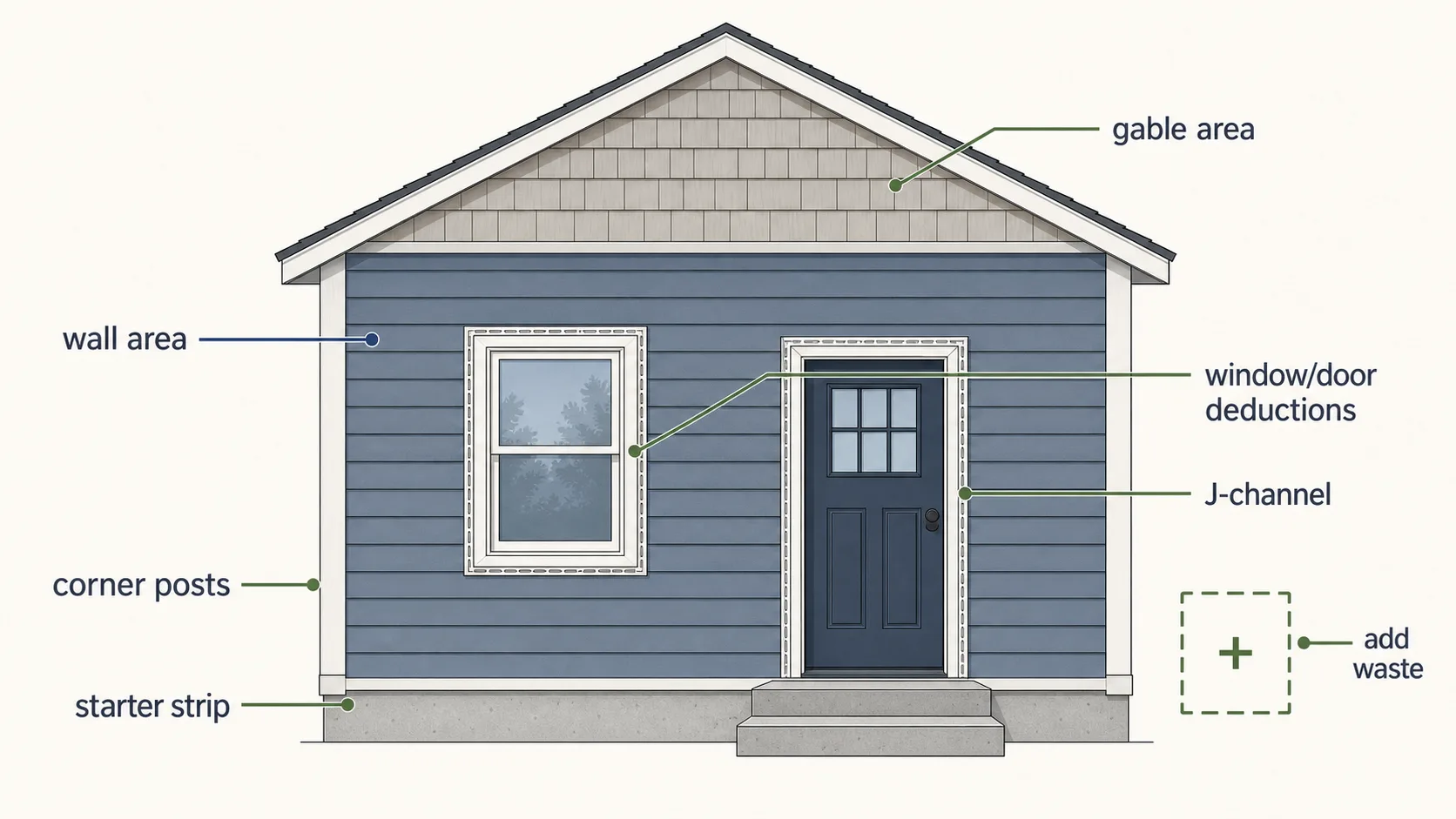
Wall body plus gables, openings out, then the starter strip, J-channel and corner posts that turn a pile of panels into a finished wall. Order the trim in the same colour batch as the siding.
Supply counter
Siding questions that come up before you order
Nine answers in the order they tend to arrive, starting with the one the drawing above exists to settle.
Why does the top course of siding end up as a sliver?
Wall height rarely divides evenly by the exposure the siding is set at, so whatever is left over becomes the top course. An 8 1/4 in board at its widest 7 in exposure leaves a 3 in strip at the top of a 9 ft wall. Tightening every course to 6.75 in gives 16 equal courses and a full top board, and the lap stays above the 1.25 in minimum.
Should I subtract every window and door?
Subtract normal windows and doors for a cleaner material number. For a quick quote, average deductions are fine. For patio doors, garage doors, bay windows, or a sunroom wall, measure each opening because the averages will be too small.
How much waste should I use for siding?
Use 10% for a simple rectangle with lap siding. Use 15% for many corners, gables, dormers, or mixed materials. Use 20% when matching an older color or profile, because later batches may not match.
What does one square of siding mean?
One square is 100 sq ft of installed wall coverage. Suppliers often sell siding by the square or carton, so the calculator rounds order area up after waste instead of leaving a fractional square.
What trim should be ordered with siding?
Plan starter strip at the bottom course, J-channel around openings and roofline transitions, and corner posts at outside corners. Ask your supplier about undersill trim, utility blocks, light blocks, and matching fasteners, and price the eave separately with our soffit calculator.
Can I install new siding over old siding?
Sometimes, but it hides sheathing problems and can trap moisture. A better takeoff assumes old siding comes off, damaged sheathing gets repaired, and new house wrap or WRB is installed before the finish siding.
Why does gable area matter so much?
A pair of gables can add several squares on a ranch, garage, or Cape Cod. Measure each triangle as base x height / 2, then add it to the wall area before waste.
Is vinyl, fiber cement, or engineered wood easiest to order?
Vinyl is usually easiest because accessories are standardized and color-matched. Fiber cement and engineered wood need closer attention to clearances, flashing, cut-end treatment, and board lengths.
What is not included in the siding estimate?
The calculator does not include house wrap, flashing tape, caulk, nails, starter clips, special mounting blocks, disposal, lift rental, or labor. Treat those as separate line items on the project quote.
Callbacks
Siding mistakes you can see from the street
Every one of these is decided at the ordering stage or in the first course. None of them is fixable once the wall is up.
Measuring only the first-floor walls
A takeoff needs every vertical wall, plus gables, dormers, garage returns and bump-outs. Sketch each elevation so nothing disappears inside a single perimeter number.
Using the same waste allowance for every layout
A clean lap-siding rectangle is fine at 10%. Stepped gables, many windows and accent zones need more, because short offcuts pile up faster than the area suggests.
Ordering siding without the accessory trim
Starter strip, corners, J-channel, undersill trim and mounting blocks all have to be ordered in the siding colour. Missing trim stops an install with the panels already on site.
Treating the siding as the drainage plane
Water management sits behind the finish. Plan house wrap, flashing tape, kickout flashing and clearances before you argue about panel count.
Averaging the unusual openings
Standard deductions are a first pass. Measure garage doors, patio doors, picture windows and bay windows directly, or the order comes out visibly wrong.
Starting the first course by eye
Snap a level chalk line for the starter strip. Every course references the one below it, so a first course out by a quarter inch is out by inches at the soffit.
On the wall
Siding details that decide how the wall looks in five years
Not a sequence, so not numbered. Each of these is a habit that separates a wall that still looks flat and tight from one that does not.
Nail vinyl in the centre of the slot and leave the head about a thirty-second of an inch off the nailing hem. Panels have to slide sideways as they warm, and a pinned panel buckles instead.
Leave a 1/4 inch gap at every butt joint and at every accessory. Vinyl moves enough over a season to close that gap on its own.
Overlap each course by at least 1 1/4 inches, or by whatever the profile calls for if that is more. Short lap is how wind-driven rain gets behind a wall that looks fine.
Install house wrap before any siding goes up. It is the second line of defence against bulk water and it keeps moisture off the sheathing.
Fiber cement wants factory priming and a field topcoat, and cut ends want sealing. Painted before it goes on the wall, it holds 15 years or more between repaints.
Wood siding is a maintenance schedule, not a finish. Budget a stain or repaint every 5 to 7 years and size it with our paint calculator.
Gable ends are where a different profile reads as deliberate rather than as a patch. Board and batten above horizontal lap is the usual pairing, and it is a separate takeoff with its own waste.
Squares and trim
How this siding calculator turns a house into squares
Perimeter times wall height, plus the gable area you enter separately, less the openings, plus waste, rounded up to whole squares. Trim comes off the same measurements rather than a second takeoff.
gross = perimeter × height + gablenet = gross − doors×21 − windows×15order = net × (1 + waste)squares = ceil(order ÷ 100)J-channel = (doors×17 + windows×16) × 1.1starter = perimeter × 1.1corner posts = height × 4 × 2Door and window deductions are planning averages, so patio doors, garage doors, picture windows and window walls should be measured and entered as gable area in reverse, or simply left in the wall and treated as spare material. Waste is applied after the openings come out, never before, and the answer is rounded up because a supplier will not sell you two thirds of a square.
Not included: house wrap, flashing tape, caulk, fasteners, starter clips, mounting blocks, tear-off, disposal, lift rental, and labour.
Priced houses
Siding cost by house size: four worked takeoffs
Run through the same arithmetic as the calculator above, so you can type any of them in and get the identical answer. Course counts use the board width you set.
One-story ranch
11
squares
$2,152 to $5,380
- Wall
- 120 × 9 ft
- Gable
- 60 sq ft
- Openings
- 2 + 8
- Waste
- 10%
- Courses
- 16
Gables, not wall height, are what people undercount here. Walk the house and sketch each triangle before ordering.
Two-story, fiber cement
32
squares
$15,720 to $31,440
- Wall
- 160 × 18 ft
- Gable
- 200 sq ft
- Openings
- 3 + 14
- Waste
- 12%
- Courses
- 31
12% waste rather than 10% covers cut-end treatment and the boards that break at height.
Large mixed-material home
46
squares
$13,614 to $31,766
- Wall
- 200 × 20 ft
- Gable
- 300 sq ft
- Openings
- 4 + 18
- Waste
- 15%
- Courses
- 35
Do not blend lap, shake and batten into one order. One zone at a time, and check the wall build-up with our insulation calculator.
Detached garage match-in
11
squares
$2,106 to $5,265
- Wall
- 96 × 10 ft
- Gable
- 48 sq ft
- Openings
- 1 + 2
- Waste
- 10%
- Courses
- 18
Small job, awkward order. Garage door trim drives the accessory list and the colour has to match a wall that has already faded.
Disclaimer
These estimates are for planning purposes only. Actual costs vary by location, material availability, and project complexity. Always get at least 3 local quotes. This calculator does not replace professional advice.
Sources