Generator Size Calculator
Find the right generator wattage by picking what you need to power at once.
What do you need to run at once?
Estimates only. Not professional advice.
Generator to buy
3,000 W
Running rating. The same unit is sold on a starting rating of about 3,750 W, which is the figure that has to clear your peak, not your steady load.
- Steady load, everything on together
- 1,500 W
- Largest single surge, from the refrigerator / freezer
- + 1,500 W
- Worst instant the generator sees
- 3,000 W
- Class it lands in
- Mid-size
- Ratings to look for on the box
- 3,000 W / 3,750 W
Wattages are typical figures for each appliance class, so treat this as a shopping size rather than a specification. Confirm against the nameplate on your own units, and run any generator outdoors only.
Last updated August 13, 2026. Reviewed by our expert review team.
Inrush
The startup surge your generator has to swallow
A motor draws one figure while it turns and a far larger one for the instant it starts. The chart is your own selection: the steady load, the spike when the biggest motor kicks in, and the ceiling a generator bought on running watts alone would hit.
Watts are to scale against the axis. Time is not: the spike is drawn half a second wide so it stays visible, and a real motor inrush is shorter than that.
A 2,000 W generator covers this load right up to the moment it does not
Your running total is 1,500 W, so a 2,000 W unit looks like enough. Its starting rating stops at 2,500 W and the refrigerator / freezer takes the instantaneous demand to 3,000 W. The generator either drops voltage until the motor stalls or throws its own breaker, which is why this calculator recommends the 3,000 W size instead: it is the first standard rating whose 3,750 W starting figure clears the spike.
Written and reviewed by
Creator
Ehsan Ghazanfari
Licensed Structural Engineer
FISE-certified structural engineer with 11+ years designing bridges, retaining walls, and foundations. MSc from Aalto University.
See full profileExpert Review
Hawkin
Certified Cost & Estimating Professional
AACE-certified estimator working with 20+ insulation companies including the two largest franchises in America.
See full profileUpdated August 13, 2026
How we verify our calculatorsWhat you asked it to run
- Refrigerator / freezer · adds 1,500 W starting
- 700 W
- Lights (10 bulbs)
- 400 W
- TV + Wi-Fi router
- 300 W
- Phone / laptop charging
- 100 W
- Running total
- 1,500 W
Outage jobs
What size generator three real backup jobs need
Every figure below is what this calculator returns for that appliance set. The running total is the easy line. The peak underneath it is the one that decides which unit you can actually buy.
Outage Essentials
Refrigerator / freezer · Lights (10 bulbs) · Phone / laptop charging · TV + Wi-Fi router
3,000 W
- Running
- 1,500 W
- Peak with surge
- 3,000 W
- Starting rating
- 3,750 W
The refrigerator is the only motor in the set, so it also sets the peak. Everything else is lights and electronics that draw the same watts at the instant they are switched on as they do an hour later. That is why the running total and the peak sit so close together here.
Heat + Water Backup
Refrigerator / freezer · Lights (10 bulbs) · Furnace blower (½ HP) · Sump pump (⅓ HP) · Well pump (½ HP)
5,000 W
- Running
- 3,700 W
- Peak with surge
- 5,250 W
- Starting rating
- 6,250 W
Two motors change the shape of the problem. The furnace blower and the well pump both surge, but only the larger of the two is added to the running total, because they will not spin up in the same instant. Start them by hand a few seconds apart and the generator never sees the worst case at all.
Whole House + Central AC
Refrigerator / freezer · Lights (10 bulbs) · TV + Wi-Fi router · Furnace blower (½ HP) · Central AC (3 ton) · Microwave
7,500 W
- Running
- 6,700 W
- Peak with surge
- 8,250 W
- Starting rating
- 9,375 W
Central air is not another appliance, it is the whole reason for the size class. It roughly doubles the running load on its own, and its compressor surges on top of that. At this point a portable on extension cords stops being the answer and a permanently installed standby on a transfer switch starts being one.
Cold-start column
Running and starting watts for common backup appliances
The third column is the figure this calculator stacks, and it is the extra a load asks for at the instant it starts rather than its full starting number. Only the largest one in your set gets added, because motors do not spin up together.
| Load | Running | Adds at startup |
|---|---|---|
| Window AC (10k BTU) | 1,200 W | + 2,400 W |
| Furnace blower (½ HP) | 800 W | + 1,550 W |
| Refrigerator / freezeryours | 700 W | + 1,500 W |
| Central AC (3 ton) | 3,500 W | + 1,500 W |
| Well pump (½ HP) | 1,000 W | + 1,100 W |
| Washing machine | 1,200 W | + 1,100 W |
| Sump pump (⅓ HP) | 800 W | + 500 W |
| Lights (10 bulbs)yours | 400 W | none |
| Phone / laptop chargingyours | 100 W | none |
| TV + Wi-Fi routeryours | 300 W | none |
| Space heater | 1,500 W | none |
| Electric water heater | 4,000 W | none |
| Microwave | 1,000 W | none |
| Coffee maker | 1,000 W | none |
Starting watts are the two columns added together, so the refrigerator's 700 W running and 1,500 W of surge make the 2,200 W figure quoted on a nameplate. The rows reading none are resistive: a heating element, a filament or a hotplate starts at exactly what it runs at. NDSU Extension puts a bare electric motor near four times its running draw to start, or roughly 4,000 starting watts against 1,000 running per horsepower, and the whole appliances here sit lower than that because the motor is only part of what the plug feeds.
Whole-house scenarios
Generator size by how much of the house you keep on
Four steps up, from a phone charger to a house that does not notice the outage. Each step roughly doubles what you spend and what you burn.
| What stays on | Running load | Generator |
|---|---|---|
| Phones, lights, Wi-Fi | ≈ 800 W | 2,000 W |
| Fridge + lights + furnace | ≈ 1,900 W | 3,000–4,000 W |
| Above + well & sump pump | ≈ 3,700 W | 5,000 W |
| Most of a home (no central AC) | ≈ 5,000 W | 7,500 W |
| Whole house with central AC | ≈ 8,000 W | 10,000–12,000 W |
Running watts only. The generator column already carries enough starting headroom for the largest motor in each set, which is why the two columns are not a fixed ratio apart.
Runtime and hookup
What a generator's wattage label leaves out
Two numbers on a carton, measured on a bench at sea level with one load on the outlet. Seven things move the size you actually need away from them.
- The number on the front of the box is the one you cannot buy on
- Retailers lead with the starting rating because it is the larger figure. That rating exists for a few seconds at a time. The running rating underneath it is what the unit holds for the whole outage, and it is the number to compare between models.
- Runtime is quoted at part load, so check which part
- A tank figure on a spec sheet is usually measured at a quarter or half of rated output. Push the same unit near its running rating and the tank empties far sooner, which is a real argument for the size above the one that just fits.
- Thin air and heat take watts off the top
- Small engines lose output as altitude rises and as intake air warms. The manufacturer publishes a derating figure in the manual for exactly this. If you are sizing for a mountain cabin, size against that number rather than the sticker.
- You almost never need everything running at once
- The calculator sizes for simultaneous load because that is the worst case, but you control the worst case. Starting the well pump before the microwave rather than with it, or letting the water heater wait, routinely drops a household a whole size class.
- Extension cords are a different job from powering the house
- Cords reach a fridge and a couple of lamps. Anything hard-wired, which means the furnace, the well pump and the sump, needs a transfer switch wired by an electrician. Budget for that alongside the generator, not after it.
- A nameplate in amps converts before it counts. Multiply amps by volts and you have watts, or run it through our amp calculator and read the wattage straight off.
- A 7 amp appliance at 120 volts is 840 running watts. The same plate at 240 volts is 1,680. Getting the voltage wrong here is the single most common way a load list comes out at half or double its real size.
- Size the air conditioner before you size the generator around it, with our BTU calculator.
- Cooling is usually the largest load in the list and the one most often oversized. A window unit matched to the room instead of guessed at can be the difference between a mid-size portable and a standby installation.
Two ratings
The two ratings a generator is sold with, and how this tool uses both
Sizing is not one sum. It is two conditions that have to hold at the same time, and the second one is the reason a generator that looks big enough is not.
The first condition is steady. Add the running watts of everything that will be on together and the generator's running rating has to clear that total, for hours, without complaint. The second condition lasts about a second. When a motor starts it draws far more than it will draw once turning, and that spike lands on top of whatever is already running. The generator's starting rating has to clear that instant.
Only the single largest surge is added. Two motors starting in the same instant is a coincidence, not a design case, and adding every appliance's startup figure would size the unit for something that will not happen. How big that surge is depends on the motor: NDSU Extension puts an electric motor at roughly four times its running power to start, or about 4,000 starting watts against 1,000 running for each horsepower of output. Appliance figures come out lower, because a fridge or a furnace is a motor plus a lot of things that do not surge.
From those two conditions the calculator works backwards to a size on the shelf. A conventional portable is sold with a starting rating about 1.25 times its running rating, so the running size that still covers your peak is the peak divided by that ratio. The recommendation is the first standard size clearing both the running total and that figure. It sizes the machine, not the hookup: transfer switches, cord gauge and circuit protection are separate calls, and the wire size calculator is where the second of those starts.
Your numbers, in the order the tool takes them
- Running watts
- 4 appliances added together
- 1,500 W
- Add largest surge
- + 1,500 W startup (Refrigerator / freezer)
- 3,000 W peak
- Recommended generator
- next standard size covering both
- 3,000 W running
Overload
Sizing calls that leave a generator stalling mid-outage
None of these is bad arithmetic. Each one is a correct total applied to the wrong condition, which is why the number looks fine until the night it has to work.
Sizing on running watts and stopping there
Check the starting rating against your peak as well. The chart at the top of this page shows the exact gap for your own selection, and it is usually a whole size class wide.
Adding every appliance's starting watts together
Add the running total plus the single largest surge. Stacking all of them can size you into a standby unit for a load a mid-size portable would carry.
Buying on the big number printed on the carton
Compare running ratings between models. The starting figure is a few seconds of headroom, not capacity you can spend for the length of an outage.
Backfeeding the house through a dryer or range outlet
Have an electrician fit a transfer switch. Backfeeding energises the utility line outside your home, which can kill a lineworker, and it is illegal for that reason.
Running the unit in a garage, a porch or under an overhang
Outdoors only, well clear of the building, with the exhaust pointed away from doors, windows and vents. Carbon monoxide is odourless and it kills in minutes, so fit battery-backed CO alarms indoors as well.
Sizing for a wish list rather than an outage
List what genuinely has to run at the same time. The freezer, the furnace and the sump earn their place; the electric water heater almost never does, and dropping it can save you 4,000 running watts on its own.
Size classes
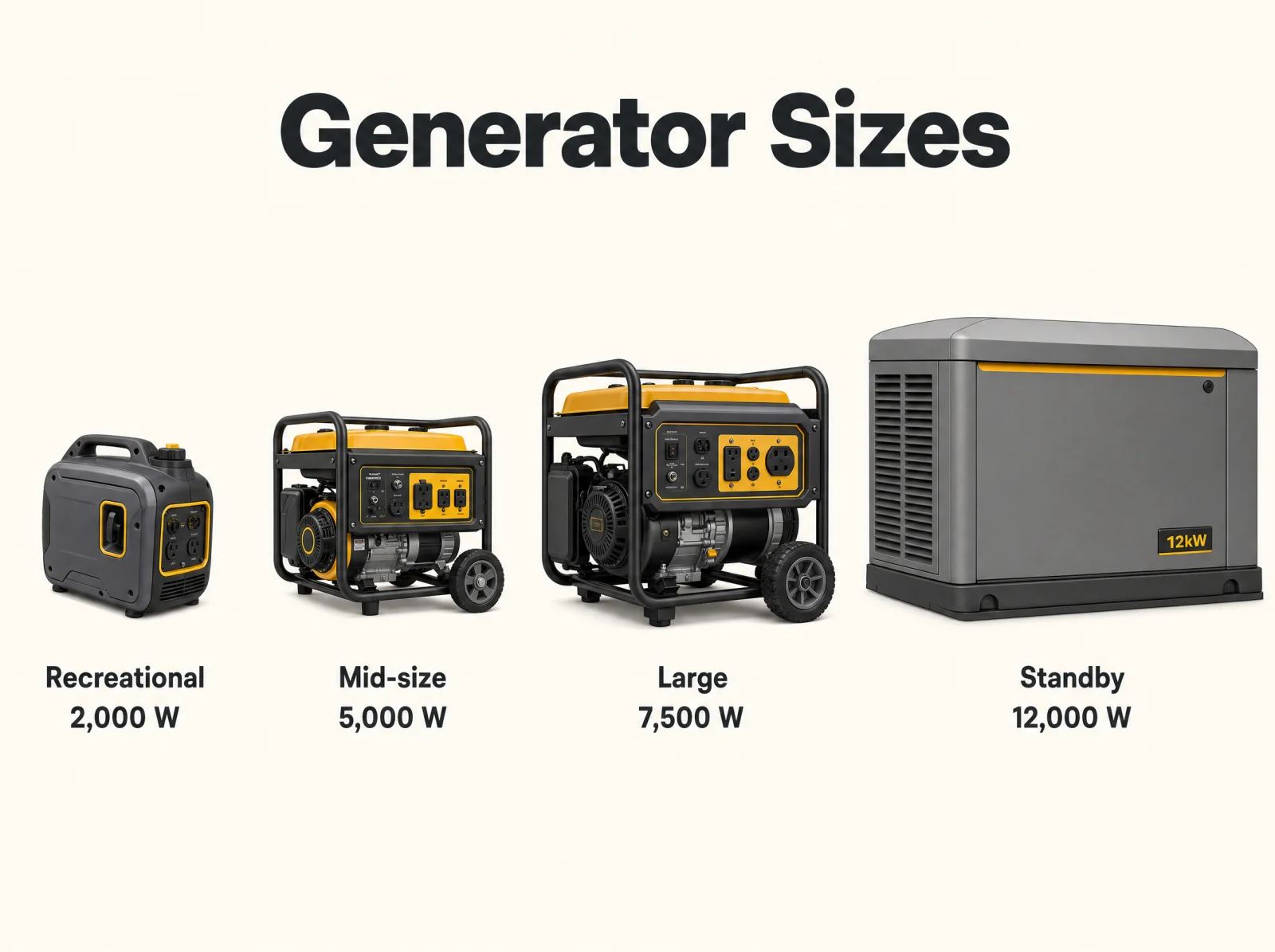
Generator size classes, from a 2,000 W inverter to a 12,000 W standby
Four bands on one wattage axis. The class your load lands in decides not just the price but whether the machine is something you carry, wheel, or bolt to a pad.
Axis is running watts, the same rating the calculator recommends. Class boundaries are the bands this tool sorts a recommendation into, not a manufacturer standard, so a unit sold as a 6,500 W portable sits inside the large band rather than between two of them.
- Inverter, roughly 2,000 to 4,000 W
- Electronically conditioned output, quiet, and frugal at part load because the engine speed follows the load instead of holding a fixed speed. The trade is capacity and price per watt. This is the class for a fridge, lights, a laptop and a router, and the one to pick if the unit will spend most of its life at a campsite.
- Conventional portable, roughly 4,000 to 10,000 W
- The most watts per pound and per pound sterling, at the cost of noise and a fixed engine speed. It is the outage workhorse: fridge, furnace blower, well pump, sump and a run of outlets. Fill it by hand and start it by hand unless you add an electric-start battery.
- Standby, roughly 10,000 W and up
- Permanently installed on a pad, fed from natural gas or propane, and wired to an automatic transfer switch that starts it within seconds of the power failing. This is the only class that covers central air conditioning without a conversation about what to turn off first, and the only one with an installation cost that rivals the machine.
- Where the class boundary really bites
- The step from a large portable to a standby is not a wattage step, it is a change of product. If your peak lands just over 10,000 W, look hard at whether the central air really has to run before committing to a permanent installation with a gas fitting and a permit.
Buyer questions
Generator sizing questions people ask before they buy
The seven that come up in every outage, answered without a sales pitch attached.
What size generator do I need for a house?
For outage essentials such as a fridge, lights, phones, Wi-Fi, and a furnace blower, a 3,000–5,000 watt generator is usually enough. To run most of a home without central air, plan on 7,500 watts; to include central AC, you're into 10,000–12,000 watt standby territory. Add up the running watts of everything you'll run at once, then add the single largest startup surge.
What's the difference between running and starting watts?
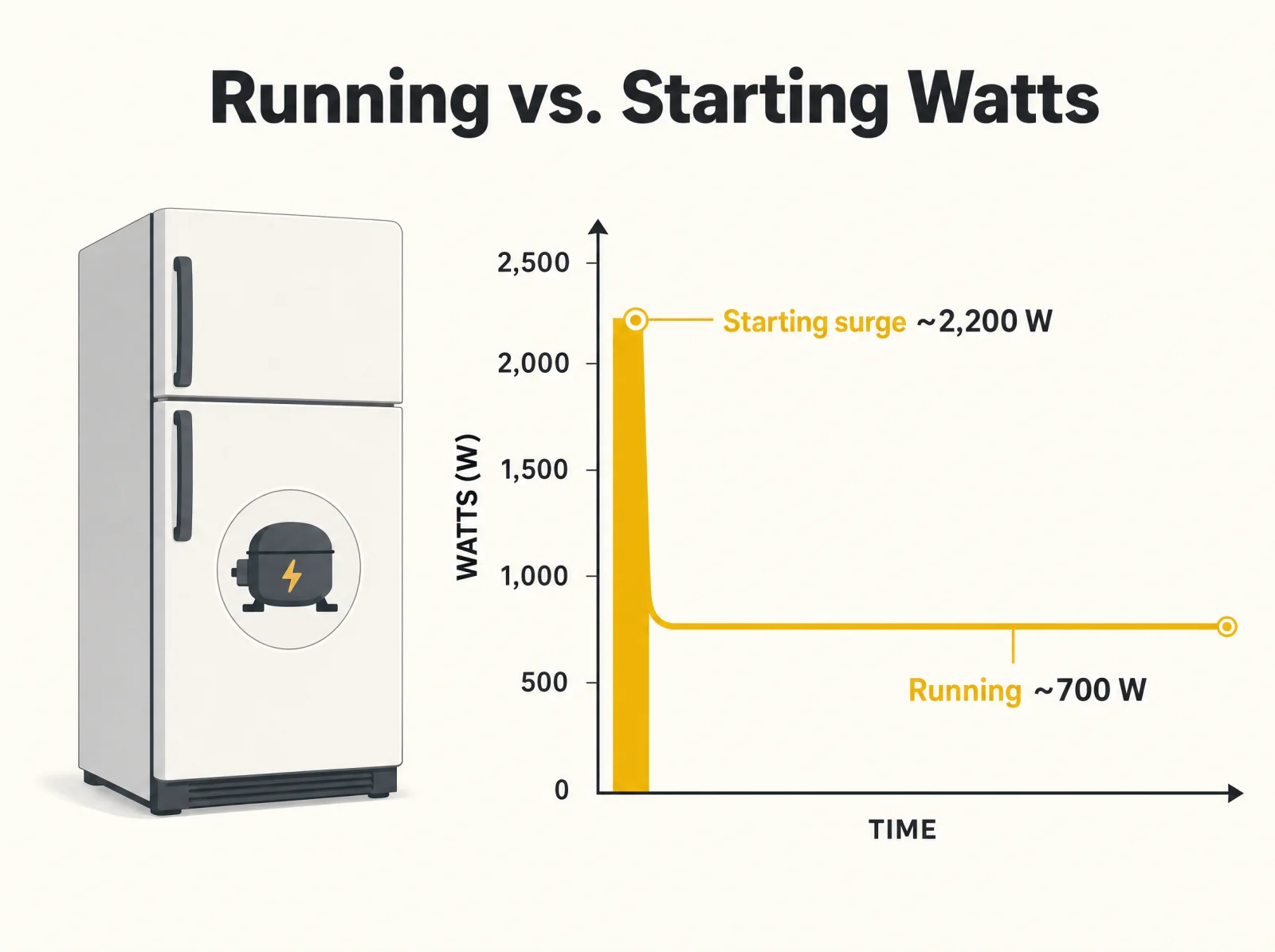
Running (rated) watts is the continuous power an appliance draws. Starting (surge) watts is the brief spike when a motor kicks on: a fridge runs at ~700 W but surges to ~2,200 W for a second. Your generator's running rating must cover the total running load, and its starting rating must cover the biggest surge on top of that.
Why do I only add the largest starting surge, not all of them?
Motors rarely start at the exact same instant, and once running they draw only their running watts. So the worst-case moment is when your biggest motor starts while everything else is already running: total running watts + the single largest surge. Adding every appliance's surge would massively oversize the generator.
What size generator runs a refrigerator and furnace?
A refrigerator (~700 W running, ~2,200 W surge) plus a gas furnace blower (~800 W running, ~2,350 W surge) and some lights needs roughly 1,900 running watts but about 4,200 starting watts. A 3,500–5,000 watt generator covers it comfortably.
What size generator do I need for central air conditioning?
A 3-ton central AC draws about 3,500 running watts and surges to ~5,000 W. Combined with a fridge, furnace, and lights, you'll want a 10,000–12,000 watt generator, typically a permanently installed standby unit with an automatic transfer switch.
Do I need a transfer switch?
To safely power your home's wiring (not just extension cords), yes. A transfer switch isolates your house from the grid so you can't 'backfeed' electricity onto the lines, which can electrocute utility workers and damage equipment. Backfeeding through a dryer outlet is dangerous and illegal, so always use a transfer switch installed by an electrician.
Can I run a generator indoors or in the garage?
Never. Generators emit carbon monoxide that can be fatal within minutes. Run them outdoors only, at least 20 feet from the house, with the exhaust pointed away from doors, windows, and vents. Install battery-backed CO alarms inside.
Disclaimer
These estimates are for planning purposes only. Actual costs vary by location, material availability, and project complexity. Always get at least 3 local quotes. This calculator does not replace professional advice.
Sources