Amp Calculator
Convert watts, volts, and ohms to amps, then check circuit headroom and planning wire size.
Electrical Values
Where to find these
The plate is usually on the back panel, inside the door frame, or under the base. It gives volts plus either watts or amps. If it gives amps directly, you do not need this conversion at all: go straight to the circuit budget below.
Estimates only. Not professional advice.
Current draw
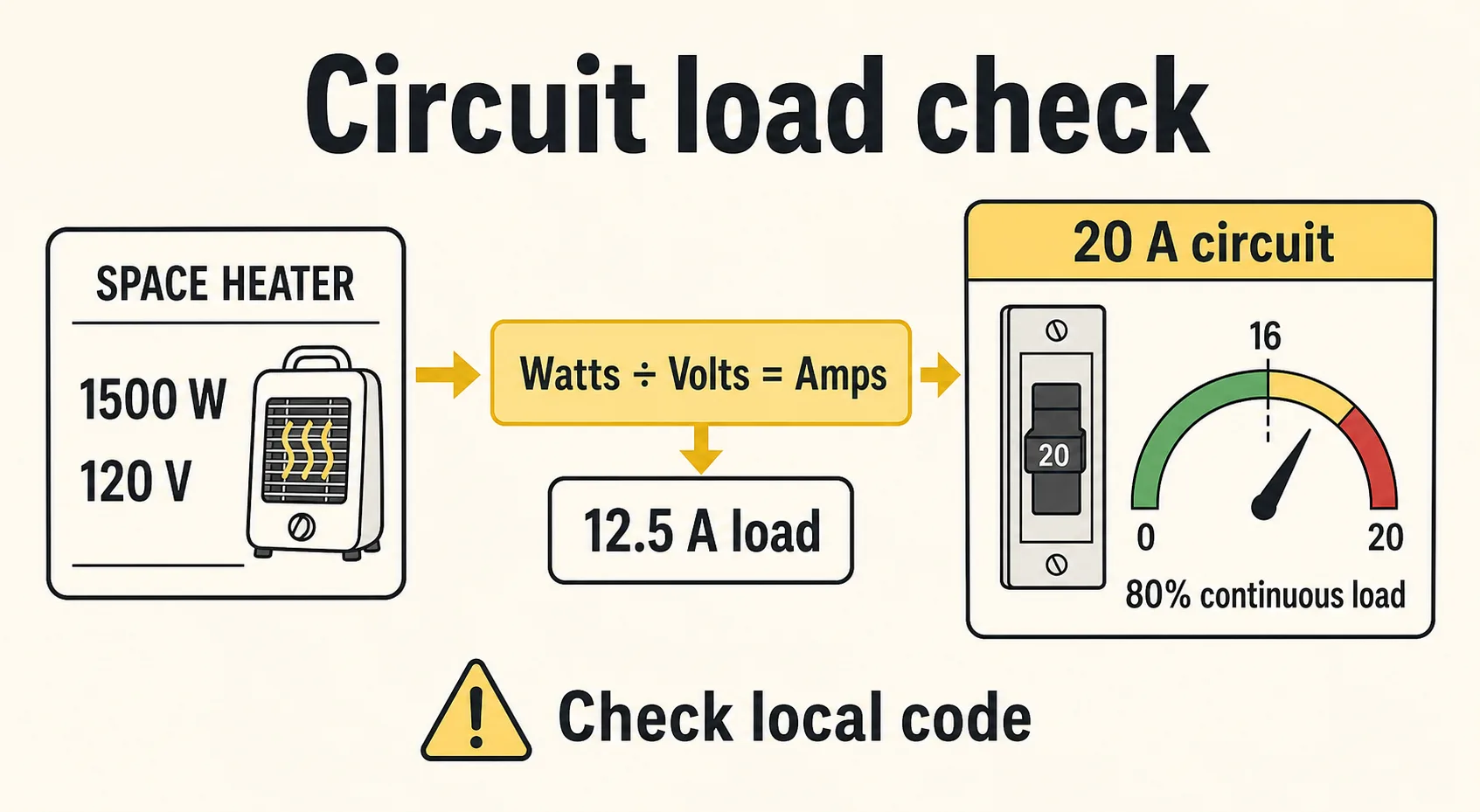
12.5 A
Single phase, solved from watts / volts. Held continuously that becomes 15.63 A of required capacity at the 125 percent factor.
- Apparent power
- 1,500 VA
- Real power
- 1.5 kW
- Resistance
- 9.6 Ω
- Usable at 80% of that breaker
- 16 A
- Planning wire and breaker
- 12 AWG on 20 A
Copper, from the 125 percent continuous-load check only. Termination temperature, conductor material, ambient derating and voltage drop all move the final gauge, and that call belongs to a licensed electrician or your local inspector.
Last updated August 4, 2026. Reviewed by our expert review team.
Load budget
How many amps can a 20 amp circuit actually carry?
Not 20. A breaker is a fault device, not an allowance, and a load that stays on is held to 80 percent of the rating. That is 16 amps on a 20 amp breaker, and it is the number kitchens trip against. Add what is already on the circuit and watch the budget close.
On the circuit
25 A
Past the 20 A breaker rating itself. This trips, and not eventually.
- Your calculated load at 120 V
- 12.5 A
- Microwave at 120 V
- 12.5 A
Move the microwave onto another circuit and the total drops to 12.5 A, back under the 16 A budget. Fitting a bigger breaker instead leaves the existing conductor unprotected, which is the one fix that turns a nuisance trip into a fire risk.
What else would fit
- Hair dryer 12.5 A
- no, takes it to 37.5 A
- Space heater 12.5 A
- no, takes it to 37.5 A
- Window AC 12.5 A
- no, takes it to 37.5 A
- Electric dryer 20.8 A
- needs its own 240 V run
- Hot tub 25 A
- needs its own 240 V run
- EV charger, Level 2 30 A
- needs its own 240 V run
- Electric range 50 A
- needs its own 240 V run
Written and reviewed by
Creator
Ehsan Ghazanfari
Licensed Structural Engineer
FISE-certified structural engineer with 11+ years designing bridges, retaining walls, and foundations. MSc from Aalto University.
See full profileExpert Review
Hawkin
Certified Cost & Estimating Professional
AACE-certified estimator working with 20+ insulation companies including the two largest franchises in America.
See full profileUpdated August 4, 2026
How we verify our calculatorsThis circuit
- Breaker
- 20 A
- Continuous limit
- 16 A
- Conductor at that breaker
- 12 AWG
- Running total
- 25 A
- Percent of breaker
- 125%
- Worst startup peak
- no motor added
Some appliances need their own run whatever the headroom says
A 240 volt appliance cannot share a 120 volt branch circuit at all, so the electric dryer, the hot tub, the Level 2 EV charger and the electric range each need a dedicated two-pole run before headroom is even a question. Which 120 volt appliances the code also requires to have their own circuit is set by NEC Article 210 on branch circuits, cited in the sources at the foot of this page. This calculator does not carry that list, so confirm it with a licensed electrician or your local inspector before you plan a kitchen or a laundry.
- Electric dryer · 240 V, two-pole
- 20.8 A
- Hot tub · 240 V, two-pole
- 25 A
- EV charger, Level 2 · 240 V, two-pole
- 30 A
- Electric range · 240 V, two-pole
- 50 A
Nameplate
What an amp draw on a nameplate leaves out
Every wrong answer on this page starts with a wrong input. These are the seven places the number you type in is not the number the circuit sees.
- Read the nameplate, not the box. The plate on the back of an appliance carries the volts and either the watts or the amps it actually draws, and it is the only figure an inspector cares about. Marketing wattage on the carton is often the peak, not the steady draw.
- A nameplate in volt-amps is not the same number as one in watts. VA is volts times amps with no power factor applied, so on a motor or a transformer the VA figure is the larger of the two and the one that sets your conductor.
- Two appliances of identical wattage draw different amps on different voltages. 1,500 watts is 12.5 amps at 120 volts and 6.25 amps at 240, which is the whole reason ranges and dryers are wired at 240.
- A gauge is only half the answer. Once you have one, our conduit fill calculator checks whether that many conductors of that size legally fit the pipe you were planning to pull them through.
- Three-phase at the same voltage carries 1.73 times the power, so the same motor reads a much lower amp figure on a three-phase supply. Check which one you are on before you trust a single-phase conversion, because almost nothing residential is three-phase.
- Power factor only matters on inductive loads. A resistance heater sits at 1.0 and needs no correction. A motor at 0.85 draws roughly 18% more current than watts divided by volts suggests, and the calculator's three-phase mode is where you enter that.
- Lighting is the load people forget to count, because each fixture is small. Total a run with our recessed lighting calculator before you decide the circuit has room for anything else.
Draw by appliance
Appliance amp draw at 120 and 240 volts
What each thing pulls, and the voltage it pulls it at. Ranges are wide because nameplates are: a 1,000 watt microwave and a 1,500 watt microwave sit in the same cabinet opening.
| Appliance | Watts | Volts | Amps |
|---|---|---|---|
| Microwave | 1,000-1,500 | 120 V | 8.3-12.5 A |
| Hair Dryer | 1,500 | 120 V | 12.5 A |
| Space Heater | 1,500 | 120 V | 12.5 A |
| Window AC | 500-1,500 | 120 V | 4.2-12.5 A |
| Electric Dryer | 5,000 | 240 V | 20.8 A |
| Electric Range | 8,000-12,000 | 240 V | 33.3-50.0 A |
| EV Charger (L2) | 7,200 | 240 V | 30.0 A |
| Hot Tub | 6,000 | 240 V | 25.0 A |
Use the nameplate on your own unit where you can reach it. Long runs do not change the draw, only the voltage drop, which is what our wire size calculator is for.
Startup surge
Why a motor's amps at startup are not its amps running
Anything with a motor draws a short spike as it overcomes standstill. Nameplates carry the running figure, breakers see the spike, and that gap is why one appliance trips a circuit it fits on paper.
| Motor load | Running | At startup | Multiple |
|---|---|---|---|
| Refrigerator / freezer | 700 W | 2,200 W | 3.1x |
| Window AC (10k BTU) | 1,200 W | 3,600 W | 3x |
| Furnace blower (½ HP) | 800 W | 2,350 W | 2.9x |
| Well pump (½ HP) | 1,000 W | 2,100 W | 2.1x |
| Washing machine | 1,200 W | 2,300 W | 1.9x |
| Sump pump (⅓ HP) | 800 W | 1,300 W | 1.6x |
| Central AC (3 ton) | 3,500 W | 5,000 W | 1.4x |
Watts are the running and starting figures from this site's generator size calculator. Multiply your appliance's amps by the multiple on the right and you have its startup draw, since the ratio holds at whatever voltage it runs on. Resistive loads have no surge at all: a space heater, an incandescent lamp and a coffee maker start at exactly their running figure, which is why a heater is the easy case and a compressor is not.
Headroom
Amperage, breaker rating and the 80 percent limit
The amp figure at the top of this page is a property of the appliance. Everything that follows is a property of the circuit, and the two get confused constantly.
- The breaker protects the conductor, not the appliance
- It exists to stop the wire in the wall from overheating. That is why the gauge and the breaker are chosen together, and why fitting a larger breaker to stop nuisance tripping is the one change you must never make: the wire is now unprotected.
- 80 percent is the ceiling for a load that stays on
- A 20 amp breaker should carry no more than 16 amps continuously. Short bursts can use the full rating, which is why a kettle and a space heater behave completely differently on the same circuit.
- 125 percent is the same rule read backwards
- Sizing up from the load instead of down from the breaker, a continuous load needs capacity of 1.25 times its amps. A 16 amp continuous load therefore needs a 20 amp breaker, not a 15. Both numbers describe one rule, and this calculator applies the 125 percent form.
- Standard breaker sizes are a short list
- 15, 20, 30, 40, 50 and 60 amps cover almost everything residential. You round up to the next one on the list, never to something in between, so a 26 amp required capacity lands on a 30.
- Voltage decides the amps, and it is the cheapest lever you have
- The same 4,800 watt appliance draws 40 amps at 120 volts and 20 amps at 240. That single fact is why every heavy appliance in a house is wired at 240, and why the voltage on the nameplate matters more than the wattage.
- A conversion is not a conductor size
- Ampacity depends on the insulation, the termination temperature, how many conductors share the pipe and the ambient heat. Long runs add voltage drop on top. This page gives you the current; the gauge is a separate calculation.
Budget by breaker
Continuous amps allowed on each standard breaker
Rating, the copper this calculator pairs with it, and what is actually usable once the 80 percent limit is applied.
| Breaker | Copper | Continuous | Watts at 120 V | Watts at 240 V |
|---|---|---|---|---|
| 15 A | 14 AWG | 12 A | 1,440 W | 2,880 W |
| 20 Ayours | 12 AWG | 16 A | 1,920 W | 3,840 W |
| 30 A | 10 AWG | 24 A | 2,880 W | 5,760 W |
| 40 A | 8 AWG | 32 A | 3,840 W | 7,680 W |
| 50 A | 6 AWG | 40 A | 4,800 W | 9,600 W |
| 60 A | 4 AWG | 48 A | 5,760 W | 11,520 W |
Gauges are the copper column this calculator pairs with each breaker, which is the familiar residential chart. Watt columns are the continuous amps times the voltage, so they are the total a circuit can hold all day, not the total it can hold for a minute.
Worked circuits
Amp draw for four real circuits, worked end to end
Every figure below is what this calculator returns for those inputs, including the gauge and breaker it pairs with them.
Kitchen microwave
1,200 W at 120 V, single phase
10 A · 14 AWG · 15 A breaker
The 125 percent check turns 10 amps into 12.5 of required capacity, which lands on a 15 amp breaker. Note where that leaves you: 12 amps of continuous budget against a 10 amp draw, so this circuit has room for a clock and not much else.
Electric dryer
5,000 W at 240 V, single phase
20.83 A · 10 AWG · 30 A breaker
At 240 volts the same 5,000 watts draws half what it would at 120. The 125 percent factor pushes 20.83 amps up to 26 of required capacity, and since 26 is not a breaker size you take the 30.
Level 2 EV charger
7,200 W at 240 V, single phase
30 A · 8 AWG · 40 A breaker
The clearest continuous load in a house: a charger pulls its full 30 amps for hours. 125 percent of 30 is 37.5, so the 40 amp breaker is not padding, and 32 amps of continuous budget on that breaker is why 30 fits and 35 would not.
Workshop motor, three phase
3,000 W at 240 V, PF 0.85
8.49 A · 14 AWG · 15 A breaker
Three phase spreads the same power across three conductors, so the per-conductor current drops sharply. The 0.85 power factor pulls in the other direction, adding about 18 percent over what watts divided by volts alone would suggest.
Trip log
Where amp calculations go wrong on a real panel
None of these is an arithmetic slip. Each one is a correct sum applied to the wrong thing, which is why the number looks fine right up to the point the breaker goes.
Treating watts and amps as the same measurement
Watts is power consumed, amps is current flowing, and voltage is the bridge between them.
Keep the voltage in the sentence. A 1,500 watt heater is 12.5 amps at 120 volts and 6.25 amps at 240, and only one of those fits a 15 amp circuit.
Sizing the breaker to the load exactly
A load that runs for hours needs headroom above it, and a breaker sized flush to it will trip in normal use.
Multiply a continuous load by 1.25, then take the next standard size. A 16 amp continuous load wants a 20 amp breaker, not a 15.
Running the numbers at 120 V for a 240 V appliance
The wattage on the plate is the same either way, so the mistake produces a figure exactly twice as large as reality.
Read the voltage off the plate first. A 4,800 watt dryer is 40 amps at 120 volts and 20 amps at 240, and the wrong one costs you two gauges of copper.
Ignoring power factor on a motor
Inductive loads draw more current than watts divided by volts predicts, because some of the current does no work.
Use the three-phase mode and enter the plate's power factor. At 0.85 the motor pulls roughly 18 percent more current than the naive figure.
Sizing a circuit for one appliance at a time
The breaker sees the sum of everything switched on, and two devices that each fit will trip together.
Total the circuit, not the appliance. Two 12 amp appliances on a 20 amp breaker come to 24 amps, past even the breaker rating, let alone the 16 amp continuous limit.
Sizing to running amps when the load has a motor
A compressor or pump pulls a brief spike far above its plate figure as it starts, and that spike is what the breaker reacts to.
Check the startup multiple in the surge table above and leave room for the largest one on the circuit. A window AC can start at three times its running draw.
Ask the inspector
Amps, watts and breaker sizing questions
The eight things people actually ask before they buy wire, answered short.
How many amps does 1500 watts draw at 120 volts?
12.5 amps. Use a 20-amp circuit with 12 AWG wire.
What is the formula for amps?
Amps = Watts / Volts for resistive loads. For AC with power factor: Amps = Watts / (Volts x PF).
What wire size for 30 amps?
10 AWG copper wire for runs up to 50 feet. Use 8 AWG for longer runs to reduce voltage drop.
How do I know what size breaker I need?
Calculate the amperage, multiply by 1.25 for continuous loads, and select the next standard breaker size (15, 20, 30, 40, 50, 60).
What is the difference between watts and amps?
Watts measure power consumed. Amps measure current flow. Watts = Amps x Volts.
Single phase vs three phase?
Single phase uses one live wire (residential). Three phase uses three live wires delivering 1.73x more power (commercial/industrial).
What is power factor?
The ratio of real power to apparent power in AC circuits. Resistive loads (heaters) have PF of 1.0. Motors have PF of 0.8 to 0.95.
How many amps can 12 AWG wire handle?
20 amps maximum per NEC. At 80% continuous rating, that is 16 amps of continuous load.
Conversions
The three amp conversions this tool runs, and the 125 percent factor
Pick the two values you actually have and the mode changes which identity is solved. Watts and volts is the everyday case. Volts and ohms is Ohm's law direct, used when you have measured a resistance rather than read a plate. Watts and ohms is the one people reach for on heating elements, where the plate gives power and the element gives resistance but nobody stamped the current.
Three-phase divides by the root of three and by the power factor, so the same power reads as a much lower per-conductor current. The wire and breaker line is a planning figure only: it applies the 125 percent continuous factor and then takes the first copper gauge whose rating clears it. It does not derate for ambient heat, for several circuits in one conduit, or for voltage drop over a long run.
The identities
amps = watts ÷ voltsamps = watts ÷ (volts × √3 × PF)amps = volts ÷ ohmsamps = √(watts ÷ ohms)capacity = amps × 1.25continuous = breaker × 0.8The last two are one rule from opposite ends: 1 ÷ 0.8 is 1.25. This calculator uses the 125 percent form to pick a breaker, and the 80 percent form to report what that breaker then leaves you.
Disclaimer
These estimates are for planning purposes only. Actual costs vary by location, material availability, and project complexity. Always get at least 3 local quotes. This calculator does not replace professional advice.
Sources