Furnace Size Calculator
Size a gas furnace by floor area, climate and AFUE, in nameplate BTU.
Home and climate
Conditioned living space, not the lot
Virginia, Tennessee, mid-Atlantic at 40 BTU/sq ft
Nameplate to shop for
100k BTU input
A 2000 sq ft home in a moderate climate, at 95% AFUE. The nameplate is fuel in; the house gets 95,000 BTU/hr of it.
- Heating load
- 2,000 sq ft × 40 BTU/sq ft = 80,000 BTU/hr
- Furnace input
- 80,000 ÷ 95% AFUE = 84,211 BTU/hr
- Round up
- next standard furnace size = 100,000 BTU
- Standard nameplate to buy
- 100,000 BTU
A per-area rate is a planning shortcut for a full ACCA Manual J, which is what accounts for windows, orientation, ceiling height, duct losses and your local design temperature. Estimates only, not professional advice.
Last updated August 6, 2026 by our expert review team.
Flue split
Furnace AFUE, drawn: what you buy against what the house gets
A furnace nameplate is fuel going in. AFUE is the share of it that reaches the rooms, and the rest leaves through the flue. Below is your own nameplate cut at your own AFUE, with the 80% rung beside it on the same axis.
Both rungs heat the same house, so the 80% burner simply buys 15,789 BTU/hr more gas to do it, which is 158 therms for every 1,000 hours the burner spends at full fire.
Both bars share one axis, so every segment is as wide as the BTU it names, and a therm is 100,000 BTU by definition. The 1,000 hours is a stated basis you can scale, not a modeled winter: this page carries no degree days, no full-load hours and no gas price, so it cannot turn that gap into dollars for your address.
Which rung to buy
80% AFUE, non-condensing
Cheapest to buy and cheapest to vent, because it can share a masonry chimney. It also sends a fifth of every therm out of the flue, which is only defensible where winters are mild, gas is cheap, or you are not keeping the house long.
90 to 95% AFUE, condensing
your pickThe default across most of the country, and what a growing number of codes now require. Needs its own plastic vent and a condensate drain, and repays the premium fastest where the burner runs long hours.
96 to 98% AFUE, modulating
Buys quiet, even heat as much as it buys fuel: a modulating burner holds a low firing rate on a mild day instead of cycling on and off. Worth the money in a very cold zone with a bill to match.
Nameplate BTU
What Size Furnace Do I Need?
Most homes land between a 40k and a 140k BTU nameplate. Getting there takes three steps, and the second one is what nearly every rule of thumb online leaves out.
Find the heat the house loses
Multiply your heated floor area by a rate for your climate, from 30 BTU/sq ft in the hot band up to 60 in the very cold one, then adjust for how tight the envelope is. That product is the heating load, in BTU per hour, on a design-cold day.
Turn the load into a nameplate
Gas furnaces are sold by INPUT, so divide the load by AFUE. An 80% burner needs a nameplate 25% larger than the heat it has to deliver; a 95% one needs about 5% larger. Then round up to the next standard size, which is one of 40k, 60k, 80k, 100k, 120k, 140k BTU.
Check it against a real load calculation
A per-area rate cannot see your windows, your ceiling height, your duct losses or your local design temperature. Ask for the ACCA Manual J before money changes hands, and use the number above to tell whether the quote in your hand is plausible.
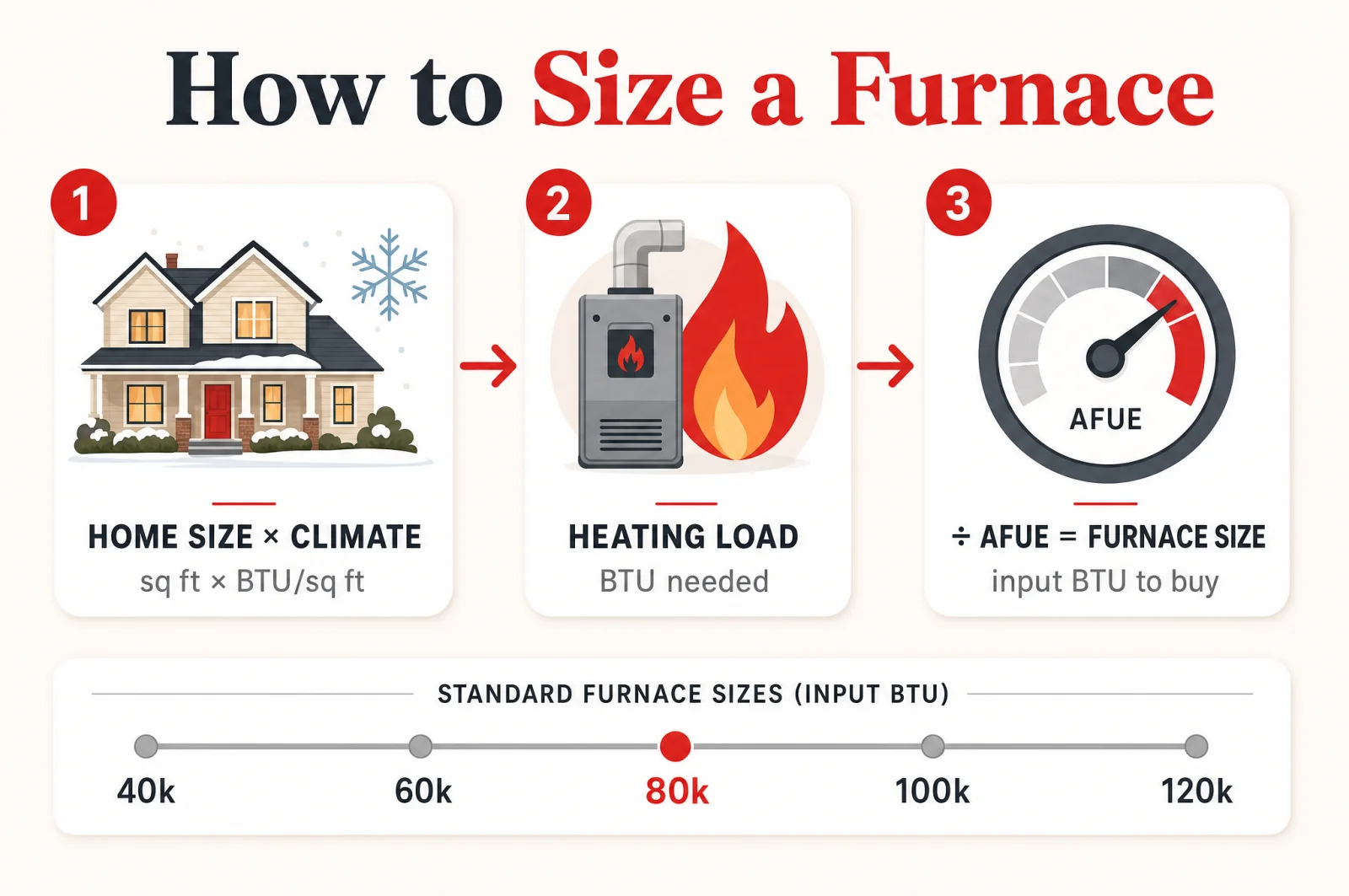
The division by AFUE is the step that turns a load into something you can shop for. Skip it and you have priced heat, not a furnace.
Firing rates
Furnace size chart by square footage and climate zone
Twenty-five nameplates, every one of them computed at the AFUE and envelope you entered rather than at somebody else's assumption. Change either input above and the whole grid moves.
Nameplate input BTU at 95% AFUE, envelope set to average at 1.00x, rounded up to a standard size. A plus sign means the load runs past the largest single residential furnace, so the row needs two units or a tighter house. The tinted row is the one nearest the area you typed.
Therms
Furnace size for three real homes, nameplate by nameplate
Each one runs through the same arithmetic as the calculator, so you can type any of them in and get the identical figures. The third one is the interesting one: a low AFUE and a leaky envelope stack up.
Cold-Climate Two-Story
120k
BTU nameplate to shop for
114,000 BTU/hr reaches the rooms
- Home
- 2,200 sq ft
- Climate
- Cold
- Envelope
- Average
- AFUE
- 95%
- Load
- 110,000 BTU/hr
- Input needed
- 115,789 BTU/hr
Big, cold-climate homes land at the top of the range. Confirm with a Manual J before buying.
Warm-Climate Ranch
60k
BTU nameplate to shop for
57,000 BTU/hr reaches the rooms
- Home
- 1,400 sq ft
- Climate
- Warm
- Envelope
- Average
- AFUE
- 95%
- Load
- 49,000 BTU/hr
- Input needed
- 51,579 BTU/hr
Mild winters need surprisingly little, so don't let a contractor oversize 'to be safe.'
Older, Drafty Home
120k
BTU nameplate to shop for
96,000 BTU/hr reaches the rooms
- Home
- 1,800 sq ft
- Climate
- Moderate
- Envelope
- Older / drafty
- AFUE
- 80%
- Load
- 82,800 BTU/hr
- Input needed
- 103,500 BTU/hr
Leaky envelope plus a low-efficiency furnace pushes the input size up. Air-sealing first can drop you a size.
Fuel to heat
How this furnace size calculator gets from floor area to nameplate BTU
Two lines of arithmetic, one round-up, and the four more the plate above needs. All seven are printed below, so nothing on this page is doing work you cannot check by hand.
heating load = area × BTU/sq ft rate × envelopefurnace input = heating load ÷ AFUEnameplate = next standard size ≥ inputheat delivered = nameplate × AFUEup the flue = nameplate − heat deliveredfuel for the load = heating load ÷ AFUEtherms per 1,000 h = extra BTU/hr ÷ 100Two things there are worth being blunt about. The per-area rate is a planning shortcut for a full ACCA Manual J: it knows your climate band and roughly how tight the house is, and it knows nothing about your glazing, your orientation or your ducts. And the fuel comparison is deliberately quoted in therms per 1,000 hours at full fire rather than per winter, because turning it into a season needs equivalent full-load hours for your address and turning it into money needs a gas tariff. This page carries neither, so it publishes neither.
Deliberately absent: a price per therm, heating degree days, equivalent full-load hours, a combustion-air or altitude derate, and any regional utility rate. Nothing above quotes one.
Short cycling
Six ways a furnace ends up the wrong size
An oversized burner is not a harmless margin. It reaches temperature, shuts off, and starts again, which wastes fuel, wears the igniter and blower, and leaves the far rooms cold anyway.
Shopping the output number
The nameplate on a gas furnace is fuel going in, not heat coming out. Divide the load by AFUE first, or you will buy a burner that delivers less heat than the house loses.
Rounding up twice
The next standard size is already a round-up. Adding a safety margin on top of it lands you two sizes over, and the burner then short cycles instead of running long and steady.
Sizing off a cooling rule
Cooling and heating do not share a per-area rate. A cold zone wants 50 to 60 BTU/sq ft of heat where the cooling figure is far lower, so start from a heating rate or from our BTU calculator.
Leaving the envelope out of it
A drafty house carries 1.15x the load of an average one and a tight house 0.85x. Air sealing before you buy can drop you a whole nameplate size, and our insulation calculator prices that route.
Fitting a condensing furnace to the old flue
A 90%-plus burner runs cool enough that its exhaust condenses, so it needs plastic venting and a condensate drain. A masonry chimney sized for an 80% unit is not a substitute, and finding that out on install day is expensive.
Never asking for the Manual J
A per-area rate plans the job and sanity checks a bid. Windows, orientation, ceiling height, duct losses and your local design temperature only turn up in an ACCA Manual J, and every contractor worth hiring will hand you theirs.
On your own numbers: this house loses 80,000 BTU/hr and the nameplate above delivers 15,000 BTU/hr more than that already. Going one size up would sit 34,000 BTU/hr over the load instead, which is where short cycling starts.
Staging
Seven things that change the furnace size on your quote
Not a sequence, so not numbered. Each one is worth raising while more than one contractor still wants the job.
Air seal and insulate before you settle the size. The envelope multiplier swings from 1.15x to 0.85x, which is roughly a quarter off the load, and a quarter off the load is often one nameplate size.
Ask whether the burner is single stage, two stage or modulating. All three can carry the same nameplate; only the last two can run at part load on a mild day, which is where most of the heating season actually sits.
Check the gas line and the meter before the burner grows. A bigger nameplate draws more fuel per hour, and an undersized supply shows up as a burner that will not hold its firing rate.
Confirm the venting route for anything above 90% AFUE. Condensing exhaust needs its own plastic vent and a condensate drain to a trap, and the run has a length limit.
Ask what the ducts can actually move. A nameplate the ductwork cannot deliver heats unevenly whatever the sizing says, so check the airflow with our CFM calculator.
Price the alternative once. In a mild zone the same load can be carried by a heat pump, and our heat pump cost calculator puts that side by side with a furnace before you commit to a burner.
Get the Manual J in writing, with the design temperature it used. Two contractors quoting different sizes usually disagree about the design day, not about your house.
Burner questions
Furnace size questions, from BTU per square foot to Manual J
Seven answers in roughly the order they arrive, starting with the size query that brings most people here.
What size furnace do I need for a 2,000 sq ft house?
In a moderate climate, a 2,000 sq ft home needs roughly 80,000 BTU of heating load, so a 100,000 BTU input furnace at 95% AFUE is typical. In a cold climate it climbs to about 120,000 BTU; in a warm climate an 80,000 BTU furnace is plenty. Insulation and air-sealing shift this, so treat it as a starting point.
How many BTUs per square foot do I need for heating?
About 30 BTU/sq ft in hot climates, 40 in moderate ones, and 50–60 in cold ones. That gives the heating load (output). The furnace's nameplate is an INPUT rating, so you divide the load by the AFUE efficiency to get the input size to shop for.
What is AFUE and how does it affect furnace size?
AFUE (Annual Fuel Utilization Efficiency) is the share of fuel a furnace turns into usable heat. An 80% furnace wastes 20% up the flue, so it needs a bigger input rating to deliver the same heat as a 95% unit. That's why this calculator divides the heating load by AFUE to find the input BTU you actually buy.
Is it bad to oversize a furnace?
Yes. An oversized furnace short-cycles: it blasts to temperature, shuts off, and repeats. That wastes fuel, wears out the igniter and blower, and leaves uneven, drafty comfort. Bigger is not better; right-sized is.
Should I get an 80% or a 95%+ AFUE furnace?
In cold climates with high heating bills, a 90–97% condensing furnace usually repays its higher upfront cost in fuel savings within a few years and is often required by code. In mild climates or short-term homes, an 80% furnace can make sense. Run the payback on your local gas price.
What's the difference between furnace input and output BTU?
Input is how much fuel energy the furnace burns per hour (the nameplate number, e.g. 100,000 BTU). Output is the heat actually delivered to your home, which is input × AFUE. A 100,000 BTU input furnace at 95% AFUE delivers about 95,000 BTU of heat.
Do I still need a Manual J load calculation?
For a final purchase, yes. A square-foot estimate like this is great for planning and sanity-checking a quote, but a proper ACCA Manual J accounts for your windows, orientation, ceiling height, duct losses, and local design temperature. Ask any contractor for their Manual J.
Disclaimer
These estimates are for planning purposes only. Actual costs vary by location, material availability, and project complexity. Always get at least 3 local quotes. This calculator does not replace professional advice.
Sources
Related Calculators
BTU Calculator
Heating & cooling load for any room
Heat Pump Cost Calculator
Compare a heat pump to a furnace
Mini Split Calculator
Ductless zone-by-zone sizing
CFM Calculator
Airflow the ducts have to move
Square Footage Calculator
Measure the heated area first
Insulation Calculator
Tighten the envelope, shrink the load