Heat Pump Cost Calculator
Price a heat pump against the system you are replacing, with the credit and the payback.
System Details
Installed cost
$6,500 to $13,500
Air-Source Heat Pump on a 2,000 sq ft home in a moderate climate, before the modeled federal credit.
- Equipment
- $3,500 to $7,500
- Installation
- $3,000 to $6,000
- Modeled federal credit
- -$2,000
- Net after the credit
- $4,500 to $11,500
18 SEER cooling, 10 HSPF heating. The system you are replacing is modeled at $1,200 a year, so the swap avoids about 4,067 lb of CO2 a year. Excludes permits, panel work, duct repairs, tear-out and disposal. Credit eligibility is modeled, not confirmed. Estimates only, not professional advice.
Last updated August 5, 2026 by our expert review team.
Quote review
Heat pump cost mistakes that surface after the install
Six of these, and every one is decided before anybody picks up a tool. The expensive ones are not about the equipment at all.
Treating the incentive as automatic
Eligibility turns on the model number, the install date, your tax position and the paperwork. Confirm it against current IRS guidance and the Energy Star product list before you let a bid subtract it for you.
Buying the pump before pricing the swap
The install price barely notices what is coming out. The running cost notices enormously. Settle which system you are replacing first, then shop equipment.
Oversizing on square footage alone
A pump sized off floor area short-cycles and controls humidity badly. Ask for a Manual J load, and sanity-check the answer with our BTU calculator.
Leaving the ductwork out of the scope
Leaky or undersized ducts can cost more than the equipment discount that hid them. Where ducts are the problem, price a ductless layout with our mini split calculator instead.
Comparing bids on the bottom line
A cheaper number often means electrical work, permits, controls, duct repairs or disposal were left off. Compare the scope line by line, then compare the totals.
Skipping the local rebate check
Utility and state programs change on their own schedule and often name eligible models. A rebate found after the install is usually a rebate lost.
Not in this estimate
Every line below is real money on a real changeover, and none of it is in the figure above. Ask which of them your bid includes.
- Electrical panel or service upgrade
- Duct repair, sealing or replacement
- Permits and inspection fees
- Tear-out and disposal of the old system
- Line sets, condensate and thermostat wiring
- Backup or strip heat, where the pump needs it
- Maintenance plan after year one
The estimate also assumes the credit lands. If your equipment or your tax position does not qualify, put the $2,000 back on the net figure.
Changeover
Heat pump payback turns on what you are replacing
The install price hardly moves with what is in the basement now. The case for doing it moves enormously. Below is your home, your pump and your climate run against all five systems that could be coming out.
The air-source heat pump on this 2,000 sq ft home is modeled at $800 a year to run, and $8,000 to buy after the modeled credit. Everything in the table changes because of the left-hand column, and nothing else.
Electric Baseboard
runs now $2,800/yr
difference $2,000/yr
payback 4.0 yr
Pays back well inside 15 to 20 years
Electric Furnace + AC
runs now $2,400/yr
difference $1,600/yr
payback 5.0 yr
Pays back well inside 15 to 20 years
Oil Furnace + AC
runs now $2,000/yr
difference $1,200/yr
payback 6.7 yr
Pays back well inside 15 to 20 years
Gas Furnace + AC
what you haveruns now $1,200/yr
difference $400/yr
payback 20.0 yr
Pays back only near the end of that service life
No Existing System
runs now nothing
difference none
payback n/a
Nothing to save against, so this is a comfort and equipment decision
The same swap in five climate zones
hot
17.9
years to pay back
$3,975 to $10,375
warm
19.3
years to pay back
$4,325 to $11,125
moderate
20.0
years to pay back
$4,500 to $11,500
your zonecool
21.4
years to pay back
$4,850 to $12,250
cold
23.4
years to pay back
$5,375 to $13,375
Net cost after the modeled credit, and the payback it buys. In this model the climate zone multiplies the equipment price and nothing else, so the running cost and the yearly difference hold still and only the capital moves.
A real machine also loses capacity and efficiency in deep cold, and a real gas or oil bill follows a local fuel price. This page carries neither: the systems coming out are flat dollars a year, not a fuel price times an efficiency. So read the ORDER of these rows, which is robust, and not the exact dollar, which is not. Whether your gas is cheap enough to beat a heat pump on running cost is a local question, and in some markets the answer is yes.
Priced changeovers
Heat pump cost by home size: four priced jobs
Each one runs through the same arithmetic as the calculator above, so you can type any of them in and get the identical figures. They differ mainly in what is coming out, because that is what moves the answer.
Small house, baseboard out
1.9
years to pay back
$2,025 to $5,100
- Home
- 1,200 sq ft
- Pump
- Mini Split
- Coming out
- Electric Baseboard
- Climate
- Cold
- Credit
- -$1,069
- Difference
- $1,287/yr
The clearest case on the page. Electric heat already pays for every unit of electricity, and the pump delivers several times more heat for each one.
Average house, gas furnace out
20.0
years to pay back
$6,500 to $13,500
- Home
- 2,000 sq ft
- Pump
- Air-Source
- Coming out
- Gas Furnace
- Climate
- Moderate
- Credit
- -$2,000
- Difference
- $400/yr
The same install price as the row above at twice the floor area, against the cheapest running cost this model carries. Payback is the whole story here.
Larger house, oil furnace out
9.3
years to pay back
$10,985 to $21,970
- Home
- 2,600 sq ft
- Pump
- Hybrid
- Coming out
- Oil Furnace
- Climate
- Cool
- Credit
- -$2,000
- Difference
- $1,560/yr
Dual fuel keeps the existing burner for the coldest hours, so the pump does not have to cover the design day on its own.
Large house, electric furnace out
12.3
years to pay back
$33,750 to $67,500
- Home
- 3,000 sq ft
- Pump
- Geothermal
- Coming out
- Electric Furnace
- Climate
- Cold
- Credit
- -$15,188
- Difference
- $2,880/yr
The only row where the modeled credit is uncapped, which is what keeps a ground loop in the conversation at all.
Cost stack
What sits inside a heat pump cost, layer by layer
The outdoor unit is one line on a quote. Labor, electrical work, controls, ducts or line sets, incentives and the yearly running cost are the rest of it, and they are where two bids on the same house end up thousands apart.
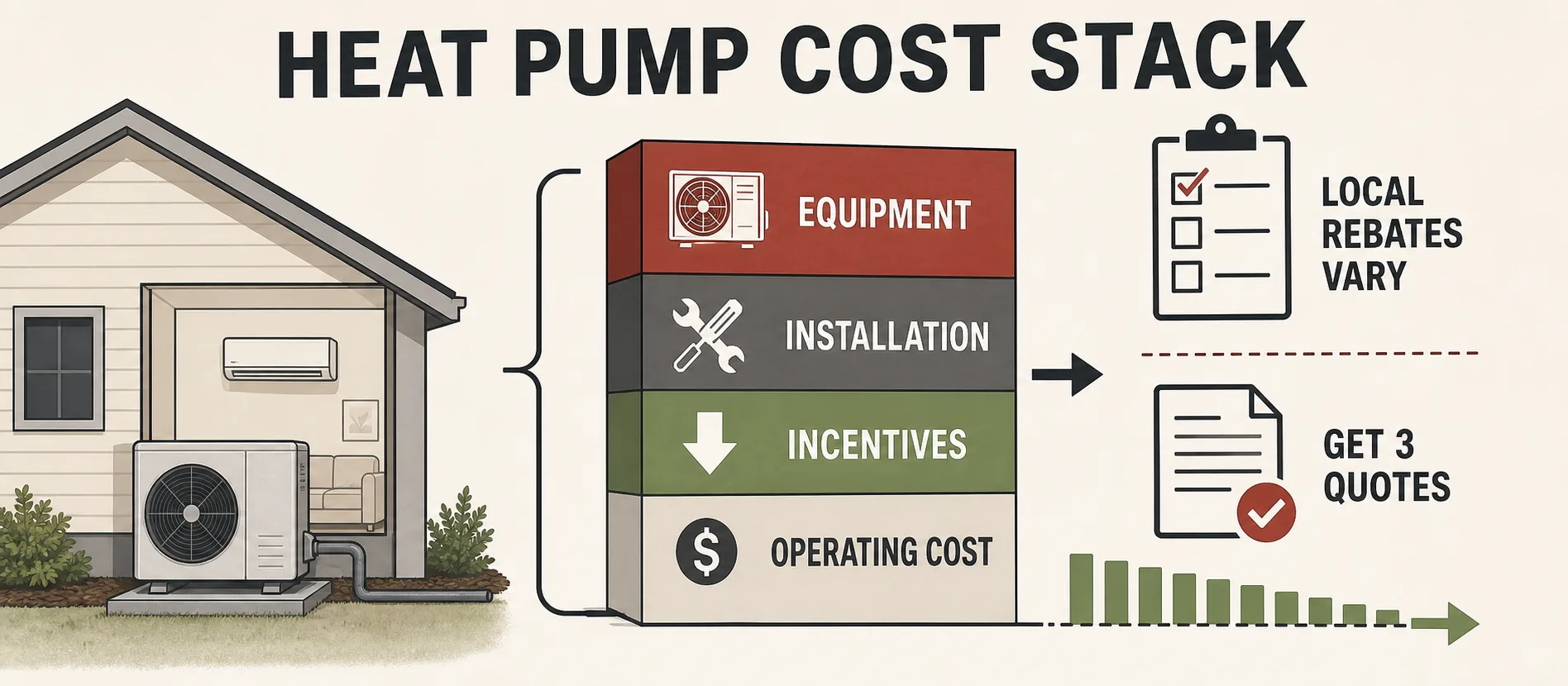
Work down the stack in order. A bid that beats another on the top layer and loses on the next three is not the cheaper job.
Before the bid
Heat pump quotes: what to settle before you sign
Not a sequence, so not numbered. Each one is a question worth asking while three contractors are still competing for the work.
Federal credits carry eligibility rules, dollar caps and dates. Check IRS guidance and the Energy Star list before you let a quote assume one.
Size the load before you shop the box. Our BTU calculator is the screen; the contractor's Manual J is the decision.
Ask every bidder to split equipment, labor, electrical work, ductwork, controls and permits onto separate lines. Three bids with the same line items is a comparison; three totals is not.
Geothermal is priced by the ground, not the machine. Drilling access, soil, trenching and yard restoration move a ground-loop quote more than the indoor unit ever will.
Hybrid dual fuel keeps the furnace for the coldest hours. It is the answer where the design temperature or the local price ratio makes an all-electric changeover hard to pencil out.
Ask what the balance point is set to and what the backup heat is. A cold-climate machine that hands off to electric strip heat at the wrong temperature will surprise you in January.
Fix the envelope first where it is cheap to fix. Our attic insulation calculator shrinks the load, and a smaller load is a smaller pump.
Local rebates change often, and some name specific model numbers. Check the utility, the state energy office and the rebate marketplace before you sign anything.
The arithmetic
How this heat pump cost calculator builds its estimate
Everything scales off one ratio: your floor area against a 2,000 sq ft baseline. Equipment also carries the climate factor; installation does not.
size factor = home ÷ 2,000 sq ftequipment = base × size factor × climateinstallation = base × size factorcredit = min(30% × average installed, $2,000)geothermal credit = 30% × average installed, uncappedrunning = $0.40 per sq ft per yr × (18 ÷ SEER)difference = current running − pump runningpayback = average net cost ÷ differenceCO2 = difference ÷ $0.12 per kWh × 1.22 lbTwo things in that list are worth being blunt about. The running cost for the pump comes from one baseline scaled by the SEER ratio, so it responds to equipment efficiency but not to your utility rate. And the system coming out is a flat dollars-per-year figure per fuel, not a local fuel price multiplied by a furnace efficiency. That is enough to rank the five changeovers against each other, which is what the ledger above does, and it is not enough to tell you whether your own gas is cheaper than your own electricity.
Deliberately absent, because this page does not carry them: a price per therm, a price per gallon of oil, a furnace AFUE, a COP at any given outdoor temperature, and any regional utility rate. Nothing on this page quotes one.
Installed price
Heat pump installed cost by system type
Four systems on one axis, so the step up to a ground loop is the real step and not a chart trick. The bars are the 2,000 sq ft baseline in a moderate climate; the right-hand figure is the same system on the home you entered.
Mini Split
$3,000 to $7,500
$3,000 to $7,500
Air-Source
your pick$6,500 to $13,500
$6,500 to $13,500
Hybrid
$8,000 to $16,000
$8,000 to $16,000
Geothermal
$20,000 to $40,000
$20,000 to $40,000
Equipment and installation together, before the modeled credit. Geothermal includes the ground loop, which is the part a site survey can move most.
Counter questions
Heat pump cost questions that come up before the bid
Eight answers in roughly the order they arrive, starting with the one the whole page exists to price.
How much does a heat pump cost?
A standard air-source heat pump costs $6,500 to $13,500 installed for a 2,000 sq ft home. Mini splits run $3,000 to $7,500, while geothermal systems range from $20,000 to $40,000 including the ground loop.
What is the federal tax credit for heat pumps?
Federal rules can change and depend on equipment eligibility. This calculator models a 30% credit with a $2,000 cap for non-geothermal systems and an uncapped geothermal estimate. Confirm details with IRS guidance or a tax professional.
Air-source vs geothermal: which is better?
Air-source systems usually cost less upfront. Geothermal systems usually cost more because of the ground loop, but can be efficient and long-lasting where site conditions make sense.
How much can I save with a heat pump?
Savings depend on your current fuel, electric rate, climate, insulation, equipment efficiency, and ductwork. Replacing electric resistance heat is often the clearest savings case.
How long does a heat pump last?
Air-source and mini split heat pumps last 15 to 20 years with proper maintenance. Geothermal ground loops last 50+ years, though the indoor heat pump unit lasts about 25 years.
Do heat pumps work in cold climates?
Yes, many modern cold-climate systems can heat in low outdoor temperatures. Capacity and efficiency still vary by model, so cold-climate projects need careful sizing and backup planning.
What is HSPF?
HSPF (Heating Seasonal Performance Factor) measures heating efficiency. Higher is better. Standard units rate 8.2 HSPF while high-efficiency models reach 10 to 13. Geothermal systems achieve an equivalent of 13 to 15 HSPF.
Is a heat pump worth it?
It can be, especially when replacing electric resistance, oil, or aging AC plus furnace equipment. The best answer depends on quote quality, incentives, utility rates, and comfort goals.
Disclaimer
These estimates are for planning purposes only. Actual costs vary by location, material availability, and project complexity. Always get at least 3 local quotes. This calculator does not replace professional advice.
Sources
Related Calculators
BTU Calculator
Room heating and cooling loads
Mini Split Calculator
Ductless system sizing
Insulation Calculator
R-value requirements
Attic Insulation Calculator
Attic R-value sizing
Spray Foam Calculator
Spray foam estimates
CFM Calculator
Room airflow & ventilation
Furnace Size Calculator
Furnace BTU by home & climate