Solar Panel Angle Calculator
Calculate the ideal panel tilt for your latitude and season, then see what your roof pitch costs.
Array and Site
The angle of the plane the panels will sit on. A 6-in-12 roof is 26.6 degrees. Fill it in and the figure below shows what that plane costs you against the ideal.
Estimates only. Not professional advice.
Annual Optimal tilt
35°
off horizontal, facing due south, for a site at 35° latitude. That is a 8.4-in-12 slope if you are matching it to a roof.
- Per month, averaged
- 633 kWh
- Output kept at your pitch
- no pitch entered
- Carbon not burned
- 9,262 lb a year
- Bill not paid, per year
- $911
Energy uses a latitude estimate of sun hours and a flat 0.80 system derate, at $0.12 per kWh. It is a planning figure, not a production forecast, and it knows nothing about your weather or your shade.
Last updated August 5, 2026 by our expert review team.
Array setup
Solar panel angle decisions worth getting right
Tilt is the smallest of the three levers on an array. Direction and shade are bigger, and both are decided before anyone picks up a wrench. Not a sequence, so not numbered.
Set the tilt to your latitude and stop there. At 35 degrees that is a 35 degree panel, and it is within a couple of percent of the best fixed angle for the whole year.
Face the array due south, which is 180 degrees of azimuth. Turning it west loses about 15% over a year, and there is no tilt that buys that back.
An adjustable rack you actually move twice a year gains 10 to 15% over a fixed one. Subtract 15 degrees for the summer setting, add 15 for the winter setting. If nobody is going to climb up and move it, fit a fixed rack and save the hardware.
A ground mount at the ideal tilt beats a roof mount on an awkward pitch by 10 to 20%. That gap, not the panel spec, is usually what decides ground against roof.
Clean panels produce 5 to 25% more than dirty ones. Twice a year is the floor, more under pollen or dust, and it is a bigger lever than a few degrees of tilt on most roofs.
Panels shade the roof deck and cut the cooling load underneath. Size the air conditioning afterwards with our BTU calculator, not before.
Convert the array wattage to amps before you touch a breaker or pull wire. Our amp calculator does the conversion, and the run itself is sized with the wire size calculator.
Your array
- Latitude
- 35°
- Season set to
- Annual
- Ideal tilt
- 35°
- Same tilt as a roof slope
- 8.4 in 12
- Facing
- 180° (due south)
- Array, dc
- 4 kW
- Panels
- 10 × 400 W
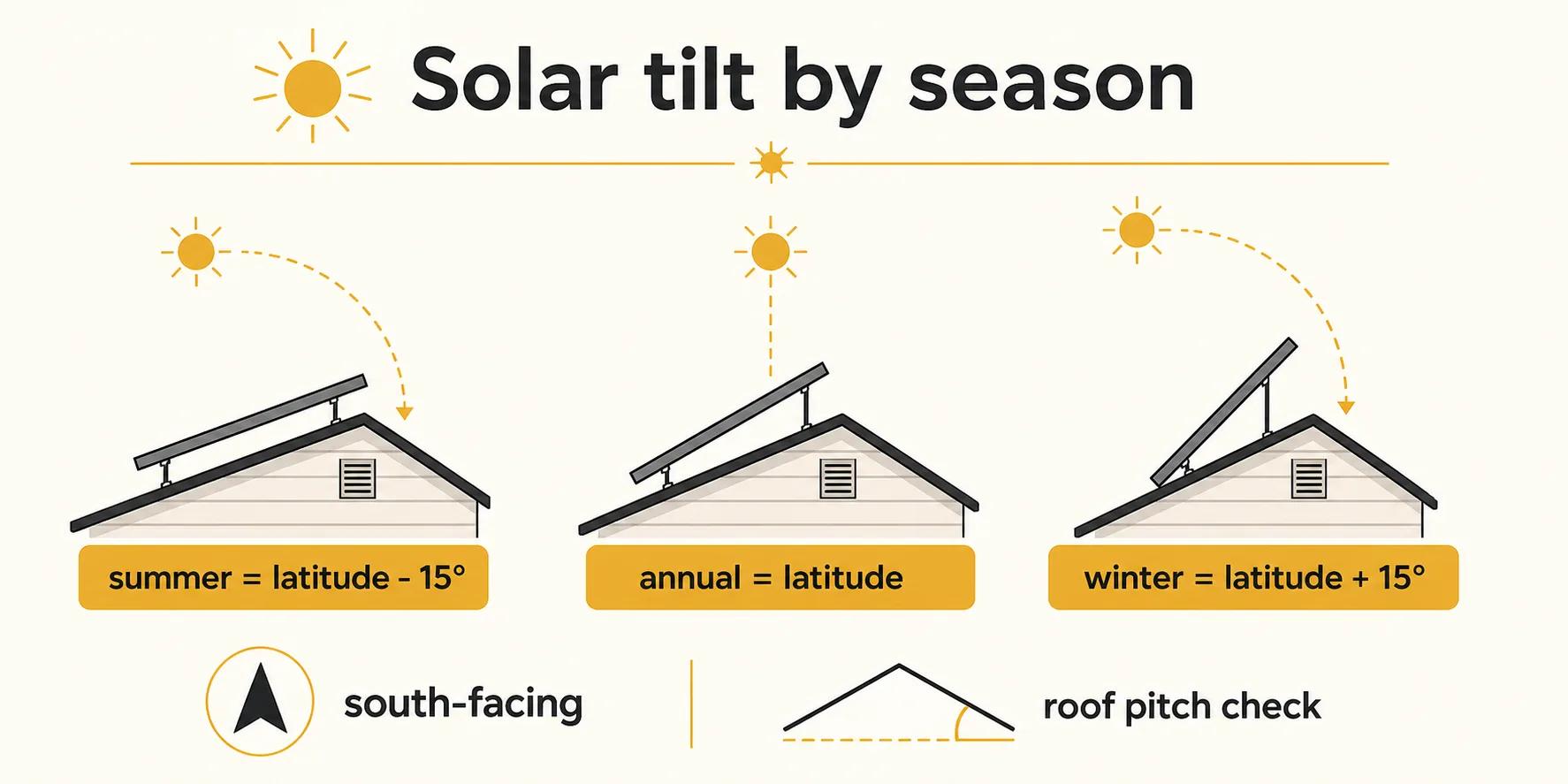
The seasonal rule the calculator uses, drawn out. Structure, wind loading, shading and the electrical work all still need somebody licensed to look at them.
Pitch against ideal
Ideal solar panel tilt against the roof you already have
Almost nobody builds an adjustable ground frame. Panels go flat on a roof that was pitched for rain, decades before anyone thought about the sun. So the real question is not what the ideal tilt is, it is how far your roof sits from it.
Every angle here is drawn true, so the wedge really is the size of the compromise. The sun line is the direction this tilt aims at, square to the plate by definition, rather than an almanac reading for a date: the seasonal 15 degree shift is a planning rule, not the sun’s real swing.
No roof pitch entered yet, so the grey plane is a 6-in-12 example. Type your own pitch into the calculator and it redraws.
- Ideal tilt, this season
- 35°Square to a sun line 55° above the horizon
- Example plane, no pitch entered
- 26.6°A 6-in-12 roof. Enter your own pitch above and this redraws
- Angle between them
- 8.4°Worth pricing a tilt frame against
- Output kept, this rule
- 95.8%Half a percent per degree off, capped at 25%
- What a tilt frame buys back
- 4.2%Before wind loading, extra racking and the structural check
That percentage is this calculator’s own linear rule, half a point of output for each degree away from the ideal, and nothing more. It is a planning approximation. It ignores diffuse light, cloud, snow, dirt and shade, all of which move output further than a few degrees of tilt ever will. For a real production figure, model the site.
Four latitudes
Solar panel angle by city: the same roof, four latitudes
One 6-in-12 roof, 26.6 degrees, in four places. The roof never changes, so the only thing moving is how far the ideal tilt has walked away from it. This is the whole argument for a tilt frame in one row of figures.
Miami, FL
1.6°
off the ideal tilt
99.2% of output kept
- Latitude
- 25°
- Ideal tilt
- 25.0°
- Roof plane
- 26.6°
- Sun line
- 65.0°
A 6/12 roof is within a degree and a half of ideal here. Racking flat on the deck is the right call.
Atlanta, GA
6.4°
off the ideal tilt
96.8% of output kept
- Latitude
- 33°
- Ideal tilt
- 33.0°
- Roof plane
- 26.6°
- Sun line
- 57.0°
Still close. The penalty is smaller than the swing you would get from one dirty season.
Denver, CO
12.4°
off the ideal tilt
93.8% of output kept
- Latitude
- 39°
- Ideal tilt
- 39.0°
- Roof plane
- 26.6°
- Sun line
- 51.0°
The gap is now worth pricing. A shallow tilt frame on the south slope closes most of it.
Seattle, WA
20.4°
off the ideal tilt
89.8% of output kept
- Latitude
- 47°
- Ideal tilt
- 47.0°
- Roof plane
- 26.6°
- Sun line
- 43.0°
The steepest ideal tilt of the four on the shallowest relative roof, so the widest gap.
Tilts follow the season selected in the calculator, so switching to winter walks all four of them 15 degrees steeper and widens every gap.
Season table
Optimal solar panel angle by latitude and season
The annual column is simply your latitude. Summer sits 15 degrees shallower and winter 15 degrees steeper, which is the swing an adjustable rack is buying. Spring and autumn sit back on the annual figure.
| Latitude | Annual | Summer | Winter |
|---|---|---|---|
| 25° | 25° | 10° | 40° |
| 30° | 30° | 15° | 45° |
| 35°nearest you | 35° | 20° | 50° |
| 40° | 40° | 25° | 55° |
| 45° | 45° | 30° | 60° |
| 50° | 50° | 35° | 65° |
Every figure computed by the same rule the calculator above uses, so the table and the readout cannot drift apart.
What each roof pitch costs against your 35° ideal
Pitches as a roofer quotes them, converted to degrees, then run through this calculator’s loss rule against the ideal tilt for your latitude and season. The bars share one axis that runs to the 25% cap.
Flat mount
0.0°
17.5%
82.5%
3 in 12
14.0°
10.5%
89.5%
4 in 12
18.4°
8.3%
91.7%
5 in 12
22.6°
6.2%
93.8%
6 in 12
26.6°
4.2%
95.8%
7 in 12
30.3°
2.4%
97.6%
8 in 12
33.7°
0.7%
99.3%
10 in 12
39.8°
2.4%
97.6%
12 in 12
45.0°
5.0%
95.0%
Degrees from the pitch by arctangent of rise over run. Loss from this calculator’s own linear rule, which is a planning approximation and not a measured output curve.
The arithmetic
How this solar panel angle calculator sets tilt and azimuth
Tilt comes from latitude and one seasonal shift. Azimuth comes from which side of the equator you are on. Everything after that, the energy, the money and the carbon, is a chain of flat coefficients, and it is the weakest part of the page.
annual tilt = |latitude|spring and autumn tilt = |latitude|summer tilt = max(0, |latitude| − 15)winter tilt = min(90, |latitude| + 15)azimuth = 180° north of the equator, 0° southsun line = 90° − tiltpeak sun hours = 6.5 − |lat − 35| × 0.05, held between 3 and 8array kW = watts × panels ÷ 1000kWh a year = watts × panels × sun hours × 365 × 0.80 ÷ 1000output lost = min(|pitch − tilt| × 0.5%, 25%)savings = kWh × $0.12carbon = kWh × 1.22 lbThe tilt rule is the honest part. Setting a fixed panel at its latitude is standard practice, and the 15 degree seasonal shift is the usual approximation of the sun’s swing between solstice and solstice. The sun line drawn in the figure above follows from that and nothing else: a panel is ideal when it faces the sun square on, so the sun line is 90 degrees minus the tilt, by definition rather than by measurement.
The energy chain is where to be careful. Peak sun hours here is a proxy that only knows your latitude, so it cannot tell Seattle from Sacramento and it will overstate any cloudy or foggy site. The 0.80 derate stands in for inverter losses, wiring, temperature and soiling all at once. The loss rule for roof pitch is linear and capped, which is a planning shortcut rather than a physical curve. Use the figures to choose an angle, and pull real typical meteorological year data from the sources at the foot of this page before you promise anybody a kilowatt hour.
Not included: shading, snow cover, panel temperature coefficients, inverter clipping, string layout, racking, permits, interconnection, or any local tariff or export rate.
Azimuth and shade
Solar panel direction, shading and the losses tilt cannot fix
Tilt is worth single digits. Every one of the five below can be worth more, and none of them appears anywhere in the angle the calculator gives you. Get these settled before the racking is ordered.
Which way the plane faces
North of the equator the array wants to look due south, 180 degrees of azimuth. South of it, due north at 0 degrees. Turning to the west costs about 15% over a year, and east or west facing runs 10 to 15% down. No tilt angle recovers a direction mistake, which is why the compass comes before the protractor. If the only clear plane on the house faces the wrong way, price a ground mount rather than accepting the loss.
What is standing between the panels and the sun
Partial shade from a chimney, a vent stack, a neighbour’s gable or one tree that is still growing takes 25 to 80% off a panel, and on a string inverter it drags the panels either side of it down too. Walk the shadow at midwinter noon, when the sun line is at its shallowest and shadows are longest, not on the summer afternoon you happen to be up on the roof.
Whether anybody will keep the glass clean
Dust, pollen, leaves and bird mess run output 5 to 25% down. Twice a year is the minimum and it is a bigger lever than several degrees of tilt on most roofs. A steeper tilt does shed water and debris a little better, which is a quiet argument for the winter setting in a dusty climate.
Whether the rack will actually get moved
Adjusting a rack twice a year, shallower for summer and steeper for winter, gains 10 to 15%. That number assumes somebody climbs up and does it. If they will not, fit a fixed rack at the annual angle and spend the hardware money on another panel instead.
What the roof can carry once panels are on it
A flush mount adds dead load. A tilt frame adds dead load, wind uplift and point loads at every foot. Check the structure with our rafter calculator and get the pitch itself off the roof rather than off a drawing with our roof pitch calculator. A few percent of tilt is never worth a structural argument.
On the racking
Where solar panel tilt goes wrong on a real roof
Six of these, in the order they tend to bite. Every one is decided before the panels are lifted, and none is cheap to undo afterwards.
Laying panels flat on a low slope roof and calling it close enough
Flat is not a small compromise at most latitudes, it is the whole tilt angle thrown away. A flat array where the ideal is 35 degrees is the full 35 degrees off, and the loss rule on this page charges 17.5% for it.
Turning the array to suit the roof plane rather than the compass
Tilt is worth a few percent. Direction is worth ten to fifteen. Find the south-facing plane first, then argue about degrees, and if no plane faces that way price a ground mount before you compromise.
Buying an adjustable rack nobody will ever adjust
The 10 to 15% seasonal gain assumes somebody gets on the roof twice a year and moves it. Unadjusted, an adjustable rack is a fixed rack with extra parts to work loose.
Signing off the angle without walking the shade
A chimney, a vent stack or one maturing tree can take 25 to 80% off a string, and no tilt recovers it. Check the shadow at midwinter noon, when it is longest, not on the summer afternoon you happen to be up there.
Trusting a latitude estimate of sun hours in a cloudy climate
The sun hour figure behind these energy numbers is a latitude proxy. It does not know about marine cloud, valley fog or smoke season. Pull the real typical meteorological year data for the site before you promise anyone a kilowatt hour figure.
Setting the tilt and forgetting the array is a sail
A tilt frame that lifts panels off the deck adds wind uplift and point loads the rafters never saw. Check the structure with our rafter calculator and let the engineer, not the tilt table, set the final angle.
Before the quote
Solar panel angle questions, answered before you drill
Eight answers in roughly the order they come up, starting with the one the figure further up this page exists to settle.
What angle should solar panels be at?
Set tilt equal to your latitude for annual optimum. At 35 degrees latitude, tilt panels to 35 degrees.
Does roof pitch matter for solar?
Yes. Every degree off the optimal tilt loses about 0.5% efficiency. A roof at 20 degrees with 35 degrees optimal loses about 7.5% vs ground mount.
Should solar panels face south?
In the Northern Hemisphere, yes (180 degrees azimuth). Southern Hemisphere faces north (0 degrees). East/west facing loses 10 to 15%.
How much energy does a 10-panel system produce?
A 10-panel system at 400W each (4kW) produces roughly 5,000 to 7,000 kWh per year depending on location and tilt.
Should I adjust panels seasonally?
Adjustable mounts gain 10 to 15% more energy. Subtract 15 degrees in summer, add 15 degrees in winter. Fixed mounts at latitude are simpler and still effective.
What is peak sun hours?
The number of hours per day when sunlight intensity equals 1,000 W per square meter. This varies from 4 hrs (Seattle) to 7+ hrs (Phoenix).
How much money do solar panels save?
A 4kW system producing 6,000 kWh/year saves about $720/year at $0.12/kWh. Payback is typically 6 to 10 years.
How much CO2 do solar panels offset?
Each kWh of solar replaces 1.22 lbs of CO2 from coal/gas. A 6,000 kWh/year system offsets about 7,300 lbs (3.3 metric tons) annually.
Disclaimer
These estimates are for planning purposes only. Actual costs vary by location, material availability, and project complexity. Always get at least 3 local quotes. This calculator does not replace professional advice.
Sources