Cinder Block Calculator
Estimate cinder blocks, CMU mortar, openings, waste, and core-fill grout.
Wall dimensions
Common walls
All three units share the same 15 5/8 in by 7 5/8 in face, so the count does not move. Width changes thickness and price.
Estimates only. Not professional advice.
Blocks to order
198
8 x 8 x 16 in standard CMU over 160 sq ft of net wall, with a 10% allowance for cuts, corners and breakage.
- Gross wall area
- 160 sq ft
- Block, at $2.25 each
- $445.50
- Mortar, at $13.00 a bag
- $208.00
- Materials, rounded
- $654$4.09 per sq ft
Last updated August 12, 2026 by our expert review team.
Module check
Where your wall height lands on the 8 inch block course
A concrete block wall only grows in 8 in steps. Every course is one unit plus the bed joint under it, so the wall is either a whole number of courses or it is a problem you solve before the first block goes down.
Drawn to scale from the dimensions above, in running bond. Metric-module block is cast at 190 mm with a 10 mm joint to course at 200 mm, about 2% tighter than the imperial module this takeoff uses.
Four ways to take up a height that does not land on the course
In the order a mason reaches for them. The first two cost nothing before the footing is poured.
- 01
Move the wall height to the nearest course
Free while the wall is still a drawing. Yours would go to 8 ft or 8 ft 8 in.
- 02
Raise or drop the top of footing
The wall starts where the footing stops, so shifting the footing shifts every course with it. Easiest when the wall has to meet a fixed height at the top, like a plate or a slab edge.
- 03
Spread it across the bed joints
A joint may run 1/4 in to 1/2 in, so 12 courses give you 1 1/2 in either way. Spread it over every joint, never over one.
- 04
Add a half-high course
A half-high unit is nominally 4 in, cast the same 3/8 in under like every other unit. It is the honest way to gain half a course, and it is stocked, not cut.
Short pallets
Concrete block orders that come up short
Seven failures, in the order they bite: the height first, then the layout, then the mortar. Every one of them produces a block count that looks perfectly reasonable on paper.
Picking a round wall height instead of a course height
A 5 ft wall is 60 in, which is seven courses and 4 in nobody has planned for.
Set the height in courses before the footing is poured. Moving it is free on paper and expensive in mortar.
Cutting the top course down to make up the height
A sawn unit loses its full face shell, the cores open up, and the cap or plate has nothing square to bear on.
Take the difference out of the bed joints, or add a half-high unit made for the job.
Counting gross wall area
Doors and windows get ordered as block, and the waste allowance then inflates that error too.
Deduct every opening first, then apply waste to what is left.
Treating the actual unit size as the layout module
Laying out at 15 5/8 in leaves a joint out of every bay and the wall drifts short.
Lay out on the nominal 16 in module. The joint is already inside it.
Setting the footing without checking it for level
The first bed joint has to swallow the whole error, and 3/8 in of joint has only 1/8 in of give.
Level the top of footing, or plan a thicker first bed joint on purpose and dress it out over two courses.
Ordering mortar to the exact bag count
Bag yield moves with joint thickness, tooling and how much falls off the board.
Treat the bag figure as a planning number and carry a spare bag or two.
Guessing which cells get grouted
Grout volume and rebar spacing are structural decisions, not takeoff decisions.
Read the filled-cell layout off the drawings, then enter it as a percentage here.
Load-bearing, retaining and below-grade block walls are structural. Have the wall, its reinforcement and its footing specified before you order a single pallet.
Ordering the block
Concrete block takeoff, from wall area to pallet
A block order comes out of net wall area, not wall length, and the count is fixed long before anyone picks a unit width. Six steps, in the order the numbers actually appear.
Measure every elevation gross
Length times height for each face, openings included for now. A corner wall is two elevations, not one long one.
Deduct the openings
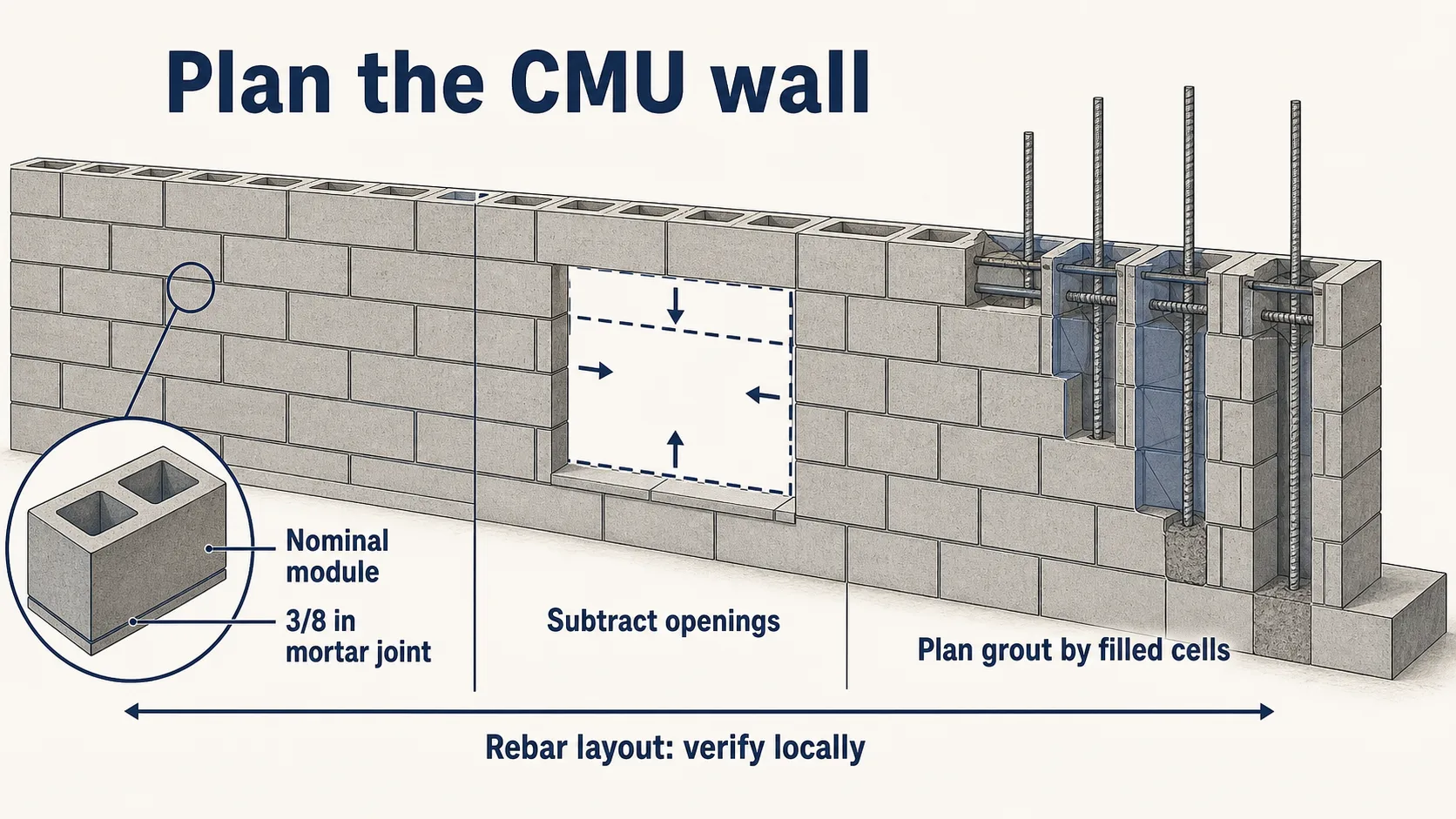
Doors, windows and vents come off before anything else. Deducting after the waste allowance quietly inflates the order.
Set the height in courses
Divide the height by 8 in and see what is left. This is the step people skip, and it is the only one that is free to fix.
Add the waste allowance
10% covers a straight run. Corners, piers, control joints and short returns push it to 15% or more.
Convert to mortar
One bag per 13 blocks at a 3/8 in joint, rounded up to whole bags.
Take the grouted cells off the drawings
Filled cells, bond beams and lintels are a structural decision. Enter them here only once someone has specified them.
Inside the count
The arithmetic behind a concrete block count
One multiplication and one division, plus a rounding rule. The mortar joint is already inside the blocks-per-sq ft figure, so it is never added on afterwards.
net area = length × height − openingsblocks = ⌈net area × 1.125 × (1 + waste)⌉mortar bags = ⌈blocks ÷ 13⌉grouted = ⌈blocks × filled cells %⌉materials = blocks × block price + bags × bag priceblocks per sq ft = 144 in² ÷ (16 in × 8 in nominal face)courses = ⌊wall height ÷ 8 in⌋Counted
- Net face area, after every opening you enter is deducted.
- The mortar joint, through the nominal face the count is built on.
- Cuts, corners and breakage, through the waste allowance.
- Mortar at whole bags, rounded up, never part bags.
- Grouted cells as a share of the block count, if you enter one.
Not counted
- Grout volume in cubic measure, which depends on the unit width and cell shape.
- Rebar, ties, anchors, bond beam units, lintels and cap block.
- The footing under the wall, and any drainage or waterproofing behind it.
- Half-high or half-length units used to resolve the coursing.
- Delivery, pallet deposits and labor.
Heights that need no thought
Every one of these is a whole number of courses, so the bed joints all stay at 3/8 in.
Ask the mason
What people ask before ordering concrete block
Eight questions that come up between measuring the wall and paying for the pallet, answered against the same figures this calculator runs on.
How many concrete blocks per square foot?
1.125 standard blocks per square foot of wall. That is the nominal 8 by 16 inch face, joints included, so a 100 square foot wall takes about 113 blocks before any waste allowance.
Why is a concrete block 7 5/8 inches and not 8?
Because the mortar joint makes up the difference. A unit is cast 3/8 inch under its nominal size, so 7 5/8 inches of block plus a 3/8 inch bed joint is exactly one 8 inch course. The same 3/8 inch comes off the length, which is why a nominal 16 inch block measures 15 5/8.
What wall heights land on the block course?
Any multiple of 8 inches. Three courses is 24 inches, six is 48, nine is 72 and twelve is 96, which is why an 8 foot block wall needs no thought at all. Heights between those have to be resolved before the first course goes down.
What do I do when the wall height is not a multiple of 8 inches?
There are four moves. Change the wall height to the nearest course, raise or lower the top of footing, spread the difference across the bed joints while they stay within 3/8 inch plus or minus 1/8, or add one half-high 4 inch course. Cutting the top course is the move to avoid.
Does block width change the block count?
No, as long as the face stays 8 by 16 inches. A 4 inch, 8 inch and 12 inch unit all cover the same wall area per block. Width changes wall thickness, weight, grout volume and price.
How much mortar do I need for a block wall?
This calculator plans one 80 lb bag per 13 standard blocks, which is a conservative field figure for a 3/8 inch joint. Thicker joints, cold weather and heavy tooling all cut the yield, so buy a bag or two over the count.
Is a cinder block the same as a concrete block?
In conversation, yes. True cinder block used coal ash as aggregate and is no longer made. Everything sold today is a concrete masonry unit, and the two names get used for the same product.
Do I need rebar in a concrete block wall?
Structural, load-bearing, retaining and most below-grade walls do, and the spacing comes from the wall design rather than a rule of thumb. Use the filled-cell percentage in this calculator only once you have a grout and reinforcement layout to read it off.
Laying clay brick rather than block changes the module, the joint and the count, so use the brick and mortar calculator for brickwork, and the retaining wall calculator for segmental landscape walls.
Before the mortar
Five things a block mason does before the first course
None of these change the block count. All of them decide whether the wall you get is the wall the count was for.
Dry-lay the bottom course before you mix anything
Set the units out end to end with the head joints spaced and you find the closure at the far corner while it is still free to move.
Check the top of footing for level first
A footing out by 1/2 in eats the whole bed-joint tolerance in course one, and the error follows you all the way up.
Mark a story pole in courses, not on a tape
Every mark is one 8 in course. Sight the pole rather than measuring up from the footing each time, so a small joint error cannot accumulate.
Build the corners, then fill to a line
Leads at both ends carry the coursing. The blocks between them follow a mason's line, which is faster and straighter than levelling every unit.
Price the footing and the steel separately
The wall takeoff stops at the block and the mortar. Size the footing with the concrete footing calculator and take the reinforcement off the drawings with the concrete rebar calculator.
Widths and cores
Concrete block sizes: what changes with width, and what does not
The three units below have the same face, so they cover the same wall area per block and course at the same 8 in. Width changes the wall, not the count.
| Unit | Actual size | Wall thickness | Per sq ft | Price each |
|---|---|---|---|---|
| 8 in standardyour block | 7 5/8 in × 7 5/8 in × 15 5/8 in | 8 in | 1.125 | $2.25 |
| 12 in wide | 11 5/8 in × 7 5/8 in × 15 5/8 in | 12 in | 1.125 | $3.25 |
| 4 in narrow | 3 5/8 in × 7 5/8 in × 15 5/8 in | 4 in | 1.125 | $1.85 |
Actual sizes follow the CMHA specification: a unit is cast 3/8 in under nominal in every direction. Prices are planning defaults you can overwrite in the calculator.
Worked walls
Four worked block walls, with the course count for each
Each wall sets its own size and allowance. The quantities are the same arithmetic the calculator above runs, and the course line is the same ledger, so read them as worked examples.
12 by 3 ft · 10% waste
Garden wall, no openings
Short enough that the leftover is worth a half-high course rather than a taller joint.
20 by 8 ft · 10% waste
Interior partition
The one height that needs no thought. Deduct the door before you order, not after.
40 by 4 ft · 15% waste
Foundation stem, below grade
Higher waste for corners and cuts. Filled cells and rebar come off the drawings.
20 by 7 ft 9 in, less 21 sq ft · 10% waste
Utility wall with one opening
A metric height in an imperial module: 2.4 m is 11 courses and a bit, so the wall gets set to the course.
Materials only, at the standard unit price and $13 a mortar bag. Labor, delivery, the footing and any grout are separate, and every one of them is usually the larger number.
Disclaimer
These estimates are for planning purposes only. Actual costs vary by location, material availability, and project complexity. Always get at least 3 local quotes. This calculator does not replace professional advice.
Sources